




Rearrange the following in the correct order of boiling points
A.

B.

C.

D.
Answer
 Verified
619.5k+ views
Hint:Consider various factors that affect the boiling points. These include the molecular weight, the degree of branching, presence of hydrogen bonds and dipole-dipole interactions.
Complete answer:
For hydrocarbons, with increase in the number of carbon atoms, the boiling point increases. Also, with increase in branching, the boiling point decreases.
The correct order of the boiling points for the compounds of the option A is

In the above order, isobutane has the lowest boiling point as it contains a branch and the total number of carbon atoms is 4. Butane also contains 4 carbon atoms but has higher boiling point than isobutane as butane lacks branching. Pentane has 5 carbon atoms (maximum number of carbon atoms). Hence, pentane has the highest boiling point.
The correct order of the boiling points for the compounds of the option B is

Hexane has the highest boiling point as it has the maximum number of carbon atoms (six carbon atoms). Isobutane has the lowest boiling point as it contains the least number of carbon atoms and a branch.
The correct order of the boiling points for the compounds of the option C is

This order is as per the expected order based on the number of carbon atoms and the degree of branching.
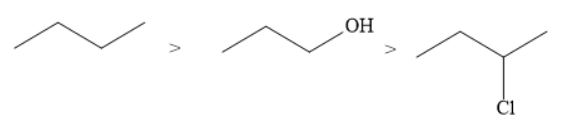
The correct order of the boiling points for the compounds of the option D is
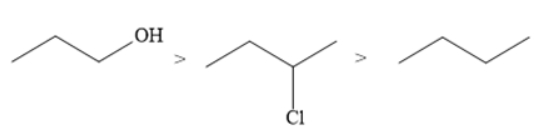
Hydrocarbons have the lowest boiling point when compared to alkyl halides and alcohols. This is because hydrocarbons are non-polar whereas alkyl halides and alcohols are polar. Hydrocarbons contain weak van der Waals forces of attraction. On the other hand, alkyl halides and alcohols contain dipole-dipole forces of attraction that are stronger than van der Waals forces.
Among alkyl halides and alcohols, the maximum boiling point is of alcohols.
Note:
Alcohols have high boiling points due to presence of intermolecular hydrogen bonds. Intermolecular hydrogen bonds lead to molecular association. More energy is needed to break these intermolecular hydrogen bonds. Alkyl halides and alcohols do not form hydrogen bonds.
Complete answer:
For hydrocarbons, with increase in the number of carbon atoms, the boiling point increases. Also, with increase in branching, the boiling point decreases.
The correct order of the boiling points for the compounds of the option A is
In the above order, isobutane has the lowest boiling point as it contains a branch and the total number of carbon atoms is 4. Butane also contains 4 carbon atoms but has higher boiling point than isobutane as butane lacks branching. Pentane has 5 carbon atoms (maximum number of carbon atoms). Hence, pentane has the highest boiling point.
The correct order of the boiling points for the compounds of the option B is
Hexane has the highest boiling point as it has the maximum number of carbon atoms (six carbon atoms). Isobutane has the lowest boiling point as it contains the least number of carbon atoms and a branch.
The correct order of the boiling points for the compounds of the option C is
This order is as per the expected order based on the number of carbon atoms and the degree of branching.
The correct order of the boiling points for the compounds of the option D is
Hydrocarbons have the lowest boiling point when compared to alkyl halides and alcohols. This is because hydrocarbons are non-polar whereas alkyl halides and alcohols are polar. Hydrocarbons contain weak van der Waals forces of attraction. On the other hand, alkyl halides and alcohols contain dipole-dipole forces of attraction that are stronger than van der Waals forces.
Among alkyl halides and alcohols, the maximum boiling point is of alcohols.
Note:
Alcohols have high boiling points due to presence of intermolecular hydrogen bonds. Intermolecular hydrogen bonds lead to molecular association. More energy is needed to break these intermolecular hydrogen bonds. Alkyl halides and alcohols do not form hydrogen bonds.
Recently Updated Pages
Basicity of sulphurous acid and sulphuric acid are

Master Class 11 English: Engaging Questions & Answers for Success
Master Class 11 Physics: Engaging Questions & Answers for Success
Master Class 11 Computer Science: Engaging Questions & Answers for Success
Master Class 11 Chemistry: Engaging Questions & Answers for Success
Master Class 11 Social Science: Engaging Questions & Answers for Success
Trending doubts
Difference Between Prokaryotic Cells and Eukaryotic Cells
Two of the body parts which do not appear in MRI are class 11 biology CBSE
One Metric ton is equal to kg A 10000 B 1000 C 100 class 11 physics CBSE
10 examples of friction in our daily life
Draw a diagram of nephron and explain its structur class 11 biology CBSE
What will happen if the mucus is not secreted by the class 11 biology CBSE