




Reaction of t-butyl bromide with sodium methoxide produces:
(A) Isobutane
(B) Isobutylene
(C) Sodium- t- butoxide
(D) t- butyl methyl ether.
Answer
 Verified
637.5k+ views
Hint: This method is called Williamson’s synthesis. General reaction of this synthesis is:

Complete step by step answer:
When alkyl halide is heated with alc. Sodium or potassium alkoxide gives corresponding ethers. Simple ethers can be easily prepared by this method.
But for preparation of mixed ether a proper choice of reactant is necessary. Primary alkyl halide is more susceptible to $S{N^2}$ reaction. Therefore, best yield of ether obtained when alkyl halide is primary and alkoxide is tertiary.
Example: tert-butyl ether is prepared by heating ethyl bromide with sodium tert-butoxide.
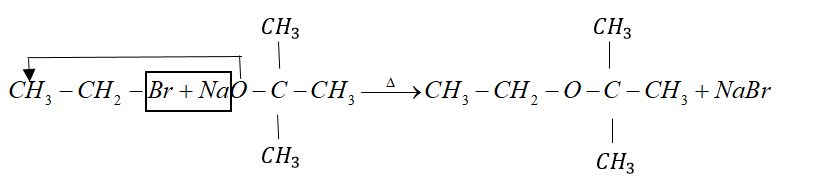
But when alkyl halide is secondary or tertiary the nucleophilic attack of alkoxide ion on $\alpha - $ carbon atom becomes difficult due to crowding effect.
Since alkoxide is a stronger base and attacking $\beta - $ hydrogen is easier. Therefore $\beta - $ elimination dominates.
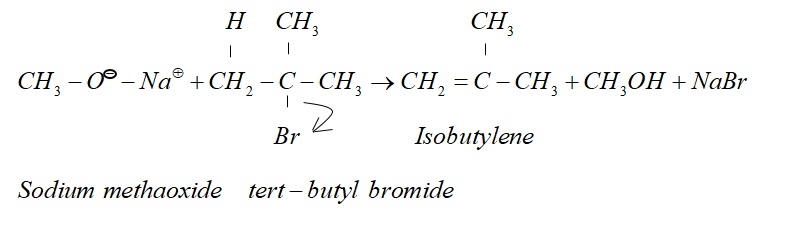
Therefore, in the given reaction isobutylene is formed.
So, the correct answer is “Option B”.
Note:
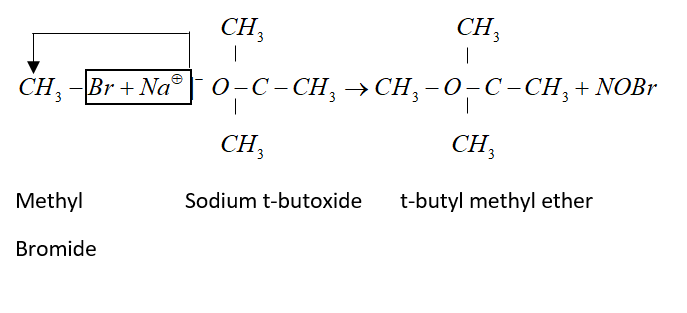
Williamson’s synthesis is a good method for preparation of mixed ether. But proper choice of reagent should be necessary. If we want to prepare t-butyl methyl ether then methyl bromide and sodium t-butoxide should be taken.
Complete step by step answer:
When alkyl halide is heated with alc. Sodium or potassium alkoxide gives corresponding ethers. Simple ethers can be easily prepared by this method.
But for preparation of mixed ether a proper choice of reactant is necessary. Primary alkyl halide is more susceptible to $S{N^2}$ reaction. Therefore, best yield of ether obtained when alkyl halide is primary and alkoxide is tertiary.
Example: tert-butyl ether is prepared by heating ethyl bromide with sodium tert-butoxide.
But when alkyl halide is secondary or tertiary the nucleophilic attack of alkoxide ion on $\alpha - $ carbon atom becomes difficult due to crowding effect.
Since alkoxide is a stronger base and attacking $\beta - $ hydrogen is easier. Therefore $\beta - $ elimination dominates.
Therefore, in the given reaction isobutylene is formed.
So, the correct answer is “Option B”.
Note:
Williamson’s synthesis is a good method for preparation of mixed ether. But proper choice of reagent should be necessary. If we want to prepare t-butyl methyl ether then methyl bromide and sodium t-butoxide should be taken.
Recently Updated Pages
Which will be the least stable resonating structure class 11 chemistry CBSE

How many 5 digit telephone numbers can be construc-class-11-maths-CBSE
How do you find the angle of the resultant vector class 11 physics CBSE
Draw labelled diagram of the following i Gram seed class 11 biology CBSE
1 Quintal is equal to a 110 kg b 10 kg c 100kg d 1000 class 11 physics CBSE
What is the need and importance of classification class 11 biology CBSE
Trending doubts
One Metric ton is equal to kg A 10000 B 1000 C 100 class 11 physics CBSE
Find the value of the expression given below sin 30circ class 11 maths CBSE
Draw a diagram of nephron and explain its structur class 11 biology CBSE
10 examples of friction in our daily life
Proton was discovered by A Thomson B Rutherford C Chadwick class 11 chemistry CBSE
The teeth used for biting and cutting food are called class 11 biology CBSE