




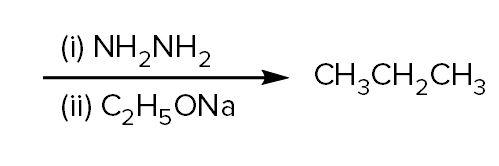
Reactant in the given reaction is:
(A) Isopropyl alcohol
(B) Butanaldehyde
(C) Acetone
(D) None of these
Answer
 Verified
584.7k+ views
Hint: The carbon which can accept the lone pair of electrons of hydrazine due to its electrophilic nature that carbon will react readily with hydrazine and gives alkane as a product followed by abstraction of base from ethanoate.
Complete step by step answer:
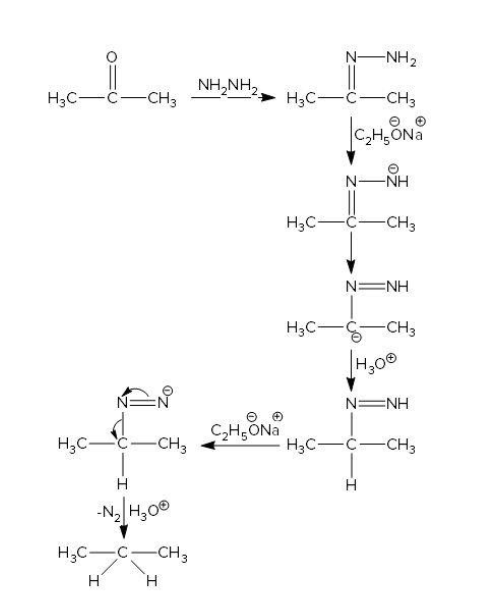
As we know that the carbonyl carbon is electrophilic in nature due to oxygen attached to it, which attracts the electrons of carbon towards itself. So now hydrazine is an electron rich compound which attacks on electrophilic carbon and forms hydrazone by eliminating water. Now the base which is sodium ethanoate in this reaction abstracts a proton from hydrazone and generates carbanion at carbonyl carbon. This carbanion itself abstracts protons from water. This process is repeated and hydrogen is attached to carbonyl carbon. So now the product we get is propane as shown in the mechanism below.
Let’s see the options,
The option (A) is Isopropyl alcohol which is not a carbonyl carbon and is not electrophilic in nature so this option is incorrect.
The option (B) is Butanaldehyde, it contains a carbonyl carbon but our product is propane so this option is also incorrect.
The option (C) is acetone which has a carbonyl carbon as well as it contains three carbon atom which can give propane as a product. Therefore, the correct option is (C).
The correct option is C.
Note:
The option containing alcohol could be simply ruled out since it is not electrophilic in nature.
Complete step by step answer:
As we know that the carbonyl carbon is electrophilic in nature due to oxygen attached to it, which attracts the electrons of carbon towards itself. So now hydrazine is an electron rich compound which attacks on electrophilic carbon and forms hydrazone by eliminating water. Now the base which is sodium ethanoate in this reaction abstracts a proton from hydrazone and generates carbanion at carbonyl carbon. This carbanion itself abstracts protons from water. This process is repeated and hydrogen is attached to carbonyl carbon. So now the product we get is propane as shown in the mechanism below.
Let’s see the options,
The option (A) is Isopropyl alcohol which is not a carbonyl carbon and is not electrophilic in nature so this option is incorrect.
The option (B) is Butanaldehyde, it contains a carbonyl carbon but our product is propane so this option is also incorrect.
The option (C) is acetone which has a carbonyl carbon as well as it contains three carbon atom which can give propane as a product. Therefore, the correct option is (C).
The correct option is C.
Note:
The option containing alcohol could be simply ruled out since it is not electrophilic in nature.
Recently Updated Pages
Master Class 11 Computer Science: Engaging Questions & Answers for Success

Master Class 11 Business Studies: Engaging Questions & Answers for Success
Master Class 11 Economics: Engaging Questions & Answers for Success
Master Class 11 English: Engaging Questions & Answers for Success
Master Class 11 Maths: Engaging Questions & Answers for Success
Master Class 11 Biology: Engaging Questions & Answers for Success
Trending doubts
One Metric ton is equal to kg A 10000 B 1000 C 100 class 11 physics CBSE
There are 720 permutations of the digits 1 2 3 4 5 class 11 maths CBSE
Discuss the various forms of bacteria class 11 biology CBSE
Draw a diagram of a plant cell and label at least eight class 11 biology CBSE
State the laws of reflection of light
Explain zero factorial class 11 maths CBSE