




When rays of light fall on a convex lens, it
A) Converges them
B) Does not bend them
C) Diverges them
D) Enlarges them
Answer
 Verified
655.8k+ views
Hint: A lens is a piece of glass or of plastic that has a curved or bent shape. It either focuses or spreads the incident rays. The structure of a convex lens is thicker at the centre and thinner at the edges. While the focal length of a convex lens is positive. It’s structure is curved outwards.
Complete step by step answer:
Step I:
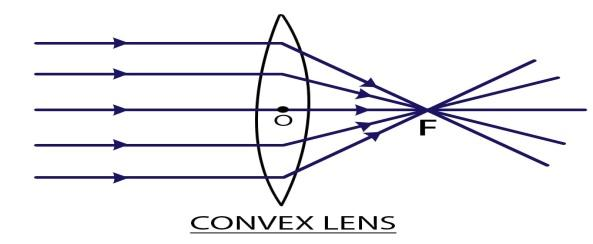
When rays of light fall on a convex lens, then the lens refracts(the incident ray undergoes refraction twice before leaving the convex lens) the incident light rays and merges the light rays at one point. The point where all the light rays meet is called its focus. It is also called a converging lens.
Step II:
Nature of image formed by a Convex Lens:
A convex lens always forms real and inverted images of the object. In some cases, it also forms a virtual image. In that case, the object is placed very near to the lens.
The distance between the centre of the lens and focal point is called focal length of the lens.
Step III:
Since the convex lens always converges the rays.
So option A is the correct answer.
Note: The distance between the focal point and the optical center of the convex lens is known as focal length of the lens. Since the convex lens always forms real images, this means the light rays are converged in a way that the image can be obtained on a screen. The size of the image formed by a convex lens depends on the position of the object. The image obtained can be diminished, of the same size as the object or highly enlarged.
Complete step by step answer:
Step I:
When rays of light fall on a convex lens, then the lens refracts(the incident ray undergoes refraction twice before leaving the convex lens) the incident light rays and merges the light rays at one point. The point where all the light rays meet is called its focus. It is also called a converging lens.
Step II:
Nature of image formed by a Convex Lens:
A convex lens always forms real and inverted images of the object. In some cases, it also forms a virtual image. In that case, the object is placed very near to the lens.
The distance between the centre of the lens and focal point is called focal length of the lens.
Step III:
Since the convex lens always converges the rays.
So option A is the correct answer.
Note: The distance between the focal point and the optical center of the convex lens is known as focal length of the lens. Since the convex lens always forms real images, this means the light rays are converged in a way that the image can be obtained on a screen. The size of the image formed by a convex lens depends on the position of the object. The image obtained can be diminished, of the same size as the object or highly enlarged.
Recently Updated Pages
If x a + bt + ct2 where x is in meters and t is in class 11 physics CBSE

A car covers the first half distance between two places class 11 physics CBSE
The resultant of two vectors overrightarrow P and overrightarrow class 11 physics CBSE
Find the value of cos 135 class 11 maths CBSE
A mass M is held in place by an applied force F and class 11 physics CBSE
A solution of glucose in water is labelled as 10 dfracwv class 11 chemistry CBSE
Trending doubts
One Metric ton is equal to kg A 10000 B 1000 C 100 class 11 physics CBSE
Find the value of the expression given below sin 30circ class 11 maths CBSE
What do you mean by retardation What is its SI uni class 11 physics CBSE
Draw a diagram of nephron and explain its structur class 11 biology CBSE
10 examples of friction in our daily life
Difference between physical and chemical change class 11 chemistry CBSE