




Raw material for the production of urea are:
A. ammonia and carbon dioxide
B. oxygen and carbon dioxide
C. ammonia and oxygen
D. ammonia and phosphate
Answer
 Verified
609.3k+ views
Hint: Urea has an Amide functional group. Urea is diamide of carbonic acid. When both hydroxyl groups of carbonic acid are replaced with ammonia groups, the formed structure is known as amide. The structure or constitutes of the product gives the idea about reactants.
Complete step by step solution:The structure of urea is as follows:
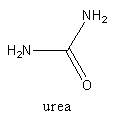
The structure tells that urea contain amine and carbonyl functional groups. The reactant for urea preparation will be ammonia and carbon dioxide. At industrial level, urea is prepared by reacting ammonia with carbon dioxide.
Urea formed at high temperature and pressure. Formation take place in two steps:
First, ammonia and carbon dioxide reacts to give ammonium carbonate. It is a reversible step.
The reaction of formation of ammonia carbonate is as follows:
${\text{N}}{{\text{H}}_{\text{3}}}\,{\text{ + }}\,{\text{C}}{{\text{O}}_{\text{2}}}\, \rightleftarrows \,\,{\text{N}}{{\text{H}}_{\text{2}}}{\text{COON}}{{\text{H}}_{\text{4}}}$
${\text{N}}{{\text{H}}_{\text{2}}}{\text{COON}}{{\text{H}}_{\text{4}}}$ is known as ammonium carbonate.
In the second step, ammonium carbonate decomposes to give urea and water. It is also a reversible step.
${\text{N}}{{\text{H}}_{\text{2}}}{\text{COON}}{{\text{H}}_{\text{4}}}\, \rightleftarrows \,{\text{N}}{{\text{H}}_{\text{2}}}{\text{COON}}{{\text{H}}_{\text{2}}}{\text{ + }}\,{{\text{H}}_{\text{2}}}{\text{O}}\,$
By the same reaction ammonia and carbon dioxide can be recycled. On decreasing pressure and increasing the temperature, ammonium carbonate decomposes into ammonia and carbon dioxide.
So, raw materials for the production of urea are ammonia and carbon dioxide.
Therefore, option (A) ammonia and carbon dioxide, is correct.
Note: Urea has a high amount of nitrogen, so it is used as fertilizer. In the laboratory, urea is prepared by the Wohler method. Urea is also used in manufacturing of resin. Ammonia is the main reactant for the urea production, so urea manufacturing is done nearby ammonia production plants. At industry level, ammonia is produced by the Haber process. In the Haber process, nitrogen is reacted with hydrogen at high temperature in presence of a catalyst to produce ammonia.
Complete step by step solution:The structure of urea is as follows:
The structure tells that urea contain amine and carbonyl functional groups. The reactant for urea preparation will be ammonia and carbon dioxide. At industrial level, urea is prepared by reacting ammonia with carbon dioxide.
Urea formed at high temperature and pressure. Formation take place in two steps:
First, ammonia and carbon dioxide reacts to give ammonium carbonate. It is a reversible step.
The reaction of formation of ammonia carbonate is as follows:
${\text{N}}{{\text{H}}_{\text{3}}}\,{\text{ + }}\,{\text{C}}{{\text{O}}_{\text{2}}}\, \rightleftarrows \,\,{\text{N}}{{\text{H}}_{\text{2}}}{\text{COON}}{{\text{H}}_{\text{4}}}$
${\text{N}}{{\text{H}}_{\text{2}}}{\text{COON}}{{\text{H}}_{\text{4}}}$ is known as ammonium carbonate.
In the second step, ammonium carbonate decomposes to give urea and water. It is also a reversible step.
${\text{N}}{{\text{H}}_{\text{2}}}{\text{COON}}{{\text{H}}_{\text{4}}}\, \rightleftarrows \,{\text{N}}{{\text{H}}_{\text{2}}}{\text{COON}}{{\text{H}}_{\text{2}}}{\text{ + }}\,{{\text{H}}_{\text{2}}}{\text{O}}\,$
By the same reaction ammonia and carbon dioxide can be recycled. On decreasing pressure and increasing the temperature, ammonium carbonate decomposes into ammonia and carbon dioxide.
So, raw materials for the production of urea are ammonia and carbon dioxide.
Therefore, option (A) ammonia and carbon dioxide, is correct.
Note: Urea has a high amount of nitrogen, so it is used as fertilizer. In the laboratory, urea is prepared by the Wohler method. Urea is also used in manufacturing of resin. Ammonia is the main reactant for the urea production, so urea manufacturing is done nearby ammonia production plants. At industry level, ammonia is produced by the Haber process. In the Haber process, nitrogen is reacted with hydrogen at high temperature in presence of a catalyst to produce ammonia.
Recently Updated Pages
Master Class 11 English: Engaging Questions & Answers for Success

Master Class 11 Social Science: Engaging Questions & Answers for Success
Master Class 11 Maths: Engaging Questions & Answers for Success
Master Class 11 Biology: Engaging Questions & Answers for Success
Master Class 11 Physics: Engaging Questions & Answers for Success
Master Class 11 Chemistry: Engaging Questions & Answers for Success
Trending doubts
One Metric ton is equal to kg A 10000 B 1000 C 100 class 11 physics CBSE
Difference Between Prokaryotic Cells and Eukaryotic Cells
Find the value of the expression given below sin 30circ class 11 maths CBSE
Difference between physical and chemical change class 11 chemistry CBSE
Two of the body parts which do not appear in MRI are class 11 biology CBSE
Draw a diagram of a plant cell and label at least eight class 11 biology CBSE