



How many rational numbers exist between any two distinct rational numbers?
(a) 2
(b) 3
(c) 10
(d) Infinite
Answer
 Verified
650.1k+ views
Hint: Try to recall the definition of rational and irrational numbers. We can also pick any two random rational numbers and try to find the answer.
Complete step-by-step answer:
Before moving to the options, let us talk about the definitions of rational numbers followed by irrational numbers.
So, rational numbers are those real numbers that can be written in the form of $\dfrac{p}{q}$ such that both p and q are integers and $q \ne 0$ . In other words, we can say that the numbers which are either terminating or recurring when converted to decimal form are called rational numbers. All the integers fall under this category.
Now, moving to irrational numbers.
Those real numbers which are non-terminating and non-recurring are termed as irrational numbers.
The roots of the numbers which are not perfect squares fall under the category of irrational numbers. $\pi \text{ and }e$ are also the standard examples of irrational numbers.
Now let us move to the solution to the above question.
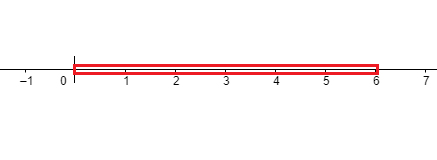
The above figure represents a number line.
Now each point on the number line represents a number. Let us pick two rational numbers 0 and 6. So, we can say each point on the red line marked between 0 and 6 represents a rational number.
We also know that a line is a combination of an infinite number of points. For instance, think of a line made up of x number of points. However, by definition, a point is nothing but just a dot. If we see in a magnified manner, we will find space between these x points making the line where we can fit in small dots. So, in this way, we can magnify and increase the number of dots, finally making the number of points on a line to be infinite.
So, we can say that there exist infinite rational numbers between given two distinct rational numbers.
Hence, the answer is option (d) infinite.
Note: We should also remember that there exist infinite irrational numbers lying between two distinct rational numbers.
Complete step-by-step answer:
Before moving to the options, let us talk about the definitions of rational numbers followed by irrational numbers.
So, rational numbers are those real numbers that can be written in the form of $\dfrac{p}{q}$ such that both p and q are integers and $q \ne 0$ . In other words, we can say that the numbers which are either terminating or recurring when converted to decimal form are called rational numbers. All the integers fall under this category.
Now, moving to irrational numbers.
Those real numbers which are non-terminating and non-recurring are termed as irrational numbers.
The roots of the numbers which are not perfect squares fall under the category of irrational numbers. $\pi \text{ and }e$ are also the standard examples of irrational numbers.
Now let us move to the solution to the above question.
The above figure represents a number line.
Now each point on the number line represents a number. Let us pick two rational numbers 0 and 6. So, we can say each point on the red line marked between 0 and 6 represents a rational number.
We also know that a line is a combination of an infinite number of points. For instance, think of a line made up of x number of points. However, by definition, a point is nothing but just a dot. If we see in a magnified manner, we will find space between these x points making the line where we can fit in small dots. So, in this way, we can magnify and increase the number of dots, finally making the number of points on a line to be infinite.
So, we can say that there exist infinite rational numbers between given two distinct rational numbers.
Hence, the answer is option (d) infinite.
Note: We should also remember that there exist infinite irrational numbers lying between two distinct rational numbers.
Recently Updated Pages
Master Class 9 General Knowledge: Engaging Questions & Answers for Success

Master Class 9 Maths: Engaging Questions & Answers for Success
Master Class 9 Science: Engaging Questions & Answers for Success
Master Class 9 English: Engaging Questions & Answers for Success
Master Class 9 Social Science: Engaging Questions & Answers for Success
Class 9 Question and Answer - Your Ultimate Solutions Guide
Trending doubts
Find the sum of series 1 + 2 + 3 + 4 + 5 + + 100 class 9 maths CBSE
Difference Between Plant Cell and Animal Cell
Fill the blanks with the suitable prepositions 1 The class 9 english CBSE
What is pollution? How many types of pollution? Define it
Name 10 Living and Non living things class 9 biology CBSE
What is the full form of pH?