




Raphides are found in
(a) Dahlia
(b) Asparagus
(c) Nut
(d) Guava
Answer
 Verified
626.7k+ views
Hint: Its young shoots are used as a spring vegetable. Like the related Allium species, onions, and garlic it was included in the lily family.
Complete answer:
Raphides are a defense mechanism against plant predators found in Asparagus shoots. They are tiny needle-like projections made up of calcium oxalate. They can be harmed by tearing the soft tissues of the throat or esophagus of a plant predator(the small black Eulophid wasp) chewing on the plant's leaves. This process is venomous and is in two stages: mechanical pricking and injection of harmful protease. Deer and many other animals eat the new shoots of Asparagus.
Additional Information:
-Guavas consist of four times more fiber than a pineapple and four times more vitamin C than an orange. Guavas are known for their seedy flesh. Guavas are evergreen shrubs, with white flowers that can grow on 20-foot high.
-Asparagus is awesome for your health because it’s rich in saponins, which are a type of phytonutrient credited with reducing cancer risks and assisting in maintaining blood pressure, regulating blood sugar, and controlling blood lipid levels.
-The name Dahlia is given to the plant after Swedish 18th-century botanist Anders Dahl. It is the official flower of the city of Seattle and originated in Central America in the 16th century. It was discovered while growing wild on the sandy hillsides of Mexico by a Spanish Botanist.
-The shell of the cashew is toxic and can’t be eaten. Similar to plant poison ivy and poison sumac, Cashews belong to the same family and they also contain itchy oil in their shell. Pistachio is also known as the “happy nut” in China and the “smiling nut” in Iran.
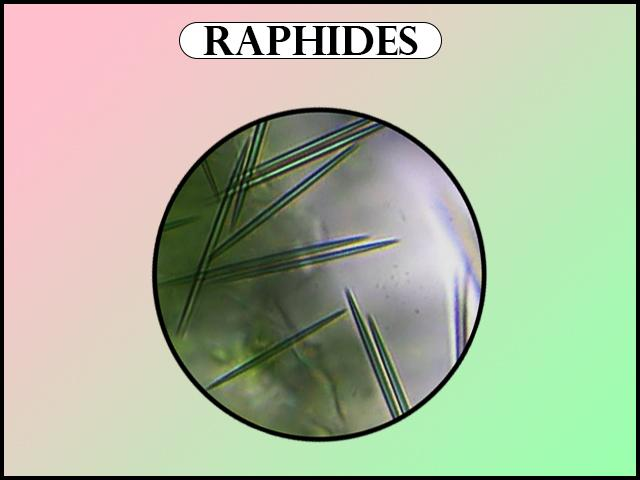
So, the correct answer is,’ Asparagus’
Note:
-Many plants accumulate calcium oxalate by doing this, plants can sequester excess calcium in their cells. Many plant lineages use calcium oxalate to make raphides.
-In-plant development, raphide crystals are initiated very early. They are consistently present in most species and have uniform distribution within mature tissues.
-In the vacuole of an idioblast, individual raphides are formed by calcium oxalate deposition within individual crystal chambers.
Complete answer:
Raphides are a defense mechanism against plant predators found in Asparagus shoots. They are tiny needle-like projections made up of calcium oxalate. They can be harmed by tearing the soft tissues of the throat or esophagus of a plant predator(the small black Eulophid wasp) chewing on the plant's leaves. This process is venomous and is in two stages: mechanical pricking and injection of harmful protease. Deer and many other animals eat the new shoots of Asparagus.
Additional Information:
-Guavas consist of four times more fiber than a pineapple and four times more vitamin C than an orange. Guavas are known for their seedy flesh. Guavas are evergreen shrubs, with white flowers that can grow on 20-foot high.
-Asparagus is awesome for your health because it’s rich in saponins, which are a type of phytonutrient credited with reducing cancer risks and assisting in maintaining blood pressure, regulating blood sugar, and controlling blood lipid levels.
-The name Dahlia is given to the plant after Swedish 18th-century botanist Anders Dahl. It is the official flower of the city of Seattle and originated in Central America in the 16th century. It was discovered while growing wild on the sandy hillsides of Mexico by a Spanish Botanist.
-The shell of the cashew is toxic and can’t be eaten. Similar to plant poison ivy and poison sumac, Cashews belong to the same family and they also contain itchy oil in their shell. Pistachio is also known as the “happy nut” in China and the “smiling nut” in Iran.
So, the correct answer is,’ Asparagus’
Note:
-Many plants accumulate calcium oxalate by doing this, plants can sequester excess calcium in their cells. Many plant lineages use calcium oxalate to make raphides.
-In-plant development, raphide crystals are initiated very early. They are consistently present in most species and have uniform distribution within mature tissues.
-In the vacuole of an idioblast, individual raphides are formed by calcium oxalate deposition within individual crystal chambers.
Recently Updated Pages
Master Class 12 Economics: Engaging Questions & Answers for Success

Master Class 12 English: Engaging Questions & Answers for Success
Master Class 12 Social Science: Engaging Questions & Answers for Success
Master Class 12 Maths: Engaging Questions & Answers for Success
Master Class 12 Physics: Engaging Questions & Answers for Success
Master Class 11 Social Science: Engaging Questions & Answers for Success
Trending doubts
One Metric ton is equal to kg A 10000 B 1000 C 100 class 11 physics CBSE
Difference Between Prokaryotic Cells and Eukaryotic Cells
Two of the body parts which do not appear in MRI are class 11 biology CBSE
1 ton equals to A 100 kg B 1000 kg C 10 kg D 10000 class 11 physics CBSE
Draw a diagram of nephron and explain its structur class 11 biology CBSE
10 examples of friction in our daily life