




What is the radius of curvature of the parabola traced out by the projectile projected at a speed $v$ and projected at an angle \[\theta \] with the horizontal at a point where the particle velocity makes an angle $\dfrac{\theta }{2}$ with the horizontal?
\[
{\text{A}}{\text{. r = }}\dfrac{{v_{}^2{{\cos }^2}\theta }}{{g{{\cos }^3}\dfrac{\theta }{2}}} \\
\\
{\text{B}}{\text{. r = }}\dfrac{{2v\sin \theta }}{{g\tan \theta }} \\
\\
{\text{C}}{\text{. r = }}\dfrac{{v\cos \theta }}{{g{{\sin }^2}\dfrac{\theta }{2}}} \\
\\
{\text{D}}{\text{. r = }}\dfrac{{3v\cos \theta }}{{g\cot \theta }} \\
\]
Answer
 Verified
646.2k+ views
Hint: Here, we can use the formula for velocity and radial acceleration. We know that the velocity is the change in the position of the object with respect to time.
Formula used:
${v_X} = v\cos \theta $
${a_r} = \dfrac{{v_{}^2}}{r}$
Where,
${a_r}$ is the radial acceleration
Complete step-by-step answer:
Let us consider the values given in the above equation.
Given that projectile projected at a speed $v$ and projected at an angle \[\theta \] with the horizontal at a point where the particle velocity makes an angle$\dfrac{\theta }{2}$.
In the diagram the projection of a projectile is shown.
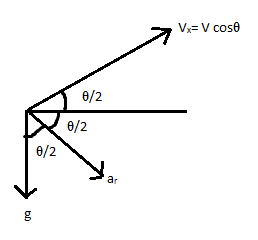
$v$ is the initial speed of the projectile in the horizontal, ${a_r}$ is the radial acceleration acting on the projectile in the direction perpendicular to the direction of initial speed and g is the acceleration due to gravity.
Let us consider the radial acceleration splits into to angles each of $\dfrac{\theta }{2}$.
Let us consider the initial speed of the projectile is in the horizontal direction we have ${v_x} = v\cos \theta $
Also, at a point of interest, the particle velocity makes an angle$\dfrac{\theta }{2}$.
Hence \[v\cos \dfrac{\theta }{2} = v\cos \theta \]
$ \Rightarrow v = \dfrac{{v\cos \theta }}{{\dfrac{{\cos \theta }}{2}}}$
We know that the radial acceleration ${a_r}$is perpendicular to the velocity component as shown in the diagram.
Hence ${a_r} = g\cos \left( {\dfrac{\theta }{2}} \right)$
Velocity in the direction of radial acceleration is given by the relation ${a_r} = \dfrac{{v_{}^2}}{r}$
$ \Rightarrow r = \dfrac{{v_{}^2}}{{{a_r}}}$
Substituting the value,$v = \dfrac{{v\cos \theta }}{{\dfrac{{\cos \theta }}{2}}}$ and ${a_r} = g\cos \left( {\dfrac{\theta }{2}} \right)$ we get,
\[ \Rightarrow r = \dfrac{{\left( {\dfrac{{v_{}^2\cos _{}^2\theta }}{{{{\cos }^2}\dfrac{\theta }{2}}}} \right)}}{{g\cos \dfrac{\theta }{2}}}\]
\[ \Rightarrow r = \dfrac{{v_{}^2\cos _{}^2\theta }}{{{{\cos }^2}\dfrac{\theta }{2} \times g\cos \dfrac{\theta }{2}}}\]
\[ \Rightarrow r = \dfrac{{v_{}^2\cos _{}^2\theta }}{{g{{\cos }^3}\dfrac{\theta }{2}}}\]
Therefore (A) \[r = \dfrac{{v_{}^2\cos _{}^2\theta }}{{g{{\cos }^3}\dfrac{\theta }{2}}}\] is the required answer.
Additional information:
The acceleration of a particle performing uniform circular motion is called radial acceleration.
Radial acceleration is also called centripetal acceleration as it acts along the radius and towards the centre.
Note:let us consider an object that is thrown by the exertion of a force. It is allowed to move freely in the air under the influence of gravity. Therefore, any object that moves through space is called Projectile and the motion is called Projectile motion.
Formula used:
${v_X} = v\cos \theta $
${a_r} = \dfrac{{v_{}^2}}{r}$
Where,
${a_r}$ is the radial acceleration
Complete step-by-step answer:
Let us consider the values given in the above equation.
Given that projectile projected at a speed $v$ and projected at an angle \[\theta \] with the horizontal at a point where the particle velocity makes an angle$\dfrac{\theta }{2}$.
In the diagram the projection of a projectile is shown.
$v$ is the initial speed of the projectile in the horizontal, ${a_r}$ is the radial acceleration acting on the projectile in the direction perpendicular to the direction of initial speed and g is the acceleration due to gravity.
Let us consider the radial acceleration splits into to angles each of $\dfrac{\theta }{2}$.
Let us consider the initial speed of the projectile is in the horizontal direction we have ${v_x} = v\cos \theta $
Also, at a point of interest, the particle velocity makes an angle$\dfrac{\theta }{2}$.
Hence \[v\cos \dfrac{\theta }{2} = v\cos \theta \]
$ \Rightarrow v = \dfrac{{v\cos \theta }}{{\dfrac{{\cos \theta }}{2}}}$
We know that the radial acceleration ${a_r}$is perpendicular to the velocity component as shown in the diagram.
Hence ${a_r} = g\cos \left( {\dfrac{\theta }{2}} \right)$
Velocity in the direction of radial acceleration is given by the relation ${a_r} = \dfrac{{v_{}^2}}{r}$
$ \Rightarrow r = \dfrac{{v_{}^2}}{{{a_r}}}$
Substituting the value,$v = \dfrac{{v\cos \theta }}{{\dfrac{{\cos \theta }}{2}}}$ and ${a_r} = g\cos \left( {\dfrac{\theta }{2}} \right)$ we get,
\[ \Rightarrow r = \dfrac{{\left( {\dfrac{{v_{}^2\cos _{}^2\theta }}{{{{\cos }^2}\dfrac{\theta }{2}}}} \right)}}{{g\cos \dfrac{\theta }{2}}}\]
\[ \Rightarrow r = \dfrac{{v_{}^2\cos _{}^2\theta }}{{{{\cos }^2}\dfrac{\theta }{2} \times g\cos \dfrac{\theta }{2}}}\]
\[ \Rightarrow r = \dfrac{{v_{}^2\cos _{}^2\theta }}{{g{{\cos }^3}\dfrac{\theta }{2}}}\]
Therefore (A) \[r = \dfrac{{v_{}^2\cos _{}^2\theta }}{{g{{\cos }^3}\dfrac{\theta }{2}}}\] is the required answer.
Additional information:
The acceleration of a particle performing uniform circular motion is called radial acceleration.
Radial acceleration is also called centripetal acceleration as it acts along the radius and towards the centre.
Note:let us consider an object that is thrown by the exertion of a force. It is allowed to move freely in the air under the influence of gravity. Therefore, any object that moves through space is called Projectile and the motion is called Projectile motion.
Recently Updated Pages
Master Class 11 English: Engaging Questions & Answers for Success

Master Class 11 Physics: Engaging Questions & Answers for Success
Master Class 11 Computer Science: Engaging Questions & Answers for Success
Master Class 11 Chemistry: Engaging Questions & Answers for Success
Master Class 11 Social Science: Engaging Questions & Answers for Success
Master Class 11 Accountancy: Engaging Questions & Answers for Success
Trending doubts
Difference Between Prokaryotic Cells and Eukaryotic Cells
Two of the body parts which do not appear in MRI are class 11 biology CBSE
One Metric ton is equal to kg A 10000 B 1000 C 100 class 11 physics CBSE
10 examples of friction in our daily life
Draw a diagram of nephron and explain its structur class 11 biology CBSE
Draw a diagram of a plant cell and label at least eight class 11 biology CBSE