




Question- what is a restriction fragment length polymorphism (RFLP)?
A.A sequence of DNA complementary to mRNA molecule
B.A variation in length of DNA fragments due to inherited differences in protein molecules
C.A variation in length of DNA fragments due to inherited differences in highly repetitive DNA
D.A variation in length of DNA fragments due to random differences in highly repetitive DNA
Answer
 Verified
593.4k+ views
Hint:RFLP is a polymorphism that occurs due to variation in DNA sequence. These variations are detected by restriction enzymes. These enzymes are used by scientists to cut DNA molecules at particular sites. They are used as markers in genetic mapping.
Complete answer:
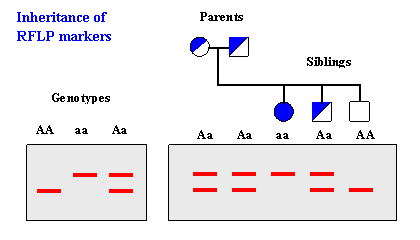
They are very useful to mark DNA fragments for a genomic DNA either for human sequence or for animals. There are sites on DNA with a series of nucleic acids which acts as a restriction site where the enzyme can bind and cleave that part of DNA. This helps to rule out the differences between the people whether they have the same restriction enzyme site or not. Even a single change in base pair results in the complete presence or absence of restriction site. When the isolated piece of DNA is taken from two people, one of them will be cut by the enzyme and the other one won't. And that results show polymorphism, or difference between those two people. They are monitored by isolating the DNA, cutting it with that bacterial restriction enzyme, and running it on a gel using electrophoresis. The sample without the enzyme site will have one band while the sample with enzyme site will have two bands which represent the cleaved product. So these differences in nucleic acid sequences and restriction enzyme binding sites just mean that there's a difference in the sequence between those two people. That sequence difference doesn't necessarily mean that there's a disease associated with it. It's a polymorphism that we could use to follow the inheritance of DNA.
Additional Information:
RFLP is one of the earliest molecular markers developed for genetic mapping. The principle of RFLP markers is that any genomic DNA can be differentiated on the basis of presence or absence of restriction enzyme sites.
Note:
Restriction fragment length polymorphism (RFLP) is a technique invented during research of hereditary diseases by Alec Jefferey in 1984. RFLP is used as part of DNA fingerprinting, to detect genetic diseases and to determine genetic relationships between species.
Complete answer:
They are very useful to mark DNA fragments for a genomic DNA either for human sequence or for animals. There are sites on DNA with a series of nucleic acids which acts as a restriction site where the enzyme can bind and cleave that part of DNA. This helps to rule out the differences between the people whether they have the same restriction enzyme site or not. Even a single change in base pair results in the complete presence or absence of restriction site. When the isolated piece of DNA is taken from two people, one of them will be cut by the enzyme and the other one won't. And that results show polymorphism, or difference between those two people. They are monitored by isolating the DNA, cutting it with that bacterial restriction enzyme, and running it on a gel using electrophoresis. The sample without the enzyme site will have one band while the sample with enzyme site will have two bands which represent the cleaved product. So these differences in nucleic acid sequences and restriction enzyme binding sites just mean that there's a difference in the sequence between those two people. That sequence difference doesn't necessarily mean that there's a disease associated with it. It's a polymorphism that we could use to follow the inheritance of DNA.
Additional Information:
RFLP is one of the earliest molecular markers developed for genetic mapping. The principle of RFLP markers is that any genomic DNA can be differentiated on the basis of presence or absence of restriction enzyme sites.
Note:
Restriction fragment length polymorphism (RFLP) is a technique invented during research of hereditary diseases by Alec Jefferey in 1984. RFLP is used as part of DNA fingerprinting, to detect genetic diseases and to determine genetic relationships between species.
Recently Updated Pages
Master Class 12 Social Science: Engaging Questions & Answers for Success

Master Class 12 Physics: Engaging Questions & Answers for Success
Master Class 12 Maths: Engaging Questions & Answers for Success
Master Class 12 Economics: Engaging Questions & Answers for Success
Master Class 12 Chemistry: Engaging Questions & Answers for Success
Master Class 12 Business Studies: Engaging Questions & Answers for Success
Trending doubts
Which are the Top 10 Largest Countries of the World?
Draw a labelled sketch of the human eye class 12 physics CBSE
Explain the structure of megasporangium class 12 biology CBSE
What are the major means of transport Explain each class 12 social science CBSE
How many chromosomes are found in human ovum a 46 b class 12 biology CBSE
The diagram of the section of a maize grain is given class 12 biology CBSE