




Pyrenoid is made up of
(a) Sugar
(b) Lipid
(c) Protein
(d) Nucleic acid
Answer
 Verified
623.4k+ views
Hint: Pyrenoids are small subcellular compartments found in the chloroplasts of many algae and in a group of land plants called the hornworts. They are made up of a central core and a surrounding layer of compactly arranged starch. This core is made of the material that repairs the body from wear and tear. It is the same type of material as keratin.
Complete Step by Step Answer:
Pyrenoids are usually associated with the operations of the carbon- concentrating mechanism (CCM) . They function as the centres of carbon dioxide (${C}{O}_{2}$) fixation. They do this by generating and maintaining a ${C}{O}_{2}$ rich environment. They have a central, viscous, granular core that is proteinaceous in nature and they are surrounded by tightly packed minute plates of starch. This central mass of protein is also known as pyreno-crystal.
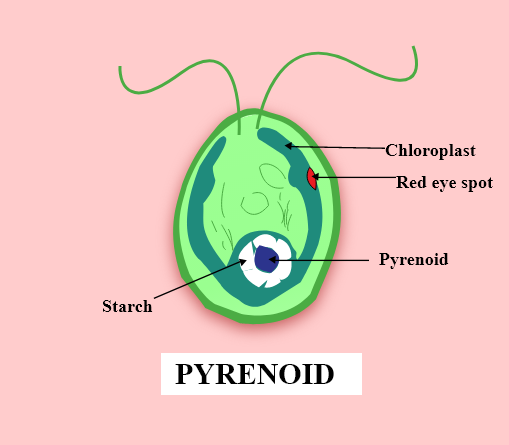
Pyrenoids are usually found in most algal lineages, irrespective of whether the chloroplasts were inherited from a single endosymbiotic event as seen in green and red algae except glaucophytes or from multiple endosymbiotic events as in diatoms, dinoflagellates, cryptophytes, and euglenozoa.
Some algal groups may even lack pyrenoids altogether as in "higher" red algae and some extremophile red algae, the green alga belonging to the genus Chloromonas. Pyrenoids are often also associated with the storage of starch, due to the presence of starch sheath around them. Pyrenoids are usually said to be poor taxonomic markers as may have evolved independently in different species many times.
So, the correct answer is, “Protein.”
Note:
- There is a huge diversity in pyrenoid morphology and ultrastructure between different algal species.
- The unicellular red algae Porphyridium purpureum and the green alga Chlamydomonas reinhardtii have a single yet highly conspicuous pyrenoid in a single chloroplast that is visible using light microscopy.
- On the other hand, in diatoms and dinoflagellates multiple pyrenoids may be present.
Recently Updated Pages
Master Class 11 English: Engaging Questions & Answers for Success

Master Class 11 Social Science: Engaging Questions & Answers for Success
Master Class 11 Maths: Engaging Questions & Answers for Success
Master Class 11 Biology: Engaging Questions & Answers for Success
Master Class 11 Physics: Engaging Questions & Answers for Success
Master Class 11 Chemistry: Engaging Questions & Answers for Success
Trending doubts
One Metric ton is equal to kg A 10000 B 1000 C 100 class 11 physics CBSE
Difference Between Prokaryotic Cells and Eukaryotic Cells
Find the value of the expression given below sin 30circ class 11 maths CBSE
Difference between physical and chemical change class 11 chemistry CBSE
Two of the body parts which do not appear in MRI are class 11 biology CBSE
Draw a diagram of a plant cell and label at least eight class 11 biology CBSE