




Pyramid of biomass indicates?
A) Biotic potential
B) Standing crop
C) Standing state
D) Productivity
Answer
 Verified
638.7k+ views
Hint: Pyramids of biomass are calculated by gathering all the organisms living at each trophic level separately, and then by measuring their dry weight.
Complete answer:
Each trophic level has a certain mass of living material at a particular time is termed as the standing crop. The standing crop is measured as the mass of living organisms that is biomass or the number of living organisms in a unit area.
Additional information:
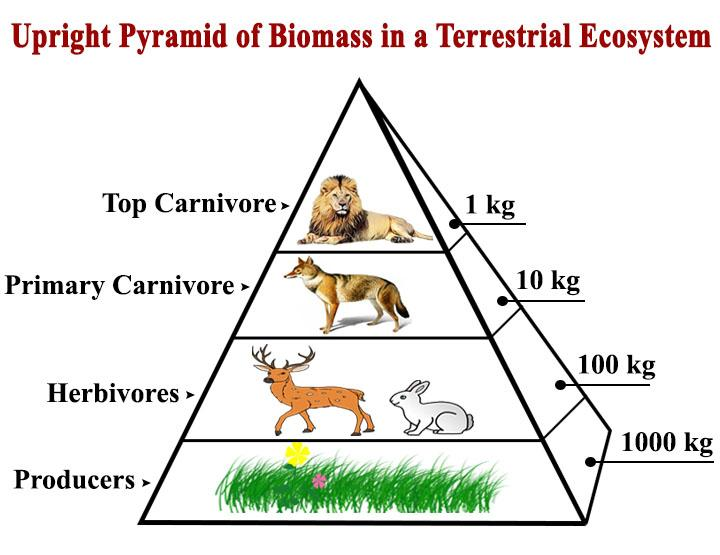
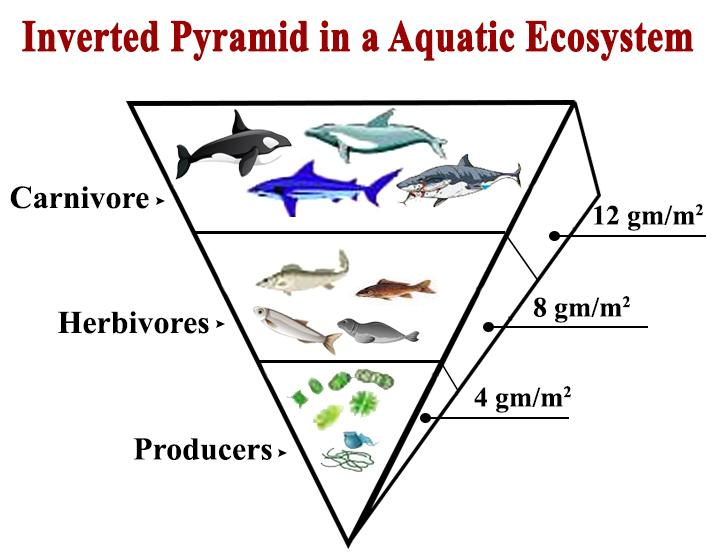
As the name suggests, pyramids of biomass show the amount of biomass (living or organic matter present in an organism) present per unit area at each trophic level. It is drawn as the producers at the base and the top carnivores at the tip.
Each trophic level contains a specific mass of living material at a particular time called standing crop, which is measured as the mass of living organisms (biomass) or the number in a unit area.
It can be upright or inverted.
In terrestrial ecosystems, such as cropland, grassland and forest, there is progressive decrease in biomass from lower to higher trophic levels. So, the pyramid of biomass is upright.
In aquatic ecosystems, such as lakes and ponds, there is progressive increase in the successive trophic levels. So, the pyramid of biomass is inverted.
When the biomass pyramid is upright, the producers have maximum biomass, and decomposers have the minimum. When the biomass pyramid is inverted, the producers are small-sized with low biomass, whereas the consumers are large-sized with high biomass.
So, the correct answer is ‘standing crop’.
Note: The biomass of a species is expressed in terms of fresh or dry weight. And among them, measurement of biomass in terms of dry weight is more accurate than the other.
Complete answer:
Each trophic level has a certain mass of living material at a particular time is termed as the standing crop. The standing crop is measured as the mass of living organisms that is biomass or the number of living organisms in a unit area.
Additional information:
As the name suggests, pyramids of biomass show the amount of biomass (living or organic matter present in an organism) present per unit area at each trophic level. It is drawn as the producers at the base and the top carnivores at the tip.
Each trophic level contains a specific mass of living material at a particular time called standing crop, which is measured as the mass of living organisms (biomass) or the number in a unit area.
It can be upright or inverted.
In terrestrial ecosystems, such as cropland, grassland and forest, there is progressive decrease in biomass from lower to higher trophic levels. So, the pyramid of biomass is upright.
In aquatic ecosystems, such as lakes and ponds, there is progressive increase in the successive trophic levels. So, the pyramid of biomass is inverted.
When the biomass pyramid is upright, the producers have maximum biomass, and decomposers have the minimum. When the biomass pyramid is inverted, the producers are small-sized with low biomass, whereas the consumers are large-sized with high biomass.
So, the correct answer is ‘standing crop’.
Note: The biomass of a species is expressed in terms of fresh or dry weight. And among them, measurement of biomass in terms of dry weight is more accurate than the other.
Recently Updated Pages
Master Class 11 English: Engaging Questions & Answers for Success

Master Class 11 Social Science: Engaging Questions & Answers for Success
Master Class 11 Maths: Engaging Questions & Answers for Success
Master Class 11 Biology: Engaging Questions & Answers for Success
Master Class 11 Physics: Engaging Questions & Answers for Success
Master Class 11 Chemistry: Engaging Questions & Answers for Success
Trending doubts
Explain the Treaty of Vienna of 1815 class 10 social science CBSE
What is the Total Duration of Football Match?
First Cotton Mill of India
In which year voting age was reduced from 21 to 18?
10 examples of evaporation in daily life with explanations
What planets have no moons Which one has only one moon class 10 physics CBSE