



What is the purpose of division in Meiosis?
Answer
 Verified
503.4k+ views
Hint: Cell division is the process by which parent cells get divided into daughter cells. In eukaryotic cells, there are predominantly two types of cell divisions which are mitosis and meiosis. Both the divisions are different from each other and are required for entirely different functions.
Complete answer:
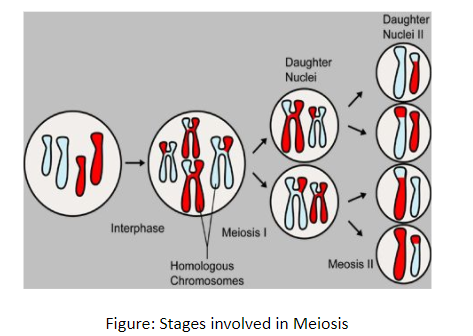
Meiosis or reduction division is predominantly present in organisms that reproduce by sexual means. It is the process by which a diploid cell that has 2n number of chromosomes produces two daughter cells containing n number of chromosomes each. For example, in a human cell, the number of chromosomes is 46 and after meiosis, each of the daughter cells receives 23 chromosomes from the parent cell.
The main function of meiosis is in producing haploid gamete cells such as sperms and eggs that have half the number of chromosomes and after fertilization, the actual chromosome number of the organism gets restored during the process of sexual reproduction. Another process that happens during meiosis is known as crossing over which helps in producing variations that make offsprings different from the parent cells. The major function of meiosis is in maintaining the chromosome number in different generations.
Note: The other type of cell division involved is known as Mitosis. It is also known as equational division. In this process, the daughter cells produced have the same number of chromosomes as that of the parent cell. This type of cell division occurs in all types of cells and is the major process involved in the production of new cells and maintaining the cell number.
Complete answer:
Meiosis or reduction division is predominantly present in organisms that reproduce by sexual means. It is the process by which a diploid cell that has 2n number of chromosomes produces two daughter cells containing n number of chromosomes each. For example, in a human cell, the number of chromosomes is 46 and after meiosis, each of the daughter cells receives 23 chromosomes from the parent cell.
The main function of meiosis is in producing haploid gamete cells such as sperms and eggs that have half the number of chromosomes and after fertilization, the actual chromosome number of the organism gets restored during the process of sexual reproduction. Another process that happens during meiosis is known as crossing over which helps in producing variations that make offsprings different from the parent cells. The major function of meiosis is in maintaining the chromosome number in different generations.
Note: The other type of cell division involved is known as Mitosis. It is also known as equational division. In this process, the daughter cells produced have the same number of chromosomes as that of the parent cell. This type of cell division occurs in all types of cells and is the major process involved in the production of new cells and maintaining the cell number.

Recently Updated Pages
Master Class 12 Business Studies: Engaging Questions & Answers for Success

Master Class 12 Biology: Engaging Questions & Answers for Success
Master Class 12 Chemistry: Engaging Questions & Answers for Success
Class 12 Question and Answer - Your Ultimate Solutions Guide
Master Class 11 Social Science: Engaging Questions & Answers for Success
Master Class 11 English: Engaging Questions & Answers for Success
Trending doubts
Find the sum of series 1 + 2 + 3 + 4 + 5 + + 100 class 9 maths CBSE
On an outline map of India show its neighbouring c class 9 social science CBSE
Write an Article on Save Earth Save Life
On an outline map of India mark the Karakoram range class 9 social science CBSE
If HCF of 210 and 55 is expressed in the form of 210 class 9 maths CBSE
What is the difference between Atleast and Atmost in class 9 maths CBSE