




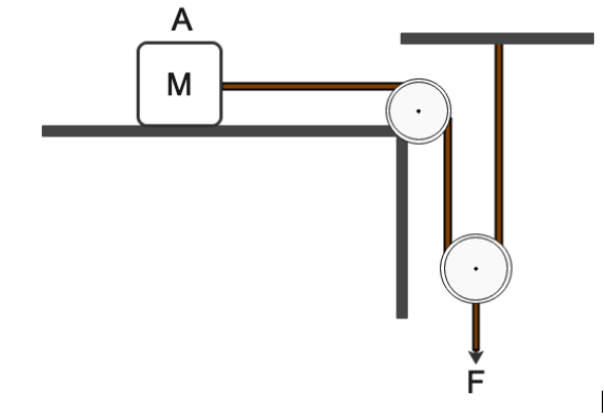
Pulleys and strings are massless. The horizontal surface is smooth. The acceleration of the block A is
$A){\text{ }}\dfrac{F}{{2M}}$
$B){\text{ }}\dfrac{F}{M}$
$C){\text{ }}\dfrac{{2F}}{M}$
$D){\text{ }}\dfrac{M}{{2F}}$
Answer
 Verified
574.5k+ views
Hint: In order to solve the question, we will first of all make the free body diagram of whole system then we will use the net force formula on free body diagram of pulley to find tension and then we will use net force formula on free body diagram of block – A along with this the tension we found to find the acceleration.
Formula Used:
${F_{Net}} = ma$
${F_{Net}}$ refers to net force applied
M refers to mass
a refers to acceleration
Complete step by step solution:
In the question we are given a body of mass M tied to pulley which is connected to another pulley and that pulley is tied on the ceiling and we have to find the acceleration of block A
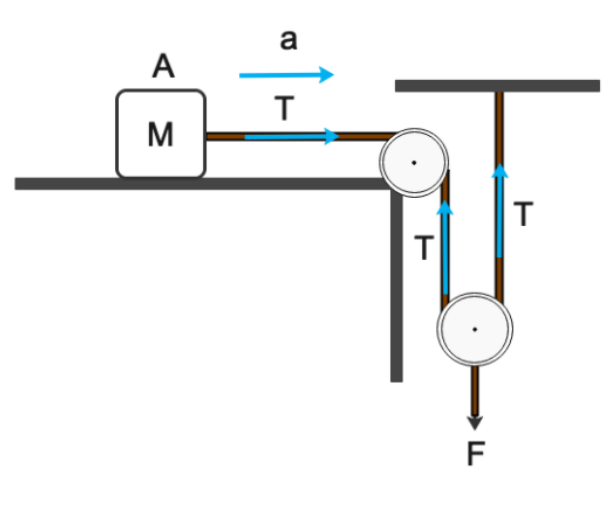
This is free body diagram of the whole system the whole system has a single rope that is why the tension in the string is same that is T
Now we will solve the question by breaking the whole system in different part and then using that we will make their free body diagram to make the equations
Free body diagram of pulley
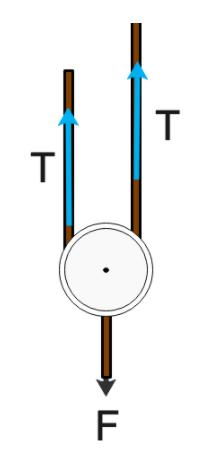
Two ropes are applying tension on the upward direction while one is applying force on downward direction
Now we will apply the formula of net force
${F_{Net}} = ma$
$F - 2T = {M_P}{a_P}$
${M_P}$ is the mass of the pulley which is zero
$\because {M_P} = 0$
$F - 2T = 0$
Taking tension on the other side
$F = 2T$
Hence tension is equal to
$T = \dfrac{F}{2}$
Free body diagram of Block - A
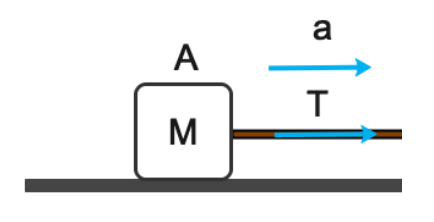
Rope is applying tension and because of acceleration is also applied in the same direction
Now we will apply the formula of net force
${F_{Net}} = ma$
$T = Ma$
Substituting the value of tension
$\dfrac{F}{2} = Ma$
Taking mass on the other side and we get the acceleration equal to
$a = \dfrac{F}{{2M}}$
Hence, the correct option $A){\text{ }}\dfrac{F}{{2M}}$.
Note:
Many of the people will make the mistake by not assuming the mass of the pulley zero as it is not mentioned in the question but these are typical types of question in which after see the options we can judge that the mass of pulley is neglected along with this tension the whole string will remain same as it doesn’t break anywhere.
Formula Used:
${F_{Net}} = ma$
${F_{Net}}$ refers to net force applied
M refers to mass
a refers to acceleration
Complete step by step solution:
In the question we are given a body of mass M tied to pulley which is connected to another pulley and that pulley is tied on the ceiling and we have to find the acceleration of block A
This is free body diagram of the whole system the whole system has a single rope that is why the tension in the string is same that is T
Now we will solve the question by breaking the whole system in different part and then using that we will make their free body diagram to make the equations
Free body diagram of pulley
Two ropes are applying tension on the upward direction while one is applying force on downward direction
Now we will apply the formula of net force
${F_{Net}} = ma$
$F - 2T = {M_P}{a_P}$
${M_P}$ is the mass of the pulley which is zero
$\because {M_P} = 0$
$F - 2T = 0$
Taking tension on the other side
$F = 2T$
Hence tension is equal to
$T = \dfrac{F}{2}$
Free body diagram of Block - A
Rope is applying tension and because of acceleration is also applied in the same direction
Now we will apply the formula of net force
${F_{Net}} = ma$
$T = Ma$
Substituting the value of tension
$\dfrac{F}{2} = Ma$
Taking mass on the other side and we get the acceleration equal to
$a = \dfrac{F}{{2M}}$
Hence, the correct option $A){\text{ }}\dfrac{F}{{2M}}$.
Note:
Many of the people will make the mistake by not assuming the mass of the pulley zero as it is not mentioned in the question but these are typical types of question in which after see the options we can judge that the mass of pulley is neglected along with this tension the whole string will remain same as it doesn’t break anywhere.
Recently Updated Pages
Which will be the least stable resonating structure class 11 chemistry CBSE

How many 5 digit telephone numbers can be construc-class-11-maths-CBSE
How do you find the angle of the resultant vector class 11 physics CBSE
Draw labelled diagram of the following i Gram seed class 11 biology CBSE
1 Quintal is equal to a 110 kg b 10 kg c 100kg d 1000 class 11 physics CBSE
What is the need and importance of classification class 11 biology CBSE
Trending doubts
Find the value of the expression given below sin 30circ class 11 maths CBSE
One Metric ton is equal to kg A 10000 B 1000 C 100 class 11 physics CBSE
10 examples of friction in our daily life
Draw a diagram of a plant cell and label at least eight class 11 biology CBSE
Difference between physical and chemical change class 11 chemistry CBSE
Proton was discovered by A Thomson B Rutherford C Chadwick class 11 chemistry CBSE