



Prove the theorem: If a transversal intersects two parallel lines, then each pair of alternate angles is equal.
Answer
 Verified
612k+ views
Hint: In this question remember the properties of angles also keep in mind to use the corresponding angles and opposite angles properties of angles, use this information to approach towards the solution of the given problem.
Complete step by step answer:
Before approaching towards the solution let’s discuss about the theorem
So the given theorem says that when a transversal intersects 2 parallel lines each pair of alternate angle becomes equal to each other so let’s draw the diagram using this theorem
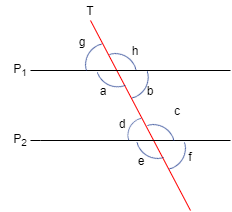
So according to the given information we have to show that the each pair of alternate angles are equal i.e. $\angle a = \angle c$ and $\angle b = \angle d$
By the corresponding property of angle we can say that $\angle g = \angle d$ (equation 1)
Also by the property of vertical opposite angle we can say that $\angle g = \angle b$ (equation 2)
So by comparing equation 1 and equation 2 we get
$\angle b = \angle d$
Now we know that by the corresponding angle property we can say that $\angle h = \angle c$(equation 3)
Also by the property of vertical opposite angle we can say that $\angle h = \angle a$ (equation 4)
By comparing equation 3 and equation 4 we get
$\angle a = \angle c$
Hence it is proved that when a transversal intersects two parallel lines the pair of each alternate angles formed are equal.
Note: In the above solution we came across the term “transversal” which can be explained as the line which passes through the 2 different lines exist in same plane but are at two different points distinct from each other when a transversal intersects any two parallel lines or more than two lines then the angles formed are interior angles, vertically opposite angles, corresponding angles, etc.
Complete step by step answer:
Before approaching towards the solution let’s discuss about the theorem
So the given theorem says that when a transversal intersects 2 parallel lines each pair of alternate angle becomes equal to each other so let’s draw the diagram using this theorem
So according to the given information we have to show that the each pair of alternate angles are equal i.e. $\angle a = \angle c$ and $\angle b = \angle d$
By the corresponding property of angle we can say that $\angle g = \angle d$ (equation 1)
Also by the property of vertical opposite angle we can say that $\angle g = \angle b$ (equation 2)
So by comparing equation 1 and equation 2 we get
$\angle b = \angle d$
Now we know that by the corresponding angle property we can say that $\angle h = \angle c$(equation 3)
Also by the property of vertical opposite angle we can say that $\angle h = \angle a$ (equation 4)
By comparing equation 3 and equation 4 we get
$\angle a = \angle c$
Hence it is proved that when a transversal intersects two parallel lines the pair of each alternate angles formed are equal.
Note: In the above solution we came across the term “transversal” which can be explained as the line which passes through the 2 different lines exist in same plane but are at two different points distinct from each other when a transversal intersects any two parallel lines or more than two lines then the angles formed are interior angles, vertically opposite angles, corresponding angles, etc.
Recently Updated Pages
Master Class 9 Social Science: Engaging Questions & Answers for Success

Master Class 9 Science: Engaging Questions & Answers for Success
Master Class 9 Maths: Engaging Questions & Answers for Success
Master Class 9 General Knowledge: Engaging Questions & Answers for Success
Class 9 Question and Answer - Your Ultimate Solutions Guide
Master Class 8 Social Science: Engaging Questions & Answers for Success
Trending doubts
Find the sum of series 1 + 2 + 3 + 4 + 5 + + 100 class 9 maths CBSE
What is the Full Form of ISI and RAW
Fill the blanks with the suitable prepositions 1 The class 9 english CBSE
Difference Between Plant Cell and Animal Cell
Who is eligible for RTE class 9 social science CBSE
What is pollution? How many types of pollution? Define it