




How will you prove the formula$\cos \left( A-B \right)=\cos A\cos B+\sin A\sin B$ using the formula of the vector product of the two vectors?
Answer
 Verified
596.4k+ views
Hint: First we have to draw two units vectors in xy plane both with the angle A and angle B with the total angle of (A+B) then after using the method of the dot product of the vectors we can prove formula which is given in the question.
Formula used:
$\overrightarrow{A}.\overrightarrow{B}=\left| \overrightarrow{A} \right|\left| \overrightarrow{B} \right|\cos \theta $
Complete answer:
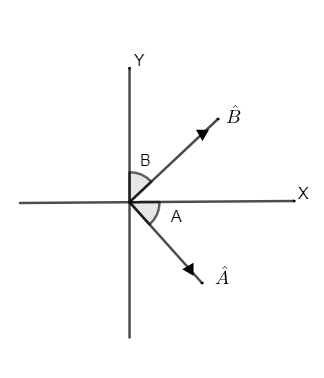
As shown in the figure, first draw the two vectors in x-y plane one makes an angle A with the x-axis and other one makes an angle B with the x-axis and the both have a total angle of (A+B).
Now in Cartesian form the vector $\widehat{A}\text{ and}\widehat{B}$ with their components can be written as,
$\widehat{A}=\cos A\widehat{i}-\sin A\widehat{j}...\left( 1 \right)$
And the vector$\widehat{B}$is,
$\widehat{B}=\cos B\widehat{i}+\sin B\widehat{j}...\left( 2 \right)$
Now let’s take the dot product of the two vectors,
$\overrightarrow{A}.\overrightarrow{B}=\left| \overrightarrow{A} \right|\left| \overrightarrow{B} \right|\cos \theta $
It should be consider that the resultant component will be in direction of $\widehat{k}$ hence,
$\overrightarrow{A}.\overrightarrow{B}=\left| \overrightarrow{A} \right|\left| \overrightarrow{B} \right|\sin \theta \widehat{k}...\left( 3 \right)$
Here the total angle θ = 90+B-A and the both vectors are unit vectors hence we can take,
$\left| \overrightarrow{A} \right|=\left| \overrightarrow{B} \right|=1...\left( 4 \right)$
Now substitute value of the equation (1) (2) and in equation (3)
\[\begin{align}
& \left( \cos A\widehat{i}-\sin A\widehat{j} \right)\left( \cos B\widehat{i}-\sin B\widehat{j} \right)-\cos \left( 90+B-A \right) \\
& \Rightarrow \sin \left( 90-\left( A-B \right) \right)\widehat{k}=\cos A\cos B\widehat{k}+\sin A\sin B\widehat{k} \\
\end{align}\]
Taking \[\widehat{k}\]vector common and substituting,
$\sin \left( 90-A-B \right)=\cos \left( A-B \right)$
We will get,
$\therefore \cos \left( A-B \right)=\cos A\cos B+\sin A\sin B$
Note:
While multiplying vectors \[\widehat{i},\widehat{j}\text{ and }\widehat{k}\] please refer below rules to avoid mistakes,
\[\begin{align}
& \widehat{i}\times \widehat{j}=\widehat{k} \\
& \widehat{j}\times \widehat{i}=-\widehat{k} \\
& \widehat{i}\times \widehat{i}=\text{null vector} \\
& \widehat{j}\times \widehat{j}=\text{null vector} \\
\end{align}\]
Formula used:
$\overrightarrow{A}.\overrightarrow{B}=\left| \overrightarrow{A} \right|\left| \overrightarrow{B} \right|\cos \theta $
Complete answer:
As shown in the figure, first draw the two vectors in x-y plane one makes an angle A with the x-axis and other one makes an angle B with the x-axis and the both have a total angle of (A+B).
Now in Cartesian form the vector $\widehat{A}\text{ and}\widehat{B}$ with their components can be written as,
$\widehat{A}=\cos A\widehat{i}-\sin A\widehat{j}...\left( 1 \right)$
And the vector$\widehat{B}$is,
$\widehat{B}=\cos B\widehat{i}+\sin B\widehat{j}...\left( 2 \right)$
Now let’s take the dot product of the two vectors,
$\overrightarrow{A}.\overrightarrow{B}=\left| \overrightarrow{A} \right|\left| \overrightarrow{B} \right|\cos \theta $
It should be consider that the resultant component will be in direction of $\widehat{k}$ hence,
$\overrightarrow{A}.\overrightarrow{B}=\left| \overrightarrow{A} \right|\left| \overrightarrow{B} \right|\sin \theta \widehat{k}...\left( 3 \right)$
Here the total angle θ = 90+B-A and the both vectors are unit vectors hence we can take,
$\left| \overrightarrow{A} \right|=\left| \overrightarrow{B} \right|=1...\left( 4 \right)$
Now substitute value of the equation (1) (2) and in equation (3)
\[\begin{align}
& \left( \cos A\widehat{i}-\sin A\widehat{j} \right)\left( \cos B\widehat{i}-\sin B\widehat{j} \right)-\cos \left( 90+B-A \right) \\
& \Rightarrow \sin \left( 90-\left( A-B \right) \right)\widehat{k}=\cos A\cos B\widehat{k}+\sin A\sin B\widehat{k} \\
\end{align}\]
Taking \[\widehat{k}\]vector common and substituting,
$\sin \left( 90-A-B \right)=\cos \left( A-B \right)$
We will get,
$\therefore \cos \left( A-B \right)=\cos A\cos B+\sin A\sin B$
Note:
While multiplying vectors \[\widehat{i},\widehat{j}\text{ and }\widehat{k}\] please refer below rules to avoid mistakes,
\[\begin{align}
& \widehat{i}\times \widehat{j}=\widehat{k} \\
& \widehat{j}\times \widehat{i}=-\widehat{k} \\
& \widehat{i}\times \widehat{i}=\text{null vector} \\
& \widehat{j}\times \widehat{j}=\text{null vector} \\
\end{align}\]
Recently Updated Pages
Master Class 11 English: Engaging Questions & Answers for Success

Master Class 11 Social Science: Engaging Questions & Answers for Success
Master Class 11 Maths: Engaging Questions & Answers for Success
Master Class 11 Biology: Engaging Questions & Answers for Success
Master Class 11 Physics: Engaging Questions & Answers for Success
Master Class 11 Chemistry: Engaging Questions & Answers for Success
Trending doubts
One Metric ton is equal to kg A 10000 B 1000 C 100 class 11 physics CBSE
What is cell theory Who formulated it class 11 biology CBSE
Phyllotaxy is the arrangement of ALeaflets BLeaves class 11 biology CBSE
Difference Between Prokaryotic Cells and Eukaryotic Cells
The symbiotic association of fungi and algae is called class 11 biology CBSE
Cell theory was formulated by A Schleiden and Schwann class 11 biology CBSE