




Prove the following statement: $\cos \left( \theta -\phi \right)=\cos \theta \cos \phi +\sin \theta \sin \phi $
Answer
 Verified
612k+ views
Hint: First we are going to draw a diagram and then from that we will try to understand the proof, we are going to use that diagram to draw triangles and with that we will prove the above identity.
We are going to prove $\cos \left( \theta +\phi \right)=\cos \theta \cos \phi -\sin \theta \sin \phi $, and then we will put $-\phi $ in place of $\phi $ , to get the desired answer.
Complete step-by-step answer:
Let’s first look at the diagram,
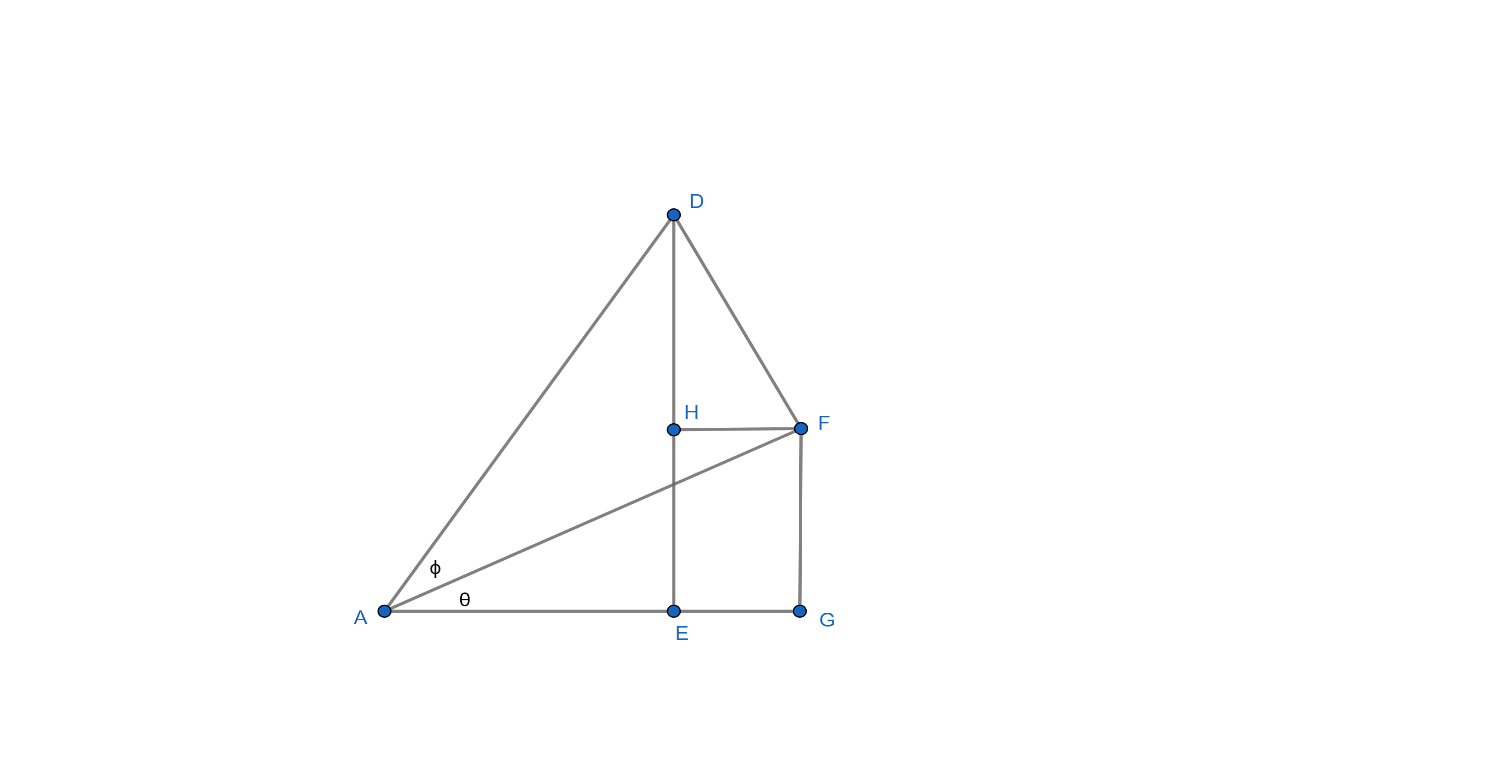
From this diagram we can conclude that,
DF $\bot $ AF
FG $\bot $ AG
HF = EG and HF $\parallel $ EG
These two are alternate angles and hence,
$\angle HFA=\angle FAG$
$\begin{align}
& \angle DFA=90 \\
& \angle DFH+\angle HFA=90 \\
& \angle DFH+\theta =90 \\
& \angle DFH=90-\theta \\
\end{align}$
Now we know that $\angle DHF=90$ ,
So in $\Delta DHF$ we get,
$\begin{align}
& \angle HDF=180-\left( 90-\theta \right)-90 \\
& \angle HDF=\theta \\
\end{align}$
In the given triangle,
$\begin{align}
& \Delta AED \\
& \cos \left( \theta +\phi \right)=\dfrac{Base}{Hypotenuse} \\
& =\dfrac{AE}{AD} \\
& =\dfrac{AG-EG}{AD} \\
& =\dfrac{AG}{AD}-\dfrac{EG}{AD} \\
\end{align}$
Now multiplying and dividing by AF and DF we get,
$=\dfrac{AG}{AF}\times \dfrac{AF}{AD}-\dfrac{EG}{DF}\times \dfrac{DF}{AD}.......(1)$
Now from $\Delta AFG$ we can find $\cos \theta $
From $\Delta ADF$ we can find $\cos \phi \text{ and sin}\phi $
From $\Delta DHF$ we can find $\sin \theta $
Now using all these values we get,
$\begin{align}
& \dfrac{AG}{AF}=\cos \theta \\
& \dfrac{EG}{DF}=\dfrac{HF}{DF}=\sin \theta \\
& \dfrac{AF}{AD}=\cos \phi \\
& \dfrac{DF}{AD}=\sin \phi \\
\end{align}$
Now putting these values in (1) we get,
$\cos \left( \theta +\phi \right)=\cos \theta \cos \phi -\sin \theta \sin \phi $
Hence, we have proved the given expression.
Now putting $-\phi $ in place of $\phi $ , we get,
$\cos \left( \theta -\phi \right)=\cos \theta \cos \phi +\sin \theta \sin \phi $
Hence, we have proved the given expression.
Note: It’s always better that we check if the answer that we have got by using the above formula we is correct or not to avoid some calculation mistake and for that we need to put some values in place of $\theta $ and $\phi $ to check whether it satisfies the above expression or not. There are a bunch of trigonometric formulas that should be kept in mind while solving these questions and if we use some different set of formulas then that will be another method to solve this question, but at some point we can see that they are nearly equal.
We are going to prove $\cos \left( \theta +\phi \right)=\cos \theta \cos \phi -\sin \theta \sin \phi $, and then we will put $-\phi $ in place of $\phi $ , to get the desired answer.
Complete step-by-step answer:
Let’s first look at the diagram,
From this diagram we can conclude that,
DF $\bot $ AF
FG $\bot $ AG
HF = EG and HF $\parallel $ EG
These two are alternate angles and hence,
$\angle HFA=\angle FAG$
$\begin{align}
& \angle DFA=90 \\
& \angle DFH+\angle HFA=90 \\
& \angle DFH+\theta =90 \\
& \angle DFH=90-\theta \\
\end{align}$
Now we know that $\angle DHF=90$ ,
So in $\Delta DHF$ we get,
$\begin{align}
& \angle HDF=180-\left( 90-\theta \right)-90 \\
& \angle HDF=\theta \\
\end{align}$
In the given triangle,
$\begin{align}
& \Delta AED \\
& \cos \left( \theta +\phi \right)=\dfrac{Base}{Hypotenuse} \\
& =\dfrac{AE}{AD} \\
& =\dfrac{AG-EG}{AD} \\
& =\dfrac{AG}{AD}-\dfrac{EG}{AD} \\
\end{align}$
Now multiplying and dividing by AF and DF we get,
$=\dfrac{AG}{AF}\times \dfrac{AF}{AD}-\dfrac{EG}{DF}\times \dfrac{DF}{AD}.......(1)$
Now from $\Delta AFG$ we can find $\cos \theta $
From $\Delta ADF$ we can find $\cos \phi \text{ and sin}\phi $
From $\Delta DHF$ we can find $\sin \theta $
Now using all these values we get,
$\begin{align}
& \dfrac{AG}{AF}=\cos \theta \\
& \dfrac{EG}{DF}=\dfrac{HF}{DF}=\sin \theta \\
& \dfrac{AF}{AD}=\cos \phi \\
& \dfrac{DF}{AD}=\sin \phi \\
\end{align}$
Now putting these values in (1) we get,
$\cos \left( \theta +\phi \right)=\cos \theta \cos \phi -\sin \theta \sin \phi $
Hence, we have proved the given expression.
Now putting $-\phi $ in place of $\phi $ , we get,
$\cos \left( \theta -\phi \right)=\cos \theta \cos \phi +\sin \theta \sin \phi $
Hence, we have proved the given expression.
Note: It’s always better that we check if the answer that we have got by using the above formula we is correct or not to avoid some calculation mistake and for that we need to put some values in place of $\theta $ and $\phi $ to check whether it satisfies the above expression or not. There are a bunch of trigonometric formulas that should be kept in mind while solving these questions and if we use some different set of formulas then that will be another method to solve this question, but at some point we can see that they are nearly equal.
Recently Updated Pages
Master Class 10 Computer Science: Engaging Questions & Answers for Success

Master Class 10 General Knowledge: Engaging Questions & Answers for Success
Master Class 10 English: Engaging Questions & Answers for Success
Master Class 10 Social Science: Engaging Questions & Answers for Success
Master Class 10 Maths: Engaging Questions & Answers for Success
Master Class 10 Science: Engaging Questions & Answers for Success
Trending doubts
What is the median of the first 10 natural numbers class 10 maths CBSE
Which women's tennis player has 24 Grand Slam singles titles?
Who is the Brand Ambassador of Incredible India?
Why is there a time difference of about 5 hours between class 10 social science CBSE
Write a letter to the principal requesting him to grant class 10 english CBSE
A moving boat is observed from the top of a 150 m high class 10 maths CBSE