




Prove the following:
$\dfrac{\cos \left( \pi +\theta \right)\cos \left( -\theta \right)}{\sin \left( \pi -\theta \right)\cos \left( \dfrac{\pi }{2}+\theta \right)}={{\cot }^{2}}\theta $
Answer
 Verified
618.9k+ views
Hint: We will be using the concepts of trigonometric function to solve the problem. We will be using the trigonometric formulae like:
\[\begin{align}
& \cos \left( \pi +\theta \right)=-\cos \theta \\
& \cos \left( -\theta \right)=\cos \theta \\
& \sin \left( \pi -\theta \right)=\sin \theta \\
& \cos \left( \dfrac{\pi }{2}+\theta \right)=-\sin \theta \\
& \dfrac{\cos \theta }{\sin \theta }=\cot \theta \\
\end{align}\]
Complete step-by-step answer:
Now, we have to prove that,
$\dfrac{\cos \left( \pi +\theta \right)\cos \left( -\theta \right)}{\sin \left( \pi -\theta \right)\cos \left( \dfrac{\pi }{2}+\theta \right)}={{\cot }^{2}}\theta $
Now, we know that for trigonometric ratios of supplementary angles are determined as,
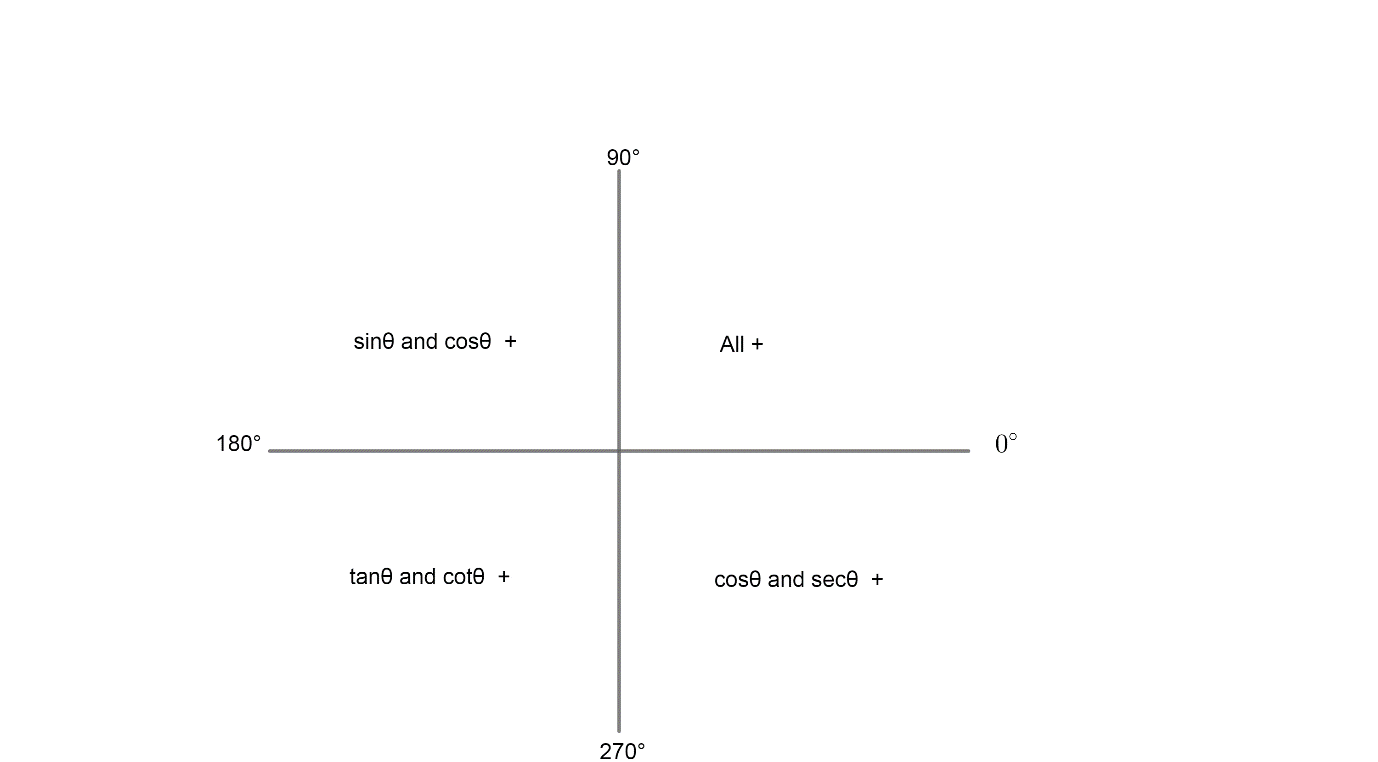
The figure shows the quadrant in which the trigonometric ratios are positive.
Now, it is important to note that the trigonometric ratio of an angle and its supplement is the same in magnitude but the sign depends on the quadrant in which it lies. For example: $\sin \left( 180-\theta \right)=\sin \left( \theta \right)$ as sin is positive in the second quadrant. Now, the same goes for complementary angles but in those the co-functions are the same and the sign depends on the quadrant in which the trigonometric function lies. For example: \[\sin \left( 90-\theta \right)=\cos \theta \].
Now, we take LHS,
$\dfrac{\cos \left( \pi +\theta \right)\cos \left( -\theta \right)}{\sin \left( \pi -\theta \right)\cos \left( \dfrac{\pi }{2}+\theta \right)}$
Now, we have,
\[\begin{align}
& \cos \left( \pi +\theta \right)=-\cos \theta \\
& \cos \left( -\theta \right)=\cos \theta \\
& \sin \left( \pi -\theta \right)=\sin \theta \\
& \cos \left( \dfrac{\pi }{2}+\theta \right)=-\sin \theta \\
\end{align}\]
So, the LHS become,
$\begin{align}
& \dfrac{-\cos \theta \times \cos \theta }{\sin \theta \times \left( -\sin \theta \right)} \\
& =\dfrac{{{\cos }^{2}}\theta }{{{\sin }^{2}}\theta } \\
\end{align}$
Now, we know that $\dfrac{\cos \theta }{\sin \theta }=\cot \theta $.
Therefore, we have,
$\dfrac{\cos \left( \pi +\theta \right)\cos \left( -\theta \right)}{\sin \left( \pi -\theta \right)\cos \left( \dfrac{\pi }{2}+\theta \right)}={{\cot }^{2}}\theta $
Now, since LHS = RHS
Hence proved.
Note: To solve these type of questions it is important to note that we have used the ASTC quadrant system in which all the trigonometric ratios are positive in the first quadrant whereas only sine, cosec is positive in the second quadrant and tan, cot is positive in the third quadrant and cos, sec is positive in the fourth quadrant like
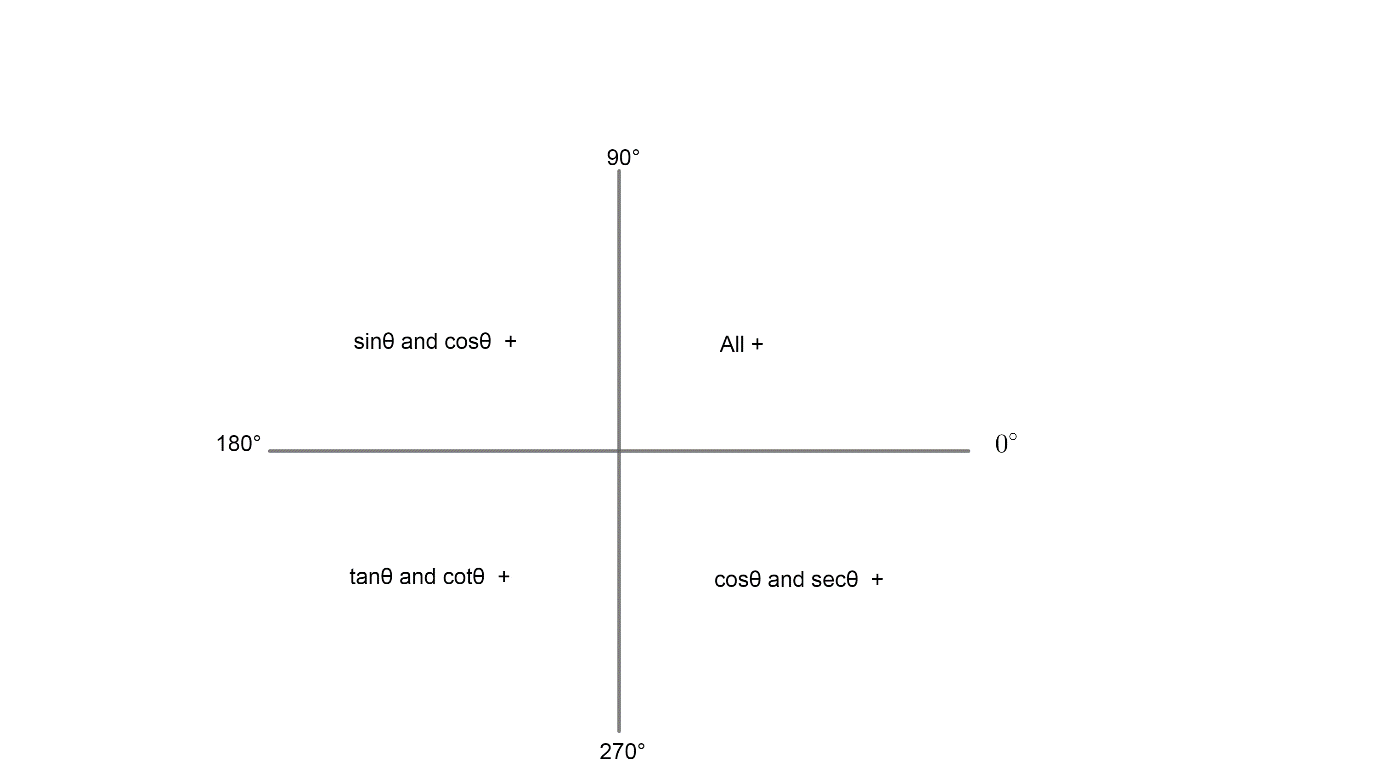
also it is important to remember the trigonometric formula like:
\[\begin{align}
& \cos \left( \pi +\theta \right)=-\cos \theta \\
& \sin \left( \dfrac{\pi }{2}+\theta \right)=\cos \left( \theta \right) \\
& \cos \left( \dfrac{\pi }{2}+\theta \right)=-\cos \theta \\
\end{align}\]
Hence, remembering these formulae will help to shorten the solution.
\[\begin{align}
& \cos \left( \pi +\theta \right)=-\cos \theta \\
& \cos \left( -\theta \right)=\cos \theta \\
& \sin \left( \pi -\theta \right)=\sin \theta \\
& \cos \left( \dfrac{\pi }{2}+\theta \right)=-\sin \theta \\
& \dfrac{\cos \theta }{\sin \theta }=\cot \theta \\
\end{align}\]
Complete step-by-step answer:
Now, we have to prove that,
$\dfrac{\cos \left( \pi +\theta \right)\cos \left( -\theta \right)}{\sin \left( \pi -\theta \right)\cos \left( \dfrac{\pi }{2}+\theta \right)}={{\cot }^{2}}\theta $
Now, we know that for trigonometric ratios of supplementary angles are determined as,
The figure shows the quadrant in which the trigonometric ratios are positive.
Now, it is important to note that the trigonometric ratio of an angle and its supplement is the same in magnitude but the sign depends on the quadrant in which it lies. For example: $\sin \left( 180-\theta \right)=\sin \left( \theta \right)$ as sin is positive in the second quadrant. Now, the same goes for complementary angles but in those the co-functions are the same and the sign depends on the quadrant in which the trigonometric function lies. For example: \[\sin \left( 90-\theta \right)=\cos \theta \].
Now, we take LHS,
$\dfrac{\cos \left( \pi +\theta \right)\cos \left( -\theta \right)}{\sin \left( \pi -\theta \right)\cos \left( \dfrac{\pi }{2}+\theta \right)}$
Now, we have,
\[\begin{align}
& \cos \left( \pi +\theta \right)=-\cos \theta \\
& \cos \left( -\theta \right)=\cos \theta \\
& \sin \left( \pi -\theta \right)=\sin \theta \\
& \cos \left( \dfrac{\pi }{2}+\theta \right)=-\sin \theta \\
\end{align}\]
So, the LHS become,
$\begin{align}
& \dfrac{-\cos \theta \times \cos \theta }{\sin \theta \times \left( -\sin \theta \right)} \\
& =\dfrac{{{\cos }^{2}}\theta }{{{\sin }^{2}}\theta } \\
\end{align}$
Now, we know that $\dfrac{\cos \theta }{\sin \theta }=\cot \theta $.
Therefore, we have,
$\dfrac{\cos \left( \pi +\theta \right)\cos \left( -\theta \right)}{\sin \left( \pi -\theta \right)\cos \left( \dfrac{\pi }{2}+\theta \right)}={{\cot }^{2}}\theta $
Now, since LHS = RHS
Hence proved.
Note: To solve these type of questions it is important to note that we have used the ASTC quadrant system in which all the trigonometric ratios are positive in the first quadrant whereas only sine, cosec is positive in the second quadrant and tan, cot is positive in the third quadrant and cos, sec is positive in the fourth quadrant like
also it is important to remember the trigonometric formula like:
\[\begin{align}
& \cos \left( \pi +\theta \right)=-\cos \theta \\
& \sin \left( \dfrac{\pi }{2}+\theta \right)=\cos \left( \theta \right) \\
& \cos \left( \dfrac{\pi }{2}+\theta \right)=-\cos \theta \\
\end{align}\]
Hence, remembering these formulae will help to shorten the solution.
Recently Updated Pages
The magnetic field in a plane electromagnetic wave class 11 physics CBSE

In a plane electromagnetic wave the electric field class 12 physics CBSE
A plane electromagnetic wave travels in vacuum along class 12 physics CBSE
Basicity of sulphurous acid and sulphuric acid are
Master Class 11 Business Studies: Engaging Questions & Answers for Success
Master Class 11 Computer Science: Engaging Questions & Answers for Success
Trending doubts
One Metric ton is equal to kg A 10000 B 1000 C 100 class 11 physics CBSE
What are the examples of C3 and C4 plants class 11 biology CBSE
State and prove Bernoullis theorem class 11 physics CBSE
Draw a diagram of a plant cell and label at least eight class 11 biology CBSE
10 examples of friction in our daily life
A body is said to be in dynamic equilibrium if A When class 11 physics CBSE