




Prove the converse of the mid-point theorem following the guidelines given below:
Consider a triangle ABC with D as the midpoint of AB. Draw DE|| BC to intersect AC in E. Let ${{\text{E}}_1}$ be the midpoint of AC. Use mid-point theorem to get ${{\text{DE}}_1}$|| BC and ${{\text{DE}}_1}=\dfrac{1}{2}$BC. Conclude $E={{\text{E}}_1}$ and hence E is the midpoint of AC.
Answer
 Verified
639.9k+ views
Hint: First we will make the diagram from the information given in the question. After that we will use the property of similar triangles that corresponding sides of two similar triangles are proportional to each other and then put the value of sides in the equation obtained to get the midpoint of side AC.
Complete step-by-step answer:
The diagram for the question is given below:
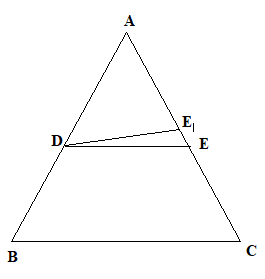
It is given that:
DE||BC
D is the midpoint of side AB.
And ${{\text{E}}_1}$is the mid- point of the side AC.
We have to prove that E=${{\text{E}}_1}$
In $\vartriangle $ABC and $\vartriangle $ADE, we have:
$\angle $ABC = $\angle $ADE ( By corresponding angle)
$\angle $ACB = $\angle $AED (By corresponding angle)
$\angle $BAC = $\angle $DAE (Common angle)
$\because $ All the angles of $\vartriangle $ABC is equal to corresponding angles of $\vartriangle $ADE.
So, by AAA rule of similarity, both the triangles are similar i.e.
$\vartriangle $ABC$ \sim $ $\vartriangle $ADE
We know that if two triangles are similar then their corresponding sides are proportional to each other.
Therefore, we can write:
$
\dfrac{{{\text{AB}}}}{{{\text{AD}}}} = \dfrac{{{\text{AC}}}}{{{\text{AE}}}} = \dfrac{{{\text{BC}}}}{{{\text{DE}}}} \\
\Rightarrow \dfrac{{{\text{AB}}}}{{{\text{AD}}}} = \dfrac{{{\text{AC}}}}{{{\text{AE}}}} \\
$ ----(1)
$ \Rightarrow \dfrac{{{\text{AB}}}}{{{\text{AD}}}} = \dfrac{{{\text{BC}}}}{{{\text{DE}}}}$ -------(2)
$\because $It is given that D is the midpoint of AB.
$\therefore $ AB = 2AD ----- (3)
Putting this value in equation 1, we get:
$\dfrac{{2{\text{AD}}}}{{{\text{AD}}}} = \dfrac{{{\text{AC}}}}{{{\text{AE}}}}$
$ \Rightarrow $ AC = 2AE
$\therefore $ E is the midpoint of AC
But it is given that ${{\text{E}}_1}$is the mid- point of AC.
Therefore, we can say that E=${{\text{E}}_1}$.
Now, using equation 2 and 3, we get:
$\dfrac{{2{\text{AD}}}}{{{\text{AD}}}} = \dfrac{{{\text{BC}}}}{{{\text{DE}}}}$
$ \Rightarrow $ BC = 2DE.
$ \Rightarrow $DE=$\dfrac{1}{2}$BC.
Therefore, it is proved that DE=$\dfrac{1}{2}$BC.
Note: First important thing is that in the question involving geometry specially proof, you must draw a diagram. It will give you a clear path to proceed. In this question, the important step is the use of the concept of similar triangles. You should know that if DE=$\dfrac{1}{2}$BC then DE|| BC. This is called the mid-point theorem.
Complete step-by-step answer:
The diagram for the question is given below:
It is given that:
DE||BC
D is the midpoint of side AB.
And ${{\text{E}}_1}$is the mid- point of the side AC.
We have to prove that E=${{\text{E}}_1}$
In $\vartriangle $ABC and $\vartriangle $ADE, we have:
$\angle $ABC = $\angle $ADE ( By corresponding angle)
$\angle $ACB = $\angle $AED (By corresponding angle)
$\angle $BAC = $\angle $DAE (Common angle)
$\because $ All the angles of $\vartriangle $ABC is equal to corresponding angles of $\vartriangle $ADE.
So, by AAA rule of similarity, both the triangles are similar i.e.
$\vartriangle $ABC$ \sim $ $\vartriangle $ADE
We know that if two triangles are similar then their corresponding sides are proportional to each other.
Therefore, we can write:
$
\dfrac{{{\text{AB}}}}{{{\text{AD}}}} = \dfrac{{{\text{AC}}}}{{{\text{AE}}}} = \dfrac{{{\text{BC}}}}{{{\text{DE}}}} \\
\Rightarrow \dfrac{{{\text{AB}}}}{{{\text{AD}}}} = \dfrac{{{\text{AC}}}}{{{\text{AE}}}} \\
$ ----(1)
$ \Rightarrow \dfrac{{{\text{AB}}}}{{{\text{AD}}}} = \dfrac{{{\text{BC}}}}{{{\text{DE}}}}$ -------(2)
$\because $It is given that D is the midpoint of AB.
$\therefore $ AB = 2AD ----- (3)
Putting this value in equation 1, we get:
$\dfrac{{2{\text{AD}}}}{{{\text{AD}}}} = \dfrac{{{\text{AC}}}}{{{\text{AE}}}}$
$ \Rightarrow $ AC = 2AE
$\therefore $ E is the midpoint of AC
But it is given that ${{\text{E}}_1}$is the mid- point of AC.
Therefore, we can say that E=${{\text{E}}_1}$.
Now, using equation 2 and 3, we get:
$\dfrac{{2{\text{AD}}}}{{{\text{AD}}}} = \dfrac{{{\text{BC}}}}{{{\text{DE}}}}$
$ \Rightarrow $ BC = 2DE.
$ \Rightarrow $DE=$\dfrac{1}{2}$BC.
Therefore, it is proved that DE=$\dfrac{1}{2}$BC.
Note: First important thing is that in the question involving geometry specially proof, you must draw a diagram. It will give you a clear path to proceed. In this question, the important step is the use of the concept of similar triangles. You should know that if DE=$\dfrac{1}{2}$BC then DE|| BC. This is called the mid-point theorem.
Recently Updated Pages
Master Class 11 English: Engaging Questions & Answers for Success

Master Class 11 Maths: Engaging Questions & Answers for Success
Class 11 Question and Answer - Your Ultimate Solutions Guide
Master Class 11 Biology: Engaging Questions & Answers for Success
Master Class 11 Physics: Engaging Questions & Answers for Success
Master Class 11 Accountancy: Engaging Questions & Answers for Success
Trending doubts
Explain the Treaty of Vienna of 1815 class 10 social science CBSE
Who Won 36 Oscar Awards? Record Holder Revealed
What is the median of the first 10 natural numbers class 10 maths CBSE
Why is it 530 pm in india when it is 1200 afternoon class 10 social science CBSE
Select the word that is correctly spelled a Twelveth class 10 english CBSE
Why is there a time difference of about 5 hours between class 10 social science CBSE