




Prove that two triangles having the same base (or equal bases) have equal areas between the same parallels.
Answer
 Verified
631.8k+ views
Hint: Assume two triangles between two parallel lines having the same base. We know the formula of the area of the triangle, \[Area=\dfrac{1}{2}\times Base\times Height\] . We also know the property that the distance between parallel lines is always constant. So, each perpendicular distance between the parallel lines is always equal to each other. Now, solve it further.
Complete step-by-step answer:
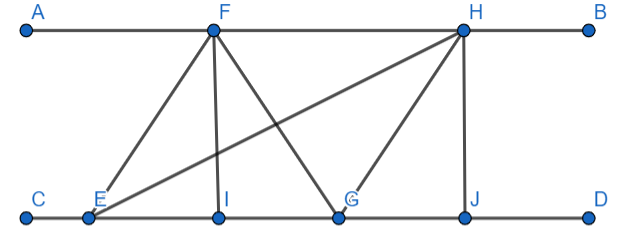
Assume two line segments AB and CD parallel to each other and two triangles which are \[\Delta FEG\] and \[\Delta HEG\] having the same base EG.
Let the distance between the parallel lines AB and CD be x.
In \[\Delta FEG\] , we have,
EG as the base of the \[\Delta FEG\] ,
FI is the height which is also perpendicular to the base EG.
We know the formula of the area of the triangle,
\[Area=\dfrac{1}{2}\times Base\times Height\]
Now, using this formula to get the area of the \[\Delta FEG\] .
Area of \[\Delta FEG\] = \[\dfrac{1}{2}\times EG\times FI\] ………………………..(1)
In \[\Delta HEG\] , we have,
EG as the base of the \[\Delta HEG\] ,
HJ is the height which is also perpendicular to the base EG.
We know the formula of the area of the triangle,
\[Area=\dfrac{1}{2}\times Base\times Height\]
Now, using this formula to get the area of the \[\Delta HEG\] .
Area of \[\Delta HEG\] = \[\dfrac{1}{2}\times EG\times HJ\] ………………..(2)
We know the property that the distance between parallel lines is always constant. So, each perpendicular distance between the parallel lines is always equal to each other.
Using this property, we can say that,
FI=HJ ………..(3)
From equation (2), and equation (3), we get
Area of \[\Delta HEG\] = \[\dfrac{1}{2}\times EG\times FI\] ………………..(4)
From equation (1), we have
Area of \[\Delta FEG\] = \[\dfrac{1}{2}\times EG\times FI\] .
Now, we can say that equation (1) and equation (4) are equal to each other.
So, Area of \[\Delta HEG\]= Area of \[\Delta FEG\] .
Therefore, two triangles having the same base (or equal bases) have equal areas between the same parallels.
Hence, proved.
Note: In this question, one may think to use heron’s formula for the area of the triangle. That is, \[Area=\sqrt{s\left( s-a \right)\left( s-b \right)\left( s-c \right)}\] . But if we use this formula, then we will not be able to use the property of parallel lines, and also this formula will make our solution complex to solve. Therefore, don’t think to use heron’s formula here.
Complete step-by-step answer:
Assume two line segments AB and CD parallel to each other and two triangles which are \[\Delta FEG\] and \[\Delta HEG\] having the same base EG.
Let the distance between the parallel lines AB and CD be x.
In \[\Delta FEG\] , we have,
EG as the base of the \[\Delta FEG\] ,
FI is the height which is also perpendicular to the base EG.
We know the formula of the area of the triangle,
\[Area=\dfrac{1}{2}\times Base\times Height\]
Now, using this formula to get the area of the \[\Delta FEG\] .
Area of \[\Delta FEG\] = \[\dfrac{1}{2}\times EG\times FI\] ………………………..(1)
In \[\Delta HEG\] , we have,
EG as the base of the \[\Delta HEG\] ,
HJ is the height which is also perpendicular to the base EG.
We know the formula of the area of the triangle,
\[Area=\dfrac{1}{2}\times Base\times Height\]
Now, using this formula to get the area of the \[\Delta HEG\] .
Area of \[\Delta HEG\] = \[\dfrac{1}{2}\times EG\times HJ\] ………………..(2)
We know the property that the distance between parallel lines is always constant. So, each perpendicular distance between the parallel lines is always equal to each other.
Using this property, we can say that,
FI=HJ ………..(3)
From equation (2), and equation (3), we get
Area of \[\Delta HEG\] = \[\dfrac{1}{2}\times EG\times FI\] ………………..(4)
From equation (1), we have
Area of \[\Delta FEG\] = \[\dfrac{1}{2}\times EG\times FI\] .
Now, we can say that equation (1) and equation (4) are equal to each other.
So, Area of \[\Delta HEG\]= Area of \[\Delta FEG\] .
Therefore, two triangles having the same base (or equal bases) have equal areas between the same parallels.
Hence, proved.
Note: In this question, one may think to use heron’s formula for the area of the triangle. That is, \[Area=\sqrt{s\left( s-a \right)\left( s-b \right)\left( s-c \right)}\] . But if we use this formula, then we will not be able to use the property of parallel lines, and also this formula will make our solution complex to solve. Therefore, don’t think to use heron’s formula here.
Recently Updated Pages
Master Class 12 Business Studies: Engaging Questions & Answers for Success

Master Class 12 Biology: Engaging Questions & Answers for Success
Master Class 12 Chemistry: Engaging Questions & Answers for Success
Class 12 Question and Answer - Your Ultimate Solutions Guide
Master Class 11 Social Science: Engaging Questions & Answers for Success
Master Class 11 English: Engaging Questions & Answers for Success
Trending doubts
What is the full form of NDA a National Democratic class 10 social science CBSE
Explain the Treaty of Vienna of 1815 class 10 social science CBSE
Who Won 36 Oscar Awards? Record Holder Revealed
Bharatiya Janata Party was founded in the year A 1979 class 10 social science CBSE
What is the median of the first 10 natural numbers class 10 maths CBSE
Why is it 530 pm in india when it is 1200 afternoon class 10 social science CBSE