




Prove that the two parabolas, having the same focus and their axes at opposite directions, cut at right angles.
Answer
 Verified
627.3k+ views
Hint: The two parabolas of same focus \[\left( a,0 \right)\] having opposite axes are shown in the below figure.
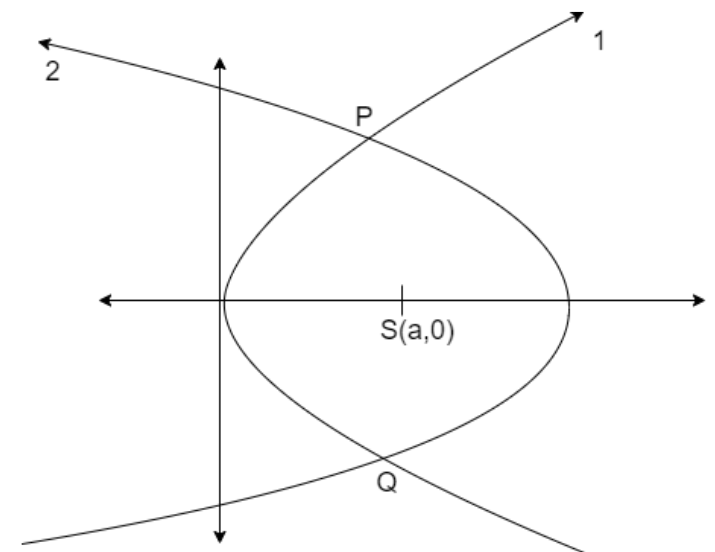
We assume that the equation of the first parabola as \[{{y}^{2}}=4ax\] then the equation of parabola having same focus but the opposite axis is given as \[{{y}^{2}}=-4a\left( x-2a \right)\] then we find the slopes of tangents of both curves at the intersection point so as to prove the product of tangents at intersection point equal to -1 which proves that the curves cut at right angles.
Complete step-by-step solution:
Let us assume that the equation of the first parabola as
\[\Rightarrow {{y}^{2}}=4ax....equation(i)\]
Then we know that the equation of parabola having the same focus but opposite direction of the axis is given as
\[\Rightarrow {{y}^{2}}=-4a\left( x-2a \right)........equation(ii)\]
Now, let us assume that the point of intersection of both the curves as P
Let us find the point P by solving both the equations of parabolas.
By combining both the equations of parabolas we get
\[\begin{align}
& \Rightarrow 4ax=-4a\left( x-2a \right) \\
& \Rightarrow 2ax=2a \\
& \Rightarrow x=a \\
\end{align}\]
By substituting the value of \['x'\] in equation (i) we get
\[\begin{align}
& \Rightarrow {{y}^{2}}=4a\left( a \right) \\
& \Rightarrow y=\pm 2a \\
\end{align}\]
Here, we can see that for each value of \['y'\] we get two points of intersection.
Let us assume that one point as \[P\left( a,2a \right)\]
Now let us find the slopes of tangents of two curves at point \[P\left( a,2a \right)\]
Let us assume that the slope of tangent of equation (i) at \[P\left( a,2a \right)\] as \[{{m}_{1}}\] given as \[\dfrac{dy}{dx}\]
By taking the equation (i) and differentiating with respect to \['x'\] we get
\[\Rightarrow \dfrac{d}{dx}\left( {{y}^{2}} \right)=\dfrac{d}{dx}\left( 4ax \right)\]
\[\begin{align}
& \Rightarrow 2y\dfrac{dy}{dx}=4a \\
& \Rightarrow {{m}_{1}}=\dfrac{2a}{y} \\
\end{align}\]
Now, by substituting the point \[P\left( a,2a \right)\] in above equation we get
\[\begin{align}
& \Rightarrow {{m}_{1}}=\dfrac{2a}{2a} \\
& \Rightarrow {{m}_{1}}=1 \\
\end{align}\]
Let us assume that the slope of tangent of equation (ii) at \[P\left( a,2a \right)\] as \[{{m}_{2}}\]given as \[\dfrac{dy}{dx}\]
By taking the equation (ii) and differentiating with respect to \['x'\] we get
\[\Rightarrow \dfrac{d}{dx}\left( {{y}^{2}} \right)=\dfrac{d}{dx}\left( -4ax+8{{a}^{2}} \right)\]
\[\begin{align}
& \Rightarrow 2y\dfrac{dy}{dx}=-4a \\
& \Rightarrow {{m}_{2}}=-\dfrac{2a}{y} \\
\end{align}\]
Now, by substituting the point \[P\left( a,2a \right)\] in above equation we get
\[\begin{align}
& \Rightarrow {{m}_{2}}=-\dfrac{2a}{2a} \\
& \Rightarrow {{m}_{2}}=-1 \\
\end{align}\]
Now, let us find the product of slopes of tangents of both curves we get
\[\Rightarrow {{m}_{1}}\times {{m}_{2}}=-1\]
Here, we can see that the product of slopes of tangents at the point of intersection is -1
Therefore we can conclude that the curves cut at right angles.
Hence the required result has been proved.
Note: We can solve the above result using the other point also that is \[Q\left( a,-2a \right)\]
Now let us find the slopes of tangents of two curves at point \[Q\left( a,-2a \right)\]
Let us assume that the slope of tangent of equation (i) at \[Q\left( a,-2a \right)\] as \[{{m}_{1}}\] given as \[\dfrac{dy}{dx}\]
By taking the equation (i) and differentiating with respect to \['x'\] we get
\[\Rightarrow \dfrac{d}{dx}\left( {{y}^{2}} \right)=\dfrac{d}{dx}\left( 4ax \right)\]
\[\begin{align}
& \Rightarrow 2y\dfrac{dy}{dx}=4a \\
& \Rightarrow {{m}_{1}}=\dfrac{2a}{y} \\
\end{align}\]
Now, by substituting the point \[Q\left( a,-2a \right)\] in above equation we get
\[\begin{align}
& \Rightarrow {{m}_{1}}=\dfrac{2a}{\left( -2a \right)} \\
& \Rightarrow {{m}_{1}}=-1 \\
\end{align}\]
Let us assume that the slope of tangent of equation (ii) at \[Q\left( a,-2a \right)\] as \[{{m}_{2}}\] given as \[\dfrac{dy}{dx}\]
By taking the equation (ii) and differentiating with respect to \['x'\] we get
\[\Rightarrow \dfrac{d}{dx}\left( {{y}^{2}} \right)=\dfrac{d}{dx}\left( -4ax+8{{a}^{2}} \right)\]
\[\begin{align}
& \Rightarrow 2y\dfrac{dy}{dx}=-4a \\
& \Rightarrow {{m}_{2}}=-\dfrac{2a}{y} \\
\end{align}\]
Now, by substituting the point \[Q\left( a,-2a \right)\] in above equation we get
\[\begin{align}
& \Rightarrow {{m}_{2}}=-\dfrac{2a}{\left( -2a \right)} \\
& \Rightarrow {{m}_{2}}=1 \\
\end{align}\]
Now, let us find the product of slopes of tangents of both curves we get
\[\Rightarrow {{m}_{1}}\times {{m}_{2}}=-1\]
Here, we can see that the product of slopes of tangents at the point of intersection is -1
Therefore we can conclude that the curves cut at right angles.
Hence the required result has been proved.
We assume that the equation of the first parabola as \[{{y}^{2}}=4ax\] then the equation of parabola having same focus but the opposite axis is given as \[{{y}^{2}}=-4a\left( x-2a \right)\] then we find the slopes of tangents of both curves at the intersection point so as to prove the product of tangents at intersection point equal to -1 which proves that the curves cut at right angles.
Complete step-by-step solution:
Let us assume that the equation of the first parabola as
\[\Rightarrow {{y}^{2}}=4ax....equation(i)\]
Then we know that the equation of parabola having the same focus but opposite direction of the axis is given as
\[\Rightarrow {{y}^{2}}=-4a\left( x-2a \right)........equation(ii)\]
Now, let us assume that the point of intersection of both the curves as P
Let us find the point P by solving both the equations of parabolas.
By combining both the equations of parabolas we get
\[\begin{align}
& \Rightarrow 4ax=-4a\left( x-2a \right) \\
& \Rightarrow 2ax=2a \\
& \Rightarrow x=a \\
\end{align}\]
By substituting the value of \['x'\] in equation (i) we get
\[\begin{align}
& \Rightarrow {{y}^{2}}=4a\left( a \right) \\
& \Rightarrow y=\pm 2a \\
\end{align}\]
Here, we can see that for each value of \['y'\] we get two points of intersection.
Let us assume that one point as \[P\left( a,2a \right)\]
Now let us find the slopes of tangents of two curves at point \[P\left( a,2a \right)\]
Let us assume that the slope of tangent of equation (i) at \[P\left( a,2a \right)\] as \[{{m}_{1}}\] given as \[\dfrac{dy}{dx}\]
By taking the equation (i) and differentiating with respect to \['x'\] we get
\[\Rightarrow \dfrac{d}{dx}\left( {{y}^{2}} \right)=\dfrac{d}{dx}\left( 4ax \right)\]
\[\begin{align}
& \Rightarrow 2y\dfrac{dy}{dx}=4a \\
& \Rightarrow {{m}_{1}}=\dfrac{2a}{y} \\
\end{align}\]
Now, by substituting the point \[P\left( a,2a \right)\] in above equation we get
\[\begin{align}
& \Rightarrow {{m}_{1}}=\dfrac{2a}{2a} \\
& \Rightarrow {{m}_{1}}=1 \\
\end{align}\]
Let us assume that the slope of tangent of equation (ii) at \[P\left( a,2a \right)\] as \[{{m}_{2}}\]given as \[\dfrac{dy}{dx}\]
By taking the equation (ii) and differentiating with respect to \['x'\] we get
\[\Rightarrow \dfrac{d}{dx}\left( {{y}^{2}} \right)=\dfrac{d}{dx}\left( -4ax+8{{a}^{2}} \right)\]
\[\begin{align}
& \Rightarrow 2y\dfrac{dy}{dx}=-4a \\
& \Rightarrow {{m}_{2}}=-\dfrac{2a}{y} \\
\end{align}\]
Now, by substituting the point \[P\left( a,2a \right)\] in above equation we get
\[\begin{align}
& \Rightarrow {{m}_{2}}=-\dfrac{2a}{2a} \\
& \Rightarrow {{m}_{2}}=-1 \\
\end{align}\]
Now, let us find the product of slopes of tangents of both curves we get
\[\Rightarrow {{m}_{1}}\times {{m}_{2}}=-1\]
Here, we can see that the product of slopes of tangents at the point of intersection is -1
Therefore we can conclude that the curves cut at right angles.
Hence the required result has been proved.
Note: We can solve the above result using the other point also that is \[Q\left( a,-2a \right)\]
Now let us find the slopes of tangents of two curves at point \[Q\left( a,-2a \right)\]
Let us assume that the slope of tangent of equation (i) at \[Q\left( a,-2a \right)\] as \[{{m}_{1}}\] given as \[\dfrac{dy}{dx}\]
By taking the equation (i) and differentiating with respect to \['x'\] we get
\[\Rightarrow \dfrac{d}{dx}\left( {{y}^{2}} \right)=\dfrac{d}{dx}\left( 4ax \right)\]
\[\begin{align}
& \Rightarrow 2y\dfrac{dy}{dx}=4a \\
& \Rightarrow {{m}_{1}}=\dfrac{2a}{y} \\
\end{align}\]
Now, by substituting the point \[Q\left( a,-2a \right)\] in above equation we get
\[\begin{align}
& \Rightarrow {{m}_{1}}=\dfrac{2a}{\left( -2a \right)} \\
& \Rightarrow {{m}_{1}}=-1 \\
\end{align}\]
Let us assume that the slope of tangent of equation (ii) at \[Q\left( a,-2a \right)\] as \[{{m}_{2}}\] given as \[\dfrac{dy}{dx}\]
By taking the equation (ii) and differentiating with respect to \['x'\] we get
\[\Rightarrow \dfrac{d}{dx}\left( {{y}^{2}} \right)=\dfrac{d}{dx}\left( -4ax+8{{a}^{2}} \right)\]
\[\begin{align}
& \Rightarrow 2y\dfrac{dy}{dx}=-4a \\
& \Rightarrow {{m}_{2}}=-\dfrac{2a}{y} \\
\end{align}\]
Now, by substituting the point \[Q\left( a,-2a \right)\] in above equation we get
\[\begin{align}
& \Rightarrow {{m}_{2}}=-\dfrac{2a}{\left( -2a \right)} \\
& \Rightarrow {{m}_{2}}=1 \\
\end{align}\]
Now, let us find the product of slopes of tangents of both curves we get
\[\Rightarrow {{m}_{1}}\times {{m}_{2}}=-1\]
Here, we can see that the product of slopes of tangents at the point of intersection is -1
Therefore we can conclude that the curves cut at right angles.
Hence the required result has been proved.
Recently Updated Pages
Master Class 11 English: Engaging Questions & Answers for Success

Master Class 11 Physics: Engaging Questions & Answers for Success
Master Class 11 Computer Science: Engaging Questions & Answers for Success
Master Class 11 Chemistry: Engaging Questions & Answers for Success
Master Class 11 Social Science: Engaging Questions & Answers for Success
Master Class 11 Accountancy: Engaging Questions & Answers for Success
Trending doubts
Difference Between Prokaryotic Cells and Eukaryotic Cells
Two of the body parts which do not appear in MRI are class 11 biology CBSE
One Metric ton is equal to kg A 10000 B 1000 C 100 class 11 physics CBSE
10 examples of friction in our daily life
Draw a diagram of nephron and explain its structur class 11 biology CBSE
Draw a diagram of a plant cell and label at least eight class 11 biology CBSE