




Prove that the tangents drawn at the ends of a diameter of a circle are parallel.
Answer
 Verified
638.4k+ views
Hint: Let $AB$ be the diameter of the circle with centre $O$, so $OA = OB$ which is the radius of the circle, and $PQ$ is the tangent to the circle at point $A$ and $RS$ is the tangent to the circle at point $B$ respectively.
We have to prove that \[PQ\parallel RS\]
Complete step-by-step answer:
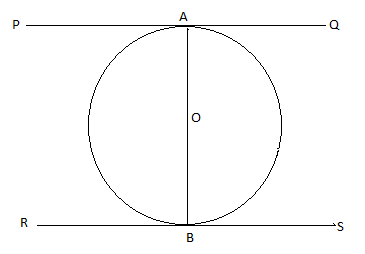
As $PQ$ is tangent to the centre with centre $O$ at point $A$ and $OA$ is the radius of the circle.
$OA \bot PQ$
Since tangent drawn at any point of a circle is always perpendicular to the circle from that point of contact.
Therefore, $\angle OAP = {90^ \circ }....\left( i \right)$
Since $OA \bot PQ$
In a similar way,
$RS$ is the tangent to the circle with centre $O$ at point $B$ and $B$ is the radius of the circle,
$OB \bot RS$
Since tangents drawn at any point of a circle is always perpendicular to the circle from that point of contact
So, $\angle OBS = {90^ \circ }....\left( {ii} \right)$
Since $OB \bot RS$
From (i) and (ii) we get-
$\angle OAP = 90_{}^0$ and $\angle OBS = 90_{}^0$
Therefore, $\angle OAP = \angle OBS$
Since, both the angles equals to$90_{}^0$
$\angle BAP = \angle ABS$
Since, both the angles are ${90^ \circ }$
For the tangents $PQ$ and $RS$ transversal $AB$,
$\angle BAP = \angle ABS$
That is, both the alternate angles are equal.
As the alternate angles are equal, therefore the tangents $PQ$ and $RS$ are parallel
i.e., \[PQ\parallel RS\]
Note:
Tangents usually touch the circle but do not cross the circle.
It always touches one point in a circle
If we draw two tangents from an external point of the circle, then both the tangents will be of equal length.
Point of tangency can be defined as the point where the tangent meets the circle.
We have to prove that \[PQ\parallel RS\]
Complete step-by-step answer:
As $PQ$ is tangent to the centre with centre $O$ at point $A$ and $OA$ is the radius of the circle.
$OA \bot PQ$
Since tangent drawn at any point of a circle is always perpendicular to the circle from that point of contact.
Therefore, $\angle OAP = {90^ \circ }....\left( i \right)$
Since $OA \bot PQ$
In a similar way,
$RS$ is the tangent to the circle with centre $O$ at point $B$ and $B$ is the radius of the circle,
$OB \bot RS$
Since tangents drawn at any point of a circle is always perpendicular to the circle from that point of contact
So, $\angle OBS = {90^ \circ }....\left( {ii} \right)$
Since $OB \bot RS$
From (i) and (ii) we get-
$\angle OAP = 90_{}^0$ and $\angle OBS = 90_{}^0$
Therefore, $\angle OAP = \angle OBS$
Since, both the angles equals to$90_{}^0$
$\angle BAP = \angle ABS$
Since, both the angles are ${90^ \circ }$
For the tangents $PQ$ and $RS$ transversal $AB$,
$\angle BAP = \angle ABS$
That is, both the alternate angles are equal.
As the alternate angles are equal, therefore the tangents $PQ$ and $RS$ are parallel
i.e., \[PQ\parallel RS\]
Note:
Tangents usually touch the circle but do not cross the circle.
It always touches one point in a circle
If we draw two tangents from an external point of the circle, then both the tangents will be of equal length.
Point of tangency can be defined as the point where the tangent meets the circle.
Recently Updated Pages
Basicity of sulphurous acid and sulphuric acid are

Master Class 10 Computer Science: Engaging Questions & Answers for Success
Master Class 10 Social Science: Engaging Questions & Answers for Success
Master Class 10 Science: Engaging Questions & Answers for Success
Class 10 Question and Answer - Your Ultimate Solutions Guide
Master Class 10 Maths: Engaging Questions & Answers for Success
Trending doubts
What is the Total Duration of Football Match?
Explain the Treaty of Vienna of 1815 class 10 social science CBSE
In football, which nation is called "La Roja"?
Why is there a time difference of about 5 hours between class 10 social science CBSE
10 examples of evaporation in daily life with explanations
What is the full form of POSCO class 10 social science CBSE