




Prove that the tangents drawn at the ends of a diameter of a circle are parallel.
Answer
 Verified
630.3k+ views
Hint: Here, we will use the property of the circle that the radius of a circle is perpendicular to the tangent to the circle. We will also use the concept of alternate angles.
Complete step-by-step solution -
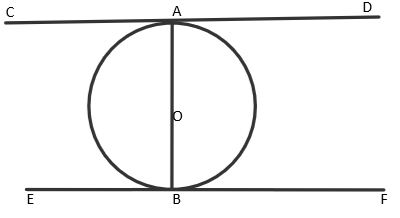
Consider a circle with center O and CD and EF as tangents.
We know that the tangents are the lines which touch the circle at exactly one point. The tangent CD touches the circle at A and the tangent EF touches the circle at B. Since, the radius of a circle is always perpendicular to the tangent to the circle, we can write that OA is perpendicular to CD and OB is perpendicular to EF.
Therefore, $\angle OAD={{90}^{0}}$
This implies that $\angle BAD={{90}^{0}}$
Similarly, $\angle OBE={{90}^{0}}$ and this implies that $\angle ABE={{90}^{0}}$.
We know that a transversal is a line that passes through the two lines in the same plane at two distinct points. Transversals play a role in establishing whether two lines in a plane are parallel or not. Here, the diameter of the circle, that is, AB cuts the lines CD and EF at two distinct points A and B.
Alternate angles are the angles that are in opposite positions relative to a transversal intersecting two lines. When the alternate angles are equal to each other, then the lines that are cut by the transversal are parallel to each other.
In this problem, we obtained the values of angles BAD and ABE as ${{90}^{0}}$. Since these angles are alternate angles and are equal to each other, so the lines CD and EF are parallel to each other.
As CD and EF are the tangents at the ends of the diameter AB of the circle and we proved that they are parallel.
Hence, it is proved that the tangents drawn at the ends of a diameter of a circle are parallel to each other.
Note: Students should note here that the radius of a circle is always perpendicular to the tangent to the circle at any point. They should remember that if alternate angles are equal to each other, then the lines that are cut by the transversal are parallel to each other. It should be observed that $\angle AOD={{90}^{0}}$ implies that $\angle BAD$ is also equal to ${{90}^{0}}$ because O, A, and B lie on the same line that is AB.
Complete step-by-step solution -
Consider a circle with center O and CD and EF as tangents.
We know that the tangents are the lines which touch the circle at exactly one point. The tangent CD touches the circle at A and the tangent EF touches the circle at B. Since, the radius of a circle is always perpendicular to the tangent to the circle, we can write that OA is perpendicular to CD and OB is perpendicular to EF.
Therefore, $\angle OAD={{90}^{0}}$
This implies that $\angle BAD={{90}^{0}}$
Similarly, $\angle OBE={{90}^{0}}$ and this implies that $\angle ABE={{90}^{0}}$.
We know that a transversal is a line that passes through the two lines in the same plane at two distinct points. Transversals play a role in establishing whether two lines in a plane are parallel or not. Here, the diameter of the circle, that is, AB cuts the lines CD and EF at two distinct points A and B.
Alternate angles are the angles that are in opposite positions relative to a transversal intersecting two lines. When the alternate angles are equal to each other, then the lines that are cut by the transversal are parallel to each other.
In this problem, we obtained the values of angles BAD and ABE as ${{90}^{0}}$. Since these angles are alternate angles and are equal to each other, so the lines CD and EF are parallel to each other.
As CD and EF are the tangents at the ends of the diameter AB of the circle and we proved that they are parallel.
Hence, it is proved that the tangents drawn at the ends of a diameter of a circle are parallel to each other.
Note: Students should note here that the radius of a circle is always perpendicular to the tangent to the circle at any point. They should remember that if alternate angles are equal to each other, then the lines that are cut by the transversal are parallel to each other. It should be observed that $\angle AOD={{90}^{0}}$ implies that $\angle BAD$ is also equal to ${{90}^{0}}$ because O, A, and B lie on the same line that is AB.
Recently Updated Pages
Master Class 11 English: Engaging Questions & Answers for Success

Master Class 11 Maths: Engaging Questions & Answers for Success
Class 11 Question and Answer - Your Ultimate Solutions Guide
Master Class 11 Biology: Engaging Questions & Answers for Success
Master Class 11 Physics: Engaging Questions & Answers for Success
Master Class 11 Accountancy: Engaging Questions & Answers for Success
Trending doubts
Explain the Treaty of Vienna of 1815 class 10 social science CBSE
Who Won 36 Oscar Awards? Record Holder Revealed
What is the median of the first 10 natural numbers class 10 maths CBSE
Why is it 530 pm in india when it is 1200 afternoon class 10 social science CBSE
Why is there a time difference of about 5 hours between class 10 social science CBSE
What is the full form of POSCO class 10 social science CBSE