




Prove that the tangent at any point of the circle is perpendicular to the radius through the point of contact.
Answer
 Verified
629.4k+ views
Hint:
A tangent AB is drawn to the circle touching it at P and now we can choose any other point Q on the the tangent and we can see that $OQ = OR + RQ$as OQ intersects the circle at R. and then we know that OR = OP as they are the radii of the circle and hence we get $OQ > OP$, from which we can say that OP is the shortest distance and by using the property shortest distance of a point from a given line is the perpendicular distance from that line , we get the proof.
Complete step by step solution:
We are given a circle with centre O and radius r
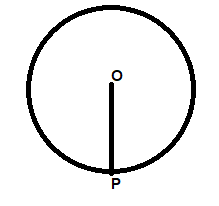
Let AB be the tangent to the circle touching the circle at point P
So the radius of the circle through this point is OP
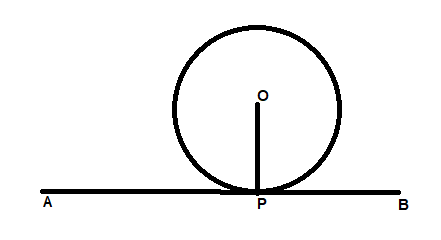
So now we need to prove $OP \bot AB$
So now let's choose a point Q other than P on the tangent AB
Join the point Q with the centre O making a line segment OQ intersecting the circle at R
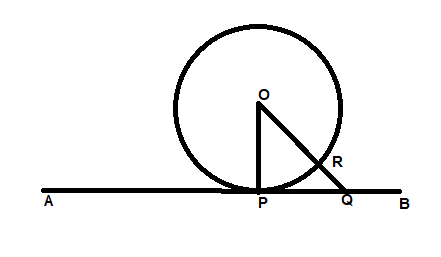
From the diagram we can see that
$ \Rightarrow OP = OR$ ……….(1)
as they are the radii of the circle
Now
$ \Rightarrow OQ = OR + RQ$
Using (1) we get
$ \Rightarrow OQ = OP + RQ$
From this we get to know that
$ \Rightarrow OQ > OP$
From this we can conclude that any line drawn from the centre to a point on the tangent is greater than OP
We know that , shortest distance of a point from a given line is the perpendicular distance from that line .
Here OP is the shortest distance
So we conclude that $OP \bot AB$
Hence proved.
Note:
1) The tangent always touches the circle at a single point.
2) It never intersects the circle at two points.
3) The length of tangents from an external point to a circle are equal.
A tangent AB is drawn to the circle touching it at P and now we can choose any other point Q on the the tangent and we can see that $OQ = OR + RQ$as OQ intersects the circle at R. and then we know that OR = OP as they are the radii of the circle and hence we get $OQ > OP$, from which we can say that OP is the shortest distance and by using the property shortest distance of a point from a given line is the perpendicular distance from that line , we get the proof.
Complete step by step solution:
We are given a circle with centre O and radius r
Let AB be the tangent to the circle touching the circle at point P
So the radius of the circle through this point is OP
So now we need to prove $OP \bot AB$
So now let's choose a point Q other than P on the tangent AB
Join the point Q with the centre O making a line segment OQ intersecting the circle at R
From the diagram we can see that
$ \Rightarrow OP = OR$ ……….(1)
as they are the radii of the circle
Now
$ \Rightarrow OQ = OR + RQ$
Using (1) we get
$ \Rightarrow OQ = OP + RQ$
From this we get to know that
$ \Rightarrow OQ > OP$
From this we can conclude that any line drawn from the centre to a point on the tangent is greater than OP
We know that , shortest distance of a point from a given line is the perpendicular distance from that line .
Here OP is the shortest distance
So we conclude that $OP \bot AB$
Hence proved.
Note:
1) The tangent always touches the circle at a single point.
2) It never intersects the circle at two points.
3) The length of tangents from an external point to a circle are equal.
Recently Updated Pages
Differentiate between voluntary action and reflex class 10 biology CBSE

The uses of bleaching powder are A It is used bleaching class 10 chemistry CBSE
Fill in the blanks with abstract nouns of the words class 10 english CBSE
How many threedigit numbers are there class 10 maths CBSE
What is a reflex arc class 10 biology CBSE
Construct a square whose diagonal is 6cm Measure the class 10 maths CBSE
Trending doubts
Explain the Treaty of Vienna of 1815 class 10 social science CBSE
The slogan Jai Hind was given by A Lal Bahadur Shastri class 10 social science CBSE
10 examples of evaporation in daily life with explanations
What is the full form of POSCO class 10 social science CBSE
Identify the feminine form of noun nephew a shenephew class 10 english CBSE
CSIR full form?