




Prove that the sum of the squares of the diagonals of parallelogram is equal to the
sum of the squares of its sides.
Answer
 Verified
611.1k+ views
Hint:- Divide the parallelogram into two triangles made by one of its diagonals and apply property of triangle.
Complete step-by-step solution -
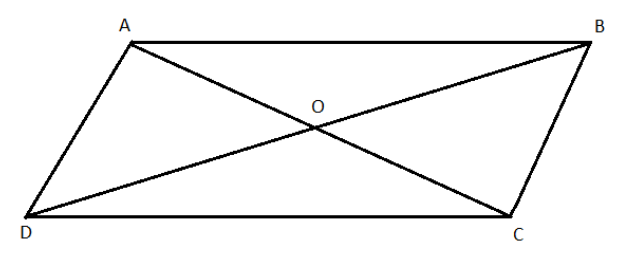
Let ABCD be a parallelogram with diagonals of AC and BD.
As, we know that diagonals of a parallelogram bisect each other, therefore
BO and DO are the medians of triangle ABC and triangle ADC respectively,
And we know that for any triangle sum of square of two sides of a triangle is equal to
the sum of \[\dfrac{1}{2}\] times the square of the third side and two times the square of its median.
\[ \Rightarrow \]So, \[{\left( {AB} \right)^2} + {\left( {BC} \right)^2} = 2{\left( {BO} \right)^2} + \dfrac{1}{2}{\left( {AC} \right)^2}\]..........................(1)
\[ \Rightarrow \]And, \[{\left( {AD} \right)^2} + {\left( {CD} \right)^2} = 2{\left( {DO} \right)^2} + \dfrac{1}{2}{\left( {AC} \right)^2}{\text{ }}\].................................... (2)
Now, adding equation 1 and 2. We get,
\[ \Rightarrow \] \[{\left( {AB} \right)^2} + {\left( {BC} \right)^2} + {\left( {CD} \right)^2} + {\left( {AD} \right)^2} = 2{\left( {BO} \right)^2} + 2{\left( {DO} \right)^2} + {\left( {AC} \right)^2}\]
Solving above equation. We get,
\[ \Rightarrow \] \[{\left( {AB} \right)^2} + {\left( {BC} \right)^2} + {\left( {CD} \right)^2} + {\left( {AD} \right)^2} = 2\left( {B{O^2} + D{O^2}} \right) + {\left( {AC} \right)^2}\] …………….(3)
As we know that,
\[ \Rightarrow \] \[DO = BO = \dfrac{1}{2}BD\]
On, solving above equation 3. We get,
\[ \Rightarrow \]\[{\left( {AB} \right)^2} + {\left( {BC} \right)^2} + {\left( {CD} \right)^2} + {\left( {AD} \right)^2} = 2\left( {\dfrac{1}{4}B{D^2} + \dfrac{1}{4}B{D^2}} \right) + {\left( {AC} \right)^2}\]
\[ \Rightarrow \]So, \[{\left( {AB} \right)^2} + {\left( {BC} \right)^2} + {\left( {CD} \right)^2} + {\left( {AD} \right)^2} = {\left( {BD} \right)^2} + {\left( {AC} \right)^2}\]
\[ \Rightarrow \]Hence sum of the squares of the diagonals of a parallelogram is equal
to the sum of the squares of its sides.
Note:- Whenever we came up with this type of question, first we draw the figure for
proper clarity and then we use the property of triangle that sum of the squares of two
sides of the triangle are equal to the sum of \[\dfrac{1}{2}\] times the square of its third side and two times the square of its median, to prove our result.
Complete step-by-step solution -
Let ABCD be a parallelogram with diagonals of AC and BD.
As, we know that diagonals of a parallelogram bisect each other, therefore
BO and DO are the medians of triangle ABC and triangle ADC respectively,
And we know that for any triangle sum of square of two sides of a triangle is equal to
the sum of \[\dfrac{1}{2}\] times the square of the third side and two times the square of its median.
\[ \Rightarrow \]So, \[{\left( {AB} \right)^2} + {\left( {BC} \right)^2} = 2{\left( {BO} \right)^2} + \dfrac{1}{2}{\left( {AC} \right)^2}\]..........................(1)
\[ \Rightarrow \]And, \[{\left( {AD} \right)^2} + {\left( {CD} \right)^2} = 2{\left( {DO} \right)^2} + \dfrac{1}{2}{\left( {AC} \right)^2}{\text{ }}\].................................... (2)
Now, adding equation 1 and 2. We get,
\[ \Rightarrow \] \[{\left( {AB} \right)^2} + {\left( {BC} \right)^2} + {\left( {CD} \right)^2} + {\left( {AD} \right)^2} = 2{\left( {BO} \right)^2} + 2{\left( {DO} \right)^2} + {\left( {AC} \right)^2}\]
Solving above equation. We get,
\[ \Rightarrow \] \[{\left( {AB} \right)^2} + {\left( {BC} \right)^2} + {\left( {CD} \right)^2} + {\left( {AD} \right)^2} = 2\left( {B{O^2} + D{O^2}} \right) + {\left( {AC} \right)^2}\] …………….(3)
As we know that,
\[ \Rightarrow \] \[DO = BO = \dfrac{1}{2}BD\]
On, solving above equation 3. We get,
\[ \Rightarrow \]\[{\left( {AB} \right)^2} + {\left( {BC} \right)^2} + {\left( {CD} \right)^2} + {\left( {AD} \right)^2} = 2\left( {\dfrac{1}{4}B{D^2} + \dfrac{1}{4}B{D^2}} \right) + {\left( {AC} \right)^2}\]
\[ \Rightarrow \]So, \[{\left( {AB} \right)^2} + {\left( {BC} \right)^2} + {\left( {CD} \right)^2} + {\left( {AD} \right)^2} = {\left( {BD} \right)^2} + {\left( {AC} \right)^2}\]
\[ \Rightarrow \]Hence sum of the squares of the diagonals of a parallelogram is equal
to the sum of the squares of its sides.
Note:- Whenever we came up with this type of question, first we draw the figure for
proper clarity and then we use the property of triangle that sum of the squares of two
sides of the triangle are equal to the sum of \[\dfrac{1}{2}\] times the square of its third side and two times the square of its median, to prove our result.

Recently Updated Pages
Master Class 9 General Knowledge: Engaging Questions & Answers for Success

Master Class 9 Social Science: Engaging Questions & Answers for Success
Master Class 9 English: Engaging Questions & Answers for Success
Master Class 9 Maths: Engaging Questions & Answers for Success
Master Class 9 Science: Engaging Questions & Answers for Success
Class 9 Question and Answer - Your Ultimate Solutions Guide
Trending doubts
Difference Between Plant Cell and Animal Cell
Fill the blanks with the suitable prepositions 1 The class 9 english CBSE
Who is eligible for RTE class 9 social science CBSE
Which places in India experience sunrise first and class 9 social science CBSE
What is pollution? How many types of pollution? Define it
Name 10 Living and Non living things class 9 biology CBSE