




Prove that the slope of a non-vertical line passing through the points A \[\left( {{x}_{1}},{{y}_{1}} \right)\] and B \[\left( {{x}_{2}},{{y}_{2}} \right)\] is given by \[m=\left( \dfrac{{{y}_{2}}-{{y}_{1}}}{{{x}_{2}}-{{x}_{1}}} \right)\].
Answer
 Verified
638.7k+ views
Hint: To prove \[m=\left( \dfrac{{{y}_{2}}-{{y}_{1}}}{{{x}_{2}}-{{x}_{1}}} \right)\] first of all we will have to consider the two points on the Cartesian plane (x-y) and then join the points to each other and construct a right angle triangle with the distance between the points as a hypotenuse. We know that the slope of a line is equal to the tangent value of angle made by the line and x-axis in anticlockwise direction.
Complete step-by-step answer:
Let us consider the given points A \[\left( {{x}_{1}},{{y}_{1}} \right)\] and B \[\left( {{x}_{2}},{{y}_{2}} \right)\] in the x-y plane and the angle made by the line with x-axis in anticlockwise direction to be \['\theta '\].
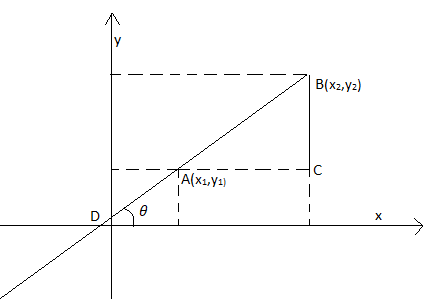
Since AC is parallel to x-axis and BD cuts them, we can say that,
\[\Rightarrow \angle BAC=\theta \] as these are corresponding angles
From the figure, we can get AC and BC by subtracting the corresponding x and y coordinates of points A, B and C. A and C have the same coordinates.
\[AC={{x}_{2}}-{{x}_{1}}\] and \[BC={{y}_{2}}-{{y}_{1}}\]
Now in triangle \[\Delta ABC\], we have as follows:
\[\tan A=\dfrac{BC}{AC}\]
Since \[\angle A=\theta \], \[AC={{x}_{2}}-{{x}_{1}}\] and \[BC={{y}_{2}}-{{y}_{1}}\]
\[\Rightarrow \tan \theta =\dfrac{{{y}_{2}}-{{y}_{1}}}{{{x}_{2}}-{{x}_{1}}}\]
Since we know that slope of a line (m) is also equal to the tangent value of angle made by the line with x-axis in anticlockwise direction.
\[\Rightarrow slope(m)=\dfrac{{{y}_{2}}-{{y}_{1}}}{{{x}_{2}}-{{x}_{1}}}=\tan \theta \]
Therefore, it is proved that the slope of a line passing through A \[\left( {{x}_{1}},{{y}_{1}} \right)\] and B \[\left( {{x}_{2}},{{y}_{2}} \right)\] is given by \[m=\dfrac{{{y}_{2}}-{{y}_{1}}}{{{x}_{2}}-{{x}_{1}}}\].
Note: Remember that if the slope of a line is equal to zero then it is parallel to x-axis and if the slope tends to infinity then it is perpendicular to x-axis. Also, you can remember that if the x-coordinates of the two points through which line passes are same then it must be perpendicular to x-axis and if y-coordinates of the two points through which line passes are same then it must be perpendicular to y-axis or parallel to x-axis.
Complete step-by-step answer:
Let us consider the given points A \[\left( {{x}_{1}},{{y}_{1}} \right)\] and B \[\left( {{x}_{2}},{{y}_{2}} \right)\] in the x-y plane and the angle made by the line with x-axis in anticlockwise direction to be \['\theta '\].
Since AC is parallel to x-axis and BD cuts them, we can say that,
\[\Rightarrow \angle BAC=\theta \] as these are corresponding angles
From the figure, we can get AC and BC by subtracting the corresponding x and y coordinates of points A, B and C. A and C have the same coordinates.
\[AC={{x}_{2}}-{{x}_{1}}\] and \[BC={{y}_{2}}-{{y}_{1}}\]
Now in triangle \[\Delta ABC\], we have as follows:
\[\tan A=\dfrac{BC}{AC}\]
Since \[\angle A=\theta \], \[AC={{x}_{2}}-{{x}_{1}}\] and \[BC={{y}_{2}}-{{y}_{1}}\]
\[\Rightarrow \tan \theta =\dfrac{{{y}_{2}}-{{y}_{1}}}{{{x}_{2}}-{{x}_{1}}}\]
Since we know that slope of a line (m) is also equal to the tangent value of angle made by the line with x-axis in anticlockwise direction.
\[\Rightarrow slope(m)=\dfrac{{{y}_{2}}-{{y}_{1}}}{{{x}_{2}}-{{x}_{1}}}=\tan \theta \]
Therefore, it is proved that the slope of a line passing through A \[\left( {{x}_{1}},{{y}_{1}} \right)\] and B \[\left( {{x}_{2}},{{y}_{2}} \right)\] is given by \[m=\dfrac{{{y}_{2}}-{{y}_{1}}}{{{x}_{2}}-{{x}_{1}}}\].
Note: Remember that if the slope of a line is equal to zero then it is parallel to x-axis and if the slope tends to infinity then it is perpendicular to x-axis. Also, you can remember that if the x-coordinates of the two points through which line passes are same then it must be perpendicular to x-axis and if y-coordinates of the two points through which line passes are same then it must be perpendicular to y-axis or parallel to x-axis.
Recently Updated Pages
Master Class 12 Economics: Engaging Questions & Answers for Success

Master Class 12 English: Engaging Questions & Answers for Success
Master Class 12 Social Science: Engaging Questions & Answers for Success
Master Class 12 Maths: Engaging Questions & Answers for Success
Master Class 12 Physics: Engaging Questions & Answers for Success
Master Class 9 General Knowledge: Engaging Questions & Answers for Success
Trending doubts
1 ton equals to A 100 kg B 1000 kg C 10 kg D 10000 class 11 physics CBSE
How do I convert ms to kmh Give an example class 11 physics CBSE
Mention the important general characters of Urocho class 11 biology CBSE
Define pneumatic bones class 11 biology CBSE
10 examples of diffusion in everyday life
The relation between molarity M and molality m is given class 11 chemistry CBSE