




Prove that the quadrilateral formed by the intersection of angle bisectors of all angles of a parallelogram is a rectangle.
Answer
 Verified
642.3k+ views
Hint: In this given question, we can use the fact that adjacent angles of a parallelogram are supplementary meaning their sum is equal to ${{180}^{\circ }}$. Then we can use the concept of Vertically Opposite Angles (VOA) as equal to prove that each angle of the quadrilateral formed is a right angle, hence making it a rectangle.
Complete step-by-step answer:
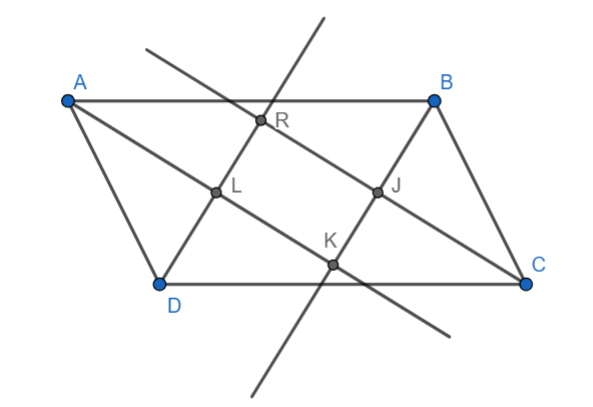
In this given question, we are asked to prove that the quadrilateral formed by the intersection of angle bisectors of all angles of a parallelogram is a rectangle.
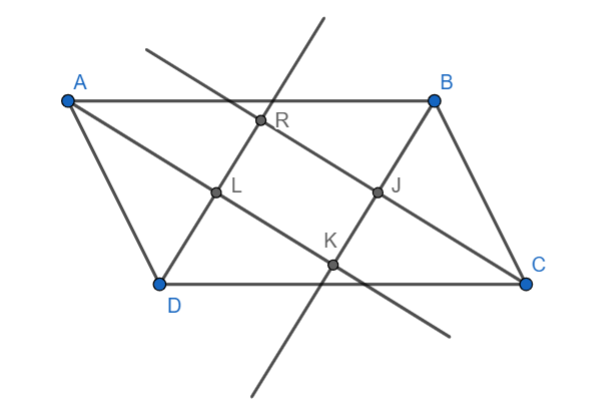
Here, we are going to the fact that adjacent angles of a parallelogram are supplementary meaning their sum is equal to ${{180}^{\circ }}$.
Also, we are going to use the angle sum property of triangles which gives us that the sum of all the angles of a triangle is equal to ${{180}^{\circ }}$.
The process of solving is as follows:
In parallelogram ABCD, as adjacent sides are supplementary so,
$\begin{align}
& \angle B+\angle C={{180}^{\circ }} \\
& \Rightarrow \dfrac{1}{2}\left( \angle B+\angle C \right)=\dfrac{1}{2}\times {{180}^{\circ }} \\
& \Rightarrow \dfrac{1}{2}\angle B+\dfrac{1}{2}\angle C={{90}^{\circ }}.............(1.1) \\
\end{align}$
As, angle bisectors bisect the angles into two equal halves,
$\angle QBC=\dfrac{1}{2}\angle B\text{ and }\angle \text{QCB=}\dfrac{1}{2}\angle C...........(1.2)$
Now, in $\Delta BQC$,
$\angle QBC+\angle QCB+\angle BQC={{180}^{\circ }}$ (by angle sum property of triangles)
$\Rightarrow \dfrac{1}{2}\angle B+\dfrac{1}{2}\angle C+\angle BQC={{180}^{\circ }}$ (from 1.2)
$\Rightarrow {{90}^{\circ }}+\angle BQC={{180}^{\circ }}$(From 1.1)
$\Rightarrow \angle BQC={{90}^{\circ }}.............(1.3)$
Now, as vertically opposite angles are equal,
$\angle BQC=\angle PQR............(1.4)$
From 1.3 and 1.4, we get,
$\angle PQR={{90}^{\circ }}$
Similarly, we can also obtain that,
$\angle QRS=\angle PSR=\angle SRQ={{90}^{\circ }}$
So, we get,
$\angle PQR=\angle QRS=\angle PSR=\angle SRQ={{90}^{\circ }}$
As all the four angles of the quadrilateral are right angles, we can conclude that it is a rectangle.
Therefore, we have proved that the quadrilateral formed by the intersection of angle bisectors of all angles of a parallelogram is a rectangle.
Note: In this sort of question, we may have also used another triangle in order to get the basis as proof as an example instead of $\Delta BQC$. Then we may have followed the same procedure and would have arrived at the same conclusion.
Complete step-by-step answer:
In this given question, we are asked to prove that the quadrilateral formed by the intersection of angle bisectors of all angles of a parallelogram is a rectangle.
Here, we are going to the fact that adjacent angles of a parallelogram are supplementary meaning their sum is equal to ${{180}^{\circ }}$.
Also, we are going to use the angle sum property of triangles which gives us that the sum of all the angles of a triangle is equal to ${{180}^{\circ }}$.
The process of solving is as follows:
In parallelogram ABCD, as adjacent sides are supplementary so,
$\begin{align}
& \angle B+\angle C={{180}^{\circ }} \\
& \Rightarrow \dfrac{1}{2}\left( \angle B+\angle C \right)=\dfrac{1}{2}\times {{180}^{\circ }} \\
& \Rightarrow \dfrac{1}{2}\angle B+\dfrac{1}{2}\angle C={{90}^{\circ }}.............(1.1) \\
\end{align}$
As, angle bisectors bisect the angles into two equal halves,
$\angle QBC=\dfrac{1}{2}\angle B\text{ and }\angle \text{QCB=}\dfrac{1}{2}\angle C...........(1.2)$
Now, in $\Delta BQC$,
$\angle QBC+\angle QCB+\angle BQC={{180}^{\circ }}$ (by angle sum property of triangles)
$\Rightarrow \dfrac{1}{2}\angle B+\dfrac{1}{2}\angle C+\angle BQC={{180}^{\circ }}$ (from 1.2)
$\Rightarrow {{90}^{\circ }}+\angle BQC={{180}^{\circ }}$(From 1.1)
$\Rightarrow \angle BQC={{90}^{\circ }}.............(1.3)$
Now, as vertically opposite angles are equal,
$\angle BQC=\angle PQR............(1.4)$
From 1.3 and 1.4, we get,
$\angle PQR={{90}^{\circ }}$
Similarly, we can also obtain that,
$\angle QRS=\angle PSR=\angle SRQ={{90}^{\circ }}$
So, we get,
$\angle PQR=\angle QRS=\angle PSR=\angle SRQ={{90}^{\circ }}$
As all the four angles of the quadrilateral are right angles, we can conclude that it is a rectangle.
Therefore, we have proved that the quadrilateral formed by the intersection of angle bisectors of all angles of a parallelogram is a rectangle.
Note: In this sort of question, we may have also used another triangle in order to get the basis as proof as an example instead of $\Delta BQC$. Then we may have followed the same procedure and would have arrived at the same conclusion.
Recently Updated Pages
Master Class 11 English: Engaging Questions & Answers for Success

Master Class 11 Social Science: Engaging Questions & Answers for Success
Master Class 11 Maths: Engaging Questions & Answers for Success
Master Class 11 Chemistry: Engaging Questions & Answers for Success
Master Class 11 Biology: Engaging Questions & Answers for Success
Master Class 11 Physics: Engaging Questions & Answers for Success
Trending doubts
Explain the Treaty of Vienna of 1815 class 10 social science CBSE
Why is it 530 pm in india when it is 1200 afternoon class 10 social science CBSE
What is the full form of CNG A Complete Natural Gas class 10 social science CBSE
In cricket, what is a "Yorker" designed to do?
What is the full form of POSCO class 10 social science CBSE
Define Potential, Developed, Stock and Reserved resources