




Prove that the locus of a point, which moves so that its distance from a fixed line is equal to the length of the tangent drawn from it to a given circle, is a parabola. Find the position of the focus and directrix.
Answer
 Verified
643.2k+ views
Hint: First of all, we need to take the given condition on the co-ordinate plane and then take the given line to be parallel to the y – axis and the given circle to have center at (0, 0) and then find the locus of point.
Complete step-by-step answer:
Let the given circle have a center O which is the origin and radius r and the given line is AB.
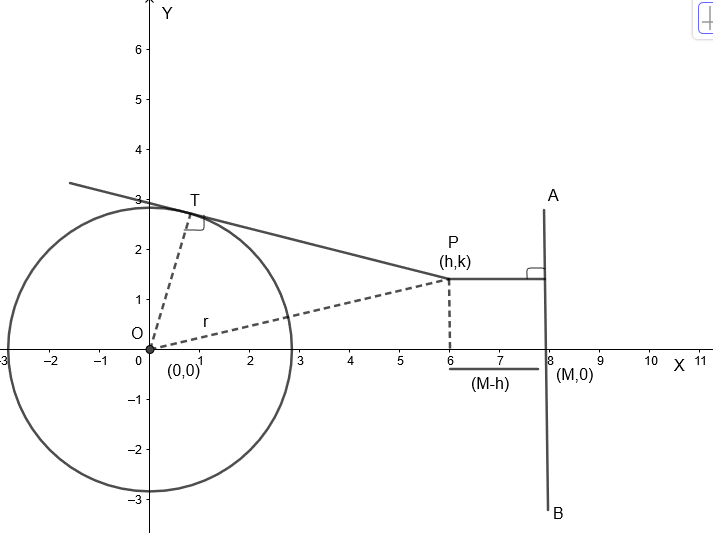
From the figure, we get, given circle is \[{{x}^{2}}+{{y}^{2}}={{r}^{2}}:{{C}_{1}}\]
And the given line is x = M, also OT = r = radius. Also, the point P whose locus to be found be (h, k).
By Pythagoras theorem, \[O{{T}^{2}}+T{{P}^{2}}=P{{O}^{2}}\]
Therefore, length of tangent \[TP=\sqrt{P{{O}^{2}}-O{{T}^{2}}}=\sqrt{P{{O}^{2}}-{{r}^{2}}}\]
By distance formula, \[OP=\sqrt{{{\left( {{x}_{2}}-{{x}_{1}} \right)}^{2}}+{{\left( {{y}_{2}}-{{y}_{1}} \right)}^{2}}{{h}^{2}}}=\sqrt{{{\left( h-0 \right)}^{2}}+{{\left( k-0 \right)}^{2}}}\]
Therefore, we get \[TP=\sqrt{{{h}^{2}}+{{k}^{2}}-{{r}^{2}}}.....\left( i \right)\]
Also, distance of point P(h, k) from given line = (M – h)…..(ii) by diagram
By equating equations (i) and (ii), we get,
\[\sqrt{{{h}^{2}}+{{k}^{2}}-{{r}^{2}}}=\left( M-h \right)\]
Squaring both sides,
\[{{\left( x-y \right)}^{2}}={{x}^{2}}+{{y}^{2}}-2xy\]
Also, \[{{h}^{2}}+{{k}^{2}}-{{r}^{2}}={{M}^{2}}+{{h}^{2}}-2Mh\]
\[{{k}^{2}}=-2Mh+{{M}^{2}}+{{r}^{2}}\]
\[\Rightarrow {{k}^{2}}=-2M\left( h-\dfrac{\left( {{M}^{2}}+{{r}^{2}} \right)}{2M} \right)\]
Replacing k by y and h by x to get the locus.
\[{{y}^{2}}=-2M\left[ h-\dfrac{\left( {{M}^{2}}+{{r}^{2}} \right)}{2M} \right]\]
which is of the form of parabola \[{{y}^{2}}=4a\left( x-h \right)\]
which has focus \[=\left\{ \left( h+a \right),0 \right\}\]
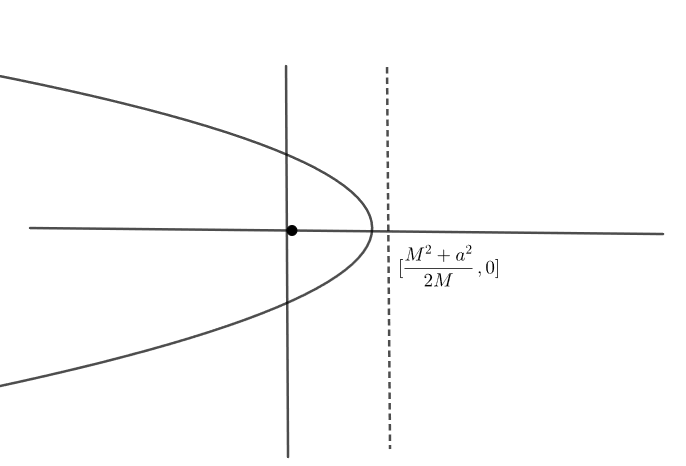
\[=\left\{ \left( \dfrac{{{M}^{2}}+{{r}^{2}}}{2M}-\dfrac{M}{2} \right),0 \right\}\]
\[=\left\{ \dfrac{{{r}^{2}}}{2M},0 \right\}\]
And directrix is X = h – a
\[X=\dfrac{{{M}^{2}}+{{r}^{2}}}{2M}+\dfrac{M}{2}\]
Rearranging the equation, we get \[2Mx=2{{M}^{2}}+{{r}^{2}}\].
Note: Students should be careful when doing these types of questions. We need to take the origin as the center as questions can get lengthy and confusing if any other arbitrary point is taken. Students often get confused in formulas for negative focus but it is the same as the general formula.
Complete step-by-step answer:
Let the given circle have a center O which is the origin and radius r and the given line is AB.
From the figure, we get, given circle is \[{{x}^{2}}+{{y}^{2}}={{r}^{2}}:{{C}_{1}}\]
And the given line is x = M, also OT = r = radius. Also, the point P whose locus to be found be (h, k).
By Pythagoras theorem, \[O{{T}^{2}}+T{{P}^{2}}=P{{O}^{2}}\]
Therefore, length of tangent \[TP=\sqrt{P{{O}^{2}}-O{{T}^{2}}}=\sqrt{P{{O}^{2}}-{{r}^{2}}}\]
By distance formula, \[OP=\sqrt{{{\left( {{x}_{2}}-{{x}_{1}} \right)}^{2}}+{{\left( {{y}_{2}}-{{y}_{1}} \right)}^{2}}{{h}^{2}}}=\sqrt{{{\left( h-0 \right)}^{2}}+{{\left( k-0 \right)}^{2}}}\]
Therefore, we get \[TP=\sqrt{{{h}^{2}}+{{k}^{2}}-{{r}^{2}}}.....\left( i \right)\]
Also, distance of point P(h, k) from given line = (M – h)…..(ii) by diagram
By equating equations (i) and (ii), we get,
\[\sqrt{{{h}^{2}}+{{k}^{2}}-{{r}^{2}}}=\left( M-h \right)\]
Squaring both sides,
\[{{\left( x-y \right)}^{2}}={{x}^{2}}+{{y}^{2}}-2xy\]
Also, \[{{h}^{2}}+{{k}^{2}}-{{r}^{2}}={{M}^{2}}+{{h}^{2}}-2Mh\]
\[{{k}^{2}}=-2Mh+{{M}^{2}}+{{r}^{2}}\]
\[\Rightarrow {{k}^{2}}=-2M\left( h-\dfrac{\left( {{M}^{2}}+{{r}^{2}} \right)}{2M} \right)\]
Replacing k by y and h by x to get the locus.
\[{{y}^{2}}=-2M\left[ h-\dfrac{\left( {{M}^{2}}+{{r}^{2}} \right)}{2M} \right]\]
which is of the form of parabola \[{{y}^{2}}=4a\left( x-h \right)\]
which has focus \[=\left\{ \left( h+a \right),0 \right\}\]
\[=\left\{ \left( \dfrac{{{M}^{2}}+{{r}^{2}}}{2M}-\dfrac{M}{2} \right),0 \right\}\]
\[=\left\{ \dfrac{{{r}^{2}}}{2M},0 \right\}\]
And directrix is X = h – a
\[X=\dfrac{{{M}^{2}}+{{r}^{2}}}{2M}+\dfrac{M}{2}\]
Rearranging the equation, we get \[2Mx=2{{M}^{2}}+{{r}^{2}}\].
Note: Students should be careful when doing these types of questions. We need to take the origin as the center as questions can get lengthy and confusing if any other arbitrary point is taken. Students often get confused in formulas for negative focus but it is the same as the general formula.
Recently Updated Pages
Master Class 11 English: Engaging Questions & Answers for Success

Master Class 11 Social Science: Engaging Questions & Answers for Success
Master Class 11 Maths: Engaging Questions & Answers for Success
Master Class 11 Biology: Engaging Questions & Answers for Success
Master Class 11 Physics: Engaging Questions & Answers for Success
Master Class 11 Chemistry: Engaging Questions & Answers for Success
Trending doubts
One Metric ton is equal to kg A 10000 B 1000 C 100 class 11 physics CBSE
Difference Between Prokaryotic Cells and Eukaryotic Cells
Find the value of the expression given below sin 30circ class 11 maths CBSE
Difference between physical and chemical change class 11 chemistry CBSE
Two of the body parts which do not appear in MRI are class 11 biology CBSE
Draw a diagram of a plant cell and label at least eight class 11 biology CBSE