




Prove that the least perimeter of an isosceles triangle in which a circle of radius r can be inscribed, is $6\sqrt {3r} $
Answer
 Verified
595.5k+ views
Hint: In order to prove this question we will use the property that tangents on a circle are equal from an external point and perimeter of a triangle is the sum of all three sides of it. Use these properties to prove the question.
Complete step-by-step answer:
Referring from diagram
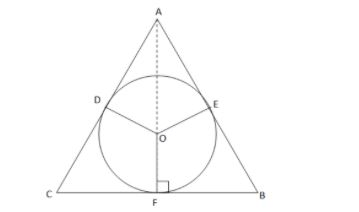
Let ABC be isosceles is \[AB = AC = x\] ,
“r” is radius of circle and BC= y and a circle with centre O and radius r is inscribed in the triangle. Join OA and OE and OD.
Sides AB, AC and BC are the tangents to the circle.
As the radius makes a right angle with the tangent to the circle at the point of intersection. So, triangle AFB is right angled at F.
In right angle triangle ABF, we will apply Pythagoras theorem
$
\Rightarrow {\left( {AF} \right)^2} + {\left( {BF} \right)^2} = {\left( {AB} \right)^2} \\
\Rightarrow {\left( {3r} \right)^2} + {\left( {\dfrac{y}{2}} \right)^2} = {\left( x \right)^2}...........{\text{(1) }}\left[ {\because BF = \dfrac{{BC}}{2}} \right] \\
$
Now again from triangle ADO, we will apply Pythagoras theorem
$
\Rightarrow {\left( {AD} \right)^2} + {\left( {DO} \right)^2} = {\left( {AO} \right)^2} \\
\Rightarrow {\left( {AD} \right)^2} + {\left( r \right)^2} = {\left( {2r} \right)^2} \\
$
(OA= 2r because center of the circle divides altitude of the triangle in the ratio 2:1)
$
\Rightarrow {\left( {AD} \right)^2} + {r^2} = 4{r^2} \\
\Rightarrow {\left( {AD} \right)^2} = 4{r^2} - {r^2} \\
\Rightarrow {\left( {AD} \right)^2} = 3{r^2} \\
\Rightarrow AD = \sqrt {3{r^2}} \\
\Rightarrow AD = \sqrt 3 r \\
$
Now, BE = BF and AD = AE (Since tangents drawn from an external point are equal) ---(2)
So,
$
AB = BE + AE \\
x = BE + AE \\
x = BF + AD{\text{ }}\left[ {{\text{from equation (2)}}} \right] \\
\Rightarrow x = \sqrt 3 r + \dfrac{y}{2} \\
\Rightarrow \dfrac{y}{2} = x - \sqrt 3 r..........(3) \\
$
Putting value of equation (3) in equation (1), we get
\[
\because {\left( {3r} \right)^2} + {\left( {\dfrac{y}{2}} \right)^2} = {\left( x \right)^2} \\
\Rightarrow {\left( {3r} \right)^2} + {\left( {x - \sqrt 3 r} \right)^2} = {\left( x \right)^2} \\
\Rightarrow 9{r^2} + {x^2} - 2\sqrt 3 rx + 3{r^2} = {\left( x \right)^2} \\
\Rightarrow 12{r^2} - 2\sqrt 3 rx = 0 \\
\Rightarrow 12{r^2} = 2\sqrt 3 rx \\
\Rightarrow 6r = \sqrt 3 x \\
\Rightarrow x = \dfrac{{6r}}{{\sqrt 3 }} \\
\]
Put the value of x in equation (3), we have
$
\because \dfrac{y}{2} = x - \sqrt 3 r \\
\Rightarrow \dfrac{y}{2} = \dfrac{{6r}}{{\sqrt 3 }} - \sqrt 3 r \\
\Rightarrow \dfrac{y}{2} = \dfrac{{6\sqrt 3 r}}{3} - \sqrt 3 r \\
\Rightarrow \dfrac{y}{2} = \dfrac{{6\sqrt 3 r - 3\sqrt 3 r}}{3} \\
\Rightarrow \dfrac{y}{2} = \dfrac{{3\sqrt 3 r}}{3} \\
\Rightarrow y = 2\sqrt 3 r \\
$
So we get the sides of triangle \[AB = AC = x = \dfrac{{6r}}{{\sqrt 3 }}\] and \[BC = y = 2\sqrt 3 r\]
As we know that the perimeter of a triangle is equal to the sum of all the sides.
Therefore, perimeter of triangle ABC = 2AB + BC
\[
= 2x + y \\
= 2 \times \left( {\dfrac{{6r}}{{\sqrt 3 }}} \right) + 2\sqrt 3 r \\
= \dfrac{{12r}}{{\sqrt 3 }} + 2\sqrt 3 r \\
= \dfrac{{12r + 6r}}{{\sqrt 3 }} \\
= \dfrac{{18r}}{{\sqrt 3 }} \\
= \dfrac{{18r}}{{\sqrt 3 }} \times \dfrac{{\sqrt 3 }}{{\sqrt 3 }} \\
= \dfrac{{18\sqrt 3 r}}{3} \\
= 6\sqrt 3 r \\
\]
So, the perimeter is $6\sqrt {3r} $
Hence, the least perimeter of an isosceles triangle in which a circle of radius r can be inscribed, is $6\sqrt {3r} $
Note: The sides of the isosceles triangle inscribing the circle are the tangent to the circle. Also tangents drawn from an external point are equal. In order to solve such problems students must remember the different properties of tangent to the circle. Some of them are mentioned in the solution. Students must draw figures for solving such questions.
Complete step-by-step answer:
Referring from diagram
Let ABC be isosceles is \[AB = AC = x\] ,
“r” is radius of circle and BC= y and a circle with centre O and radius r is inscribed in the triangle. Join OA and OE and OD.
Sides AB, AC and BC are the tangents to the circle.
As the radius makes a right angle with the tangent to the circle at the point of intersection. So, triangle AFB is right angled at F.
In right angle triangle ABF, we will apply Pythagoras theorem
$
\Rightarrow {\left( {AF} \right)^2} + {\left( {BF} \right)^2} = {\left( {AB} \right)^2} \\
\Rightarrow {\left( {3r} \right)^2} + {\left( {\dfrac{y}{2}} \right)^2} = {\left( x \right)^2}...........{\text{(1) }}\left[ {\because BF = \dfrac{{BC}}{2}} \right] \\
$
Now again from triangle ADO, we will apply Pythagoras theorem
$
\Rightarrow {\left( {AD} \right)^2} + {\left( {DO} \right)^2} = {\left( {AO} \right)^2} \\
\Rightarrow {\left( {AD} \right)^2} + {\left( r \right)^2} = {\left( {2r} \right)^2} \\
$
(OA= 2r because center of the circle divides altitude of the triangle in the ratio 2:1)
$
\Rightarrow {\left( {AD} \right)^2} + {r^2} = 4{r^2} \\
\Rightarrow {\left( {AD} \right)^2} = 4{r^2} - {r^2} \\
\Rightarrow {\left( {AD} \right)^2} = 3{r^2} \\
\Rightarrow AD = \sqrt {3{r^2}} \\
\Rightarrow AD = \sqrt 3 r \\
$
Now, BE = BF and AD = AE (Since tangents drawn from an external point are equal) ---(2)
So,
$
AB = BE + AE \\
x = BE + AE \\
x = BF + AD{\text{ }}\left[ {{\text{from equation (2)}}} \right] \\
\Rightarrow x = \sqrt 3 r + \dfrac{y}{2} \\
\Rightarrow \dfrac{y}{2} = x - \sqrt 3 r..........(3) \\
$
Putting value of equation (3) in equation (1), we get
\[
\because {\left( {3r} \right)^2} + {\left( {\dfrac{y}{2}} \right)^2} = {\left( x \right)^2} \\
\Rightarrow {\left( {3r} \right)^2} + {\left( {x - \sqrt 3 r} \right)^2} = {\left( x \right)^2} \\
\Rightarrow 9{r^2} + {x^2} - 2\sqrt 3 rx + 3{r^2} = {\left( x \right)^2} \\
\Rightarrow 12{r^2} - 2\sqrt 3 rx = 0 \\
\Rightarrow 12{r^2} = 2\sqrt 3 rx \\
\Rightarrow 6r = \sqrt 3 x \\
\Rightarrow x = \dfrac{{6r}}{{\sqrt 3 }} \\
\]
Put the value of x in equation (3), we have
$
\because \dfrac{y}{2} = x - \sqrt 3 r \\
\Rightarrow \dfrac{y}{2} = \dfrac{{6r}}{{\sqrt 3 }} - \sqrt 3 r \\
\Rightarrow \dfrac{y}{2} = \dfrac{{6\sqrt 3 r}}{3} - \sqrt 3 r \\
\Rightarrow \dfrac{y}{2} = \dfrac{{6\sqrt 3 r - 3\sqrt 3 r}}{3} \\
\Rightarrow \dfrac{y}{2} = \dfrac{{3\sqrt 3 r}}{3} \\
\Rightarrow y = 2\sqrt 3 r \\
$
So we get the sides of triangle \[AB = AC = x = \dfrac{{6r}}{{\sqrt 3 }}\] and \[BC = y = 2\sqrt 3 r\]
As we know that the perimeter of a triangle is equal to the sum of all the sides.
Therefore, perimeter of triangle ABC = 2AB + BC
\[
= 2x + y \\
= 2 \times \left( {\dfrac{{6r}}{{\sqrt 3 }}} \right) + 2\sqrt 3 r \\
= \dfrac{{12r}}{{\sqrt 3 }} + 2\sqrt 3 r \\
= \dfrac{{12r + 6r}}{{\sqrt 3 }} \\
= \dfrac{{18r}}{{\sqrt 3 }} \\
= \dfrac{{18r}}{{\sqrt 3 }} \times \dfrac{{\sqrt 3 }}{{\sqrt 3 }} \\
= \dfrac{{18\sqrt 3 r}}{3} \\
= 6\sqrt 3 r \\
\]
So, the perimeter is $6\sqrt {3r} $
Hence, the least perimeter of an isosceles triangle in which a circle of radius r can be inscribed, is $6\sqrt {3r} $
Note: The sides of the isosceles triangle inscribing the circle are the tangent to the circle. Also tangents drawn from an external point are equal. In order to solve such problems students must remember the different properties of tangent to the circle. Some of them are mentioned in the solution. Students must draw figures for solving such questions.
Recently Updated Pages
Master Class 10 Computer Science: Engaging Questions & Answers for Success

Master Class 10 General Knowledge: Engaging Questions & Answers for Success
Master Class 10 English: Engaging Questions & Answers for Success
Master Class 10 Social Science: Engaging Questions & Answers for Success
Master Class 10 Maths: Engaging Questions & Answers for Success
Master Class 10 Science: Engaging Questions & Answers for Success
Trending doubts
What is the median of the first 10 natural numbers class 10 maths CBSE
Which women's tennis player has 24 Grand Slam singles titles?
Who is the Brand Ambassador of Incredible India?
Why is there a time difference of about 5 hours between class 10 social science CBSE
Write a letter to the principal requesting him to grant class 10 english CBSE
A moving boat is observed from the top of a 150 m high class 10 maths CBSE