



Prove that the lateral surface area of the cube is $4{{a}^{2}}$.
Answer
 Verified
664.2k+ views
Hint: To specify a figure most fundamental quantities are perimeter, area and volume for a three-dimensional object. Area can be defined as the space occupied by a flat shape or the surface of an object. So, using this definition, we can easily prove the desired part in our problem.
Complete step-by-step answer:
According to our problem, we are given a cube having side length as a. We have to prove that the lateral surface area of the cube is $4{{a}^{2}}$.
For proving this, we must know what is meant by lateral surface area. There are two types of surface area related to a solid. One is the total surface area and other is the lateral surface area. Total surface area includes the area of all the surfaces while the lateral surface area includes the area excluding the top and bottom surfaces.
Therefore, a cube has four lateral surfaces after excluding the top and bottom surfaces. Area of one lateral surface is the area of a square, that is ${{a}^{2}}$. The below given cube shows the lateral surface area excluding the top and bottom surfaces.
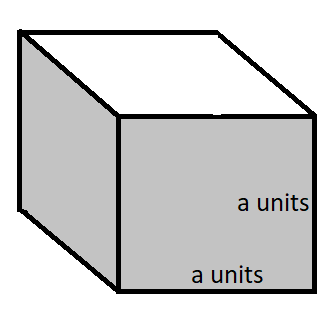
The lateral surface area of cube $=4{{a}^{2}}$.
Hence, we prove that the lateral surface area of the cube is $4{{a}^{2}}$.
Note: The key concept involved in solving this problem is the knowledge of surface area of three dimensional solid particularly lateral surface area. By using that simple definition of lateral surface area, we proved our result.
Complete step-by-step answer:
According to our problem, we are given a cube having side length as a. We have to prove that the lateral surface area of the cube is $4{{a}^{2}}$.
For proving this, we must know what is meant by lateral surface area. There are two types of surface area related to a solid. One is the total surface area and other is the lateral surface area. Total surface area includes the area of all the surfaces while the lateral surface area includes the area excluding the top and bottom surfaces.
Therefore, a cube has four lateral surfaces after excluding the top and bottom surfaces. Area of one lateral surface is the area of a square, that is ${{a}^{2}}$. The below given cube shows the lateral surface area excluding the top and bottom surfaces.
The lateral surface area of cube $=4{{a}^{2}}$.
Hence, we prove that the lateral surface area of the cube is $4{{a}^{2}}$.
Note: The key concept involved in solving this problem is the knowledge of surface area of three dimensional solid particularly lateral surface area. By using that simple definition of lateral surface area, we proved our result.
Recently Updated Pages
Master Class 12 Economics: Engaging Questions & Answers for Success

Master Class 12 Biology: Engaging Questions & Answers for Success
Master Class 11 English: Engaging Questions & Answers for Success
Master Class 11 Physics: Engaging Questions & Answers for Success
Master Class 11 Computer Science: Engaging Questions & Answers for Success
Master Class 11 Chemistry: Engaging Questions & Answers for Success
Trending doubts
What is BLO What is the full form of BLO class 8 social science CBSE
Citizens of India can vote at the age of A 18 years class 8 social science CBSE
Full form of STD, ISD and PCO
One cusec is equal to how many liters class 8 maths CBSE
Give me the opposite gender of Duck class 8 english CBSE
What are the methods of reducing friction. Explain