




Prove that the force of friction depends on the nature of two surfaces in contact.
Answer
 Verified
577.2k+ views
Hint:Friction is defined as the force that resists the motion of an object when the object is moving on the other object. The friction works in the opposite direction in which the object will move and will make the body slow. Here, we will consider an example in which we will move the object on a rough surface and on the smooth surface to prove how the force of friction depends on the nature of two surfaces in contact.
Complete answer:
We know that the force of friction depends on the smoothness or roughness of two surfaces that will be in contact with each other. When the two surfaces that will be in contact are smooth, then the friction between the surfaces will be small. On the other hand, when the two surfaces that will be in contact are rough, then the friction between the surfaces will be large. To prove this, we will consider an example which is given below Here, we will consider a rough surface on which an object is moving.
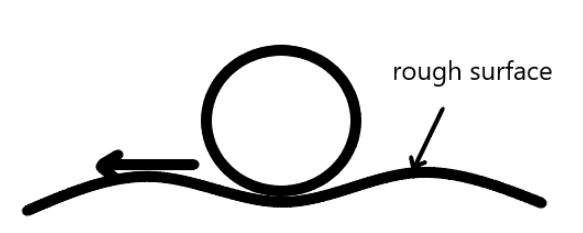
Here, the interlocking, when the rough surface will be in contact, will be more and thus the friction will be more. Therefore, the object will not be able to move easily due to more friction.
Now, we will consider a smooth surface on which an object is moving.
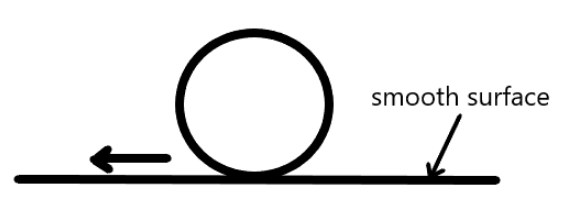
Now, the interlocking, when the smooth surface will be in contact with the surface will be less and thus, the friction will be less. Therefore, the object will not be able to move easily due to less friction.
Hence, we have proved that the force of friction depends on the nature of two surfaces in contact.
Note:Here, when the object will move on a rough surface then it will be difficult for the object to move on that surface, which means that the friction will be high. Also, when the object will move on a smooth surface then it will be easy for the object to move on that surface, which means that the friction will be low.
Complete answer:
We know that the force of friction depends on the smoothness or roughness of two surfaces that will be in contact with each other. When the two surfaces that will be in contact are smooth, then the friction between the surfaces will be small. On the other hand, when the two surfaces that will be in contact are rough, then the friction between the surfaces will be large. To prove this, we will consider an example which is given below Here, we will consider a rough surface on which an object is moving.
Here, the interlocking, when the rough surface will be in contact, will be more and thus the friction will be more. Therefore, the object will not be able to move easily due to more friction.
Now, we will consider a smooth surface on which an object is moving.
Now, the interlocking, when the smooth surface will be in contact with the surface will be less and thus, the friction will be less. Therefore, the object will not be able to move easily due to less friction.
Hence, we have proved that the force of friction depends on the nature of two surfaces in contact.
Note:Here, when the object will move on a rough surface then it will be difficult for the object to move on that surface, which means that the friction will be high. Also, when the object will move on a smooth surface then it will be easy for the object to move on that surface, which means that the friction will be low.
Recently Updated Pages
Master Class 11 Economics: Engaging Questions & Answers for Success

Master Class 11 English: Engaging Questions & Answers for Success
Master Class 11 Maths: Engaging Questions & Answers for Success
Class 11 Question and Answer - Your Ultimate Solutions Guide
Master Class 11 Social Science: Engaging Questions & Answers for Success
Master Class 11 Business Studies: Engaging Questions & Answers for Success
Trending doubts
One Metric ton is equal to kg A 10000 B 1000 C 100 class 11 physics CBSE
There are 720 permutations of the digits 1 2 3 4 5 class 11 maths CBSE
State and prove Bernoullis theorem class 11 physics CBSE
Draw a diagram of a plant cell and label at least eight class 11 biology CBSE
Difference Between Prokaryotic Cells and Eukaryotic Cells
Discuss the various forms of bacteria class 11 biology CBSE