




Prove that the diagonals of a parallelogram divide it into four triangles of equal area.
Answer
 Verified
686.4k+ views
Hint: First draw the diagram of a parallelogram ABCD with its diagonal as AC and BD. To prove that the area of two triangles is equal, use the theorem that triangles on the same base and between the same two parallel lines have equal area and also use the theorem that the median divides the triangle into two equal area triangles.
Complete step-by-step answer:
In the question, we have a parallelogram and we have to prove that the diagonals divide the parallelogram into four triangles of equal area.
The diagram for the question is given as:
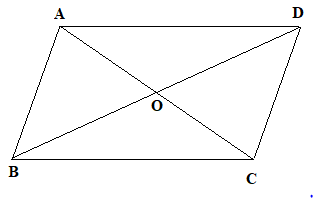
From the diagram we can say that we to prove that:
${\text{ar(}}\vartriangle {\text{AOB) = ar(}}\vartriangle {\text{BOC) = ar(}}\vartriangle {\text{COD) = ar(}}\vartriangle {\text{DOA)}}$
We know the theorem that triangles on the same base and between the same two parallel lines have equal area.
Now, In $\vartriangle {\text{ABC and }}\vartriangle {\text{BCD}}$
BC is the common side i.e. they are on the same base.
And also they are between the same parallel lines AD and BC.
Therefore, ${\text{ar(}}\vartriangle {\text{ABC) = ar(}}\vartriangle {\text{BCD)}}$ (1)
Equation 1 can be written as:
\[\;{\text{ar(}}\vartriangle {\text{AOB) + ar(BOC) = ar(}}\vartriangle {\text{COD) + ar(}}\vartriangle {\text{BOC)}}\]
\[ \Rightarrow \;{\text{ar(}}\vartriangle {\text{AOB) = ar(}}\vartriangle {\text{COD)}}\] (2)
Now, we know that the diagonals of a parallelogram bisect each other.
$\therefore $ OA=OC
Or we can say that BO is the median of $\vartriangle {\text{ABC}}$ .
According to theorem on median of a triangle:
The median of a triangle divides the triangle in two triangles of equal area.
So, using this theorem we can write:
${\text{ar(}}\vartriangle {\text{AOB) = ar(}}\vartriangle {\text{BOC)}}$ (3)
In $\vartriangle {\text{ACD}}$ , OD is the median.
Therefore, we can write:
${\text{ar(}}\vartriangle {\text{AOD) = ar(}}\vartriangle {\text{COD)}}$ (4)
From equation 1, 2, 3 and 4, we can write:
${\text{ar(}}\vartriangle {\text{AOB) = ar(}}\vartriangle {\text{BOC) = ar(}}\vartriangle {\text{COD) = ar(}}\vartriangle {\text{DOA)}}$
Note: In this type of question, we should remember the theorem on the area of a triangle. There are two theorems on the area of triangles. First one is that triangles on the same base and between same parallel lines have equal area and second one is that the median of the triangle divides the triangle into two triangles of equal area.
Complete step-by-step answer:
In the question, we have a parallelogram and we have to prove that the diagonals divide the parallelogram into four triangles of equal area.
The diagram for the question is given as:
From the diagram we can say that we to prove that:
${\text{ar(}}\vartriangle {\text{AOB) = ar(}}\vartriangle {\text{BOC) = ar(}}\vartriangle {\text{COD) = ar(}}\vartriangle {\text{DOA)}}$
We know the theorem that triangles on the same base and between the same two parallel lines have equal area.
Now, In $\vartriangle {\text{ABC and }}\vartriangle {\text{BCD}}$
BC is the common side i.e. they are on the same base.
And also they are between the same parallel lines AD and BC.
Therefore, ${\text{ar(}}\vartriangle {\text{ABC) = ar(}}\vartriangle {\text{BCD)}}$ (1)
Equation 1 can be written as:
\[\;{\text{ar(}}\vartriangle {\text{AOB) + ar(BOC) = ar(}}\vartriangle {\text{COD) + ar(}}\vartriangle {\text{BOC)}}\]
\[ \Rightarrow \;{\text{ar(}}\vartriangle {\text{AOB) = ar(}}\vartriangle {\text{COD)}}\] (2)
Now, we know that the diagonals of a parallelogram bisect each other.
$\therefore $ OA=OC
Or we can say that BO is the median of $\vartriangle {\text{ABC}}$ .
According to theorem on median of a triangle:
The median of a triangle divides the triangle in two triangles of equal area.
So, using this theorem we can write:
${\text{ar(}}\vartriangle {\text{AOB) = ar(}}\vartriangle {\text{BOC)}}$ (3)
In $\vartriangle {\text{ACD}}$ , OD is the median.
Therefore, we can write:
${\text{ar(}}\vartriangle {\text{AOD) = ar(}}\vartriangle {\text{COD)}}$ (4)
From equation 1, 2, 3 and 4, we can write:
${\text{ar(}}\vartriangle {\text{AOB) = ar(}}\vartriangle {\text{BOC) = ar(}}\vartriangle {\text{COD) = ar(}}\vartriangle {\text{DOA)}}$
Note: In this type of question, we should remember the theorem on the area of a triangle. There are two theorems on the area of triangles. First one is that triangles on the same base and between same parallel lines have equal area and second one is that the median of the triangle divides the triangle into two triangles of equal area.
Recently Updated Pages
Write any three differences between metals and nonmetals class 10 social science CBSE

Amit standing on a horizontal plane finds a bird flying class 10 maths CBSE
Two circles of radii 5 cm and 3 cm intersect at two class 10 maths CBSE
Solve the following i John and Jivanti together have class 10 maths CBSE
What is the relation between orthocenter circumcentre class 10 maths CBSE
Two plane mirrors are inclined at 70circ A ray incident class 10 physics CBSE
Trending doubts
Explain the Treaty of Vienna of 1815 class 10 social science CBSE
Which country is known as "The land of Fire and Ice"?
1 GB equals how many MB?
10 examples of evaporation in daily life with explanations
What is the full form of POSCO class 10 social science CBSE
Which is the hottest planet in the Solar system A Earth class 10 social science CBSE