




Prove that the bisector of interior angles of a parallelogram form a rectangle.\[\]
Answer
 Verified
580.8k+ views
Hint: We take the parallelogram ABDC. We denote the point of intersection of angle bisectors of angles A and B as P, the point of intersection of angle bisectors of angles B and D as , the point of intersection of angle bisectors of angles D and C as R and the point of intersection of angle bisectors of angles C and A as S. The points of intersection form a quadrilateral PQRS. We take the triangle APB and with the fact that sum of the angles $A+P+B={{180}^{\circ }}$ and the sum of co-interior angles $A+B={{180}^{\circ }}$ we prove $P={{90}^{\circ }}$. We similarly take triangles BQD, DRC, CSA to prove $Q=R=S={{90}^{\circ }}$.\[\]
Complete step-by-step answer:
Let us now solve this question.
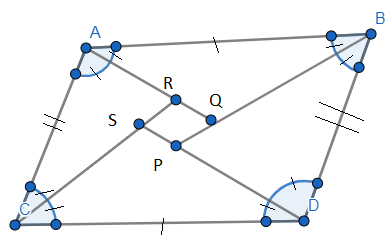
Let us first look at the figure provided below.
Let us observe the triangle APB. We know that the opposite sides of a parallelogram are parallel.
Therefore, AC ll BD and AB is the transversal.
Now, angle A + angle B =${{180}^{\circ }}$ (co – interior angles)
Therefore, we get \[\dfrac{1}{2}A\ +\ \dfrac{1}{2}B\ =\ \dfrac{1}{2}\times 180{}^\circ \ =\ 90{}^\circ \]
Now, in ∆APB, \[\dfrac{1}{2}A\ +\ \dfrac{1}{2}B\ +\ P\ =\ 180{}^\circ \]
\[90^\circ \; + \;P\; = \;180^\circ \left( {\because \dfrac{1}{2}A\; + \;\dfrac{1}{2}B\; = \;90^\circ } \right)\]
$P={{180}^{\circ }}-{{90}^{\circ }}={{90}^{\circ }}$.Therefore, angle P =${{90}^{\circ }}$
Now, in a similar way, AC ll BD and CD is the transversal.
So, by following the same method as shown above, we get the measure of angle R.
Angle R = ${90}^{\circ}$
Now, as we know that AB ll CD, therefore, the transversal is BD.
Now, angle B + angle D = ${{180}^{\circ }}$ (co – interior angles)
Therefore, we get \[\dfrac{1}{2}B\ +\ \dfrac{1}{2}D\ =\ \dfrac{1}{2}\times 180{}^\circ \ =\ 90{}^\circ \]
Now, in ∆BDQ, \[\dfrac{1}{2}B\ +\ \dfrac{1}{2}D\ +\ Q\ =\ 180{}^\circ \] (angle sum property)
\[90{}^\circ \ +\ Q\ =\ 180{}^\circ \] \[(\because \dfrac{1}{2}B\ +\ \dfrac{1}{2}D\ =\ 90{}^\circ )\]
$Q={{180}^{\circ }}-{{90}^{\circ }}={{90}^{\circ }}$
Therefore, angle
Now, in a similar way, AB ll CD and AC is the transversal.
So, by following the same method as shown above, we get the measure of angle S.
Angle S = ${{90}^{\circ }}$
So, after solving this question, we get:-
Angle P = angle R = angle Q = angle S = ${{90}^{\circ }}$
And, as all the angles of PQRS have a measure of ${{90}^{\circ }}$, therefore, PQRS is a rectangle.
Hence, proved. \[\]
Note: We note of different angles formed when a transversal cuts two parallel lines. Here are some of them:- Corresponding Angles(equal angles on the same side of the transverse line), Vertically Opposite Angles(equal angles at opposite side at the points of intersection), Linear Pair(supplementary angles at the same side), Alternate Interior Angles(equal angles at different side ), Alternate Exterior Angles(equal angles on both side of the transverse line) Etc.
Complete step-by-step answer:
Let us now solve this question.
Let us first look at the figure provided below.
Let us observe the triangle APB. We know that the opposite sides of a parallelogram are parallel.
Therefore, AC ll BD and AB is the transversal.
Now, angle A + angle B =${{180}^{\circ }}$ (co – interior angles)
Therefore, we get \[\dfrac{1}{2}A\ +\ \dfrac{1}{2}B\ =\ \dfrac{1}{2}\times 180{}^\circ \ =\ 90{}^\circ \]
Now, in ∆APB, \[\dfrac{1}{2}A\ +\ \dfrac{1}{2}B\ +\ P\ =\ 180{}^\circ \]
\[90^\circ \; + \;P\; = \;180^\circ \left( {\because \dfrac{1}{2}A\; + \;\dfrac{1}{2}B\; = \;90^\circ } \right)\]
$P={{180}^{\circ }}-{{90}^{\circ }}={{90}^{\circ }}$.Therefore, angle P =${{90}^{\circ }}$
Now, in a similar way, AC ll BD and CD is the transversal.
So, by following the same method as shown above, we get the measure of angle R.
Angle R = ${90}^{\circ}$
Now, as we know that AB ll CD, therefore, the transversal is BD.
Now, angle B + angle D = ${{180}^{\circ }}$ (co – interior angles)
Therefore, we get \[\dfrac{1}{2}B\ +\ \dfrac{1}{2}D\ =\ \dfrac{1}{2}\times 180{}^\circ \ =\ 90{}^\circ \]
Now, in ∆BDQ, \[\dfrac{1}{2}B\ +\ \dfrac{1}{2}D\ +\ Q\ =\ 180{}^\circ \] (angle sum property)
\[90{}^\circ \ +\ Q\ =\ 180{}^\circ \] \[(\because \dfrac{1}{2}B\ +\ \dfrac{1}{2}D\ =\ 90{}^\circ )\]
$Q={{180}^{\circ }}-{{90}^{\circ }}={{90}^{\circ }}$
Therefore, angle
Now, in a similar way, AB ll CD and AC is the transversal.
So, by following the same method as shown above, we get the measure of angle S.
Angle S = ${{90}^{\circ }}$
So, after solving this question, we get:-
Angle P = angle R = angle Q = angle S = ${{90}^{\circ }}$
And, as all the angles of PQRS have a measure of ${{90}^{\circ }}$, therefore, PQRS is a rectangle.
Hence, proved. \[\]
Note: We note of different angles formed when a transversal cuts two parallel lines. Here are some of them:- Corresponding Angles(equal angles on the same side of the transverse line), Vertically Opposite Angles(equal angles at opposite side at the points of intersection), Linear Pair(supplementary angles at the same side), Alternate Interior Angles(equal angles at different side ), Alternate Exterior Angles(equal angles on both side of the transverse line) Etc.
Recently Updated Pages
Master Class 10 Computer Science: Engaging Questions & Answers for Success

Master Class 10 General Knowledge: Engaging Questions & Answers for Success
Master Class 10 English: Engaging Questions & Answers for Success
Master Class 10 Social Science: Engaging Questions & Answers for Success
Master Class 10 Maths: Engaging Questions & Answers for Success
Master Class 10 Science: Engaging Questions & Answers for Success
Trending doubts
What is the median of the first 10 natural numbers class 10 maths CBSE
Which women's tennis player has 24 Grand Slam singles titles?
Who is the Brand Ambassador of Incredible India?
Why is there a time difference of about 5 hours between class 10 social science CBSE
Write a letter to the principal requesting him to grant class 10 english CBSE
A moving boat is observed from the top of a 150 m high class 10 maths CBSE