




Prove that the angles opposite to equal sides of a triangle are equal.
Answer
 Verified
595.8k+ views
Hint: To solve this question, we will use the special properties of the isosceles triangle that two of its sides are equal and that the altitude is the same as the median. Further, in this problem, we will use the properties of congruence to prove that the angles opposite to equal sides of a triangle are equal.
Complete step-by-step answer:
Before solving the problem, we should know the basics of how we can apply the results of congruency to get the answer to the above problem in hand. For reference to the above solution, we will refer to the following diagram of triangle ABC below.
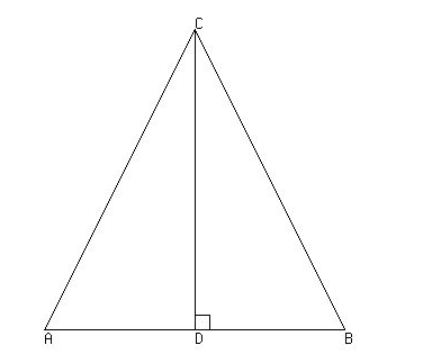
Thus, we have a triangle ABC.
Now we will construct a line CD which is perpendicular to the side AB.
We are given that two sides are equal (in this case, we take AC=BC). We would then have to prove that angle A = angle B. Thus, we will consider two triangles, triangle ADC and triangle BDC. From both these triangles, we have,
AC = BC (according to question)
Angle ADC = angle BDC = 90 degrees (CD is the altitude a shown)
CD = CD (common side of both triangles)
Thus, according to the RHS criteria of congruence, which states that two triangles are congruent if both are right-angled, hypotenuse are equal (AC = BC) and one other side is equal (CD = CD). Thus triangles ADC and BDC are congruent to each other. This means all their properties and values are exactly the same. Thus, we can conclude that angle A = angle B.
Hence, proved.
Note: In this problem, we used the RHS criteria to prove the congruence. We also have many other congruence criteria like SSS (side, side side), SAS (side, angle and side), ASA (angle, side and angle) and AAS (angle, angle and side). For example, if two triangles have all the sides of the same length, we can use the SSS criteria to prove their congruency.
Complete step-by-step answer:
Before solving the problem, we should know the basics of how we can apply the results of congruency to get the answer to the above problem in hand. For reference to the above solution, we will refer to the following diagram of triangle ABC below.
Thus, we have a triangle ABC.
Now we will construct a line CD which is perpendicular to the side AB.
We are given that two sides are equal (in this case, we take AC=BC). We would then have to prove that angle A = angle B. Thus, we will consider two triangles, triangle ADC and triangle BDC. From both these triangles, we have,
AC = BC (according to question)
Angle ADC = angle BDC = 90 degrees (CD is the altitude a shown)
CD = CD (common side of both triangles)
Thus, according to the RHS criteria of congruence, which states that two triangles are congruent if both are right-angled, hypotenuse are equal (AC = BC) and one other side is equal (CD = CD). Thus triangles ADC and BDC are congruent to each other. This means all their properties and values are exactly the same. Thus, we can conclude that angle A = angle B.
Hence, proved.
Note: In this problem, we used the RHS criteria to prove the congruence. We also have many other congruence criteria like SSS (side, side side), SAS (side, angle and side), ASA (angle, side and angle) and AAS (angle, angle and side). For example, if two triangles have all the sides of the same length, we can use the SSS criteria to prove their congruency.
Recently Updated Pages
Master Class 10 Computer Science: Engaging Questions & Answers for Success

Master Class 10 General Knowledge: Engaging Questions & Answers for Success
Master Class 10 English: Engaging Questions & Answers for Success
Master Class 10 Social Science: Engaging Questions & Answers for Success
Master Class 10 Maths: Engaging Questions & Answers for Success
Master Class 10 Science: Engaging Questions & Answers for Success
Trending doubts
What is the median of the first 10 natural numbers class 10 maths CBSE
Which women's tennis player has 24 Grand Slam singles titles?
Who is the Brand Ambassador of Incredible India?
Why is there a time difference of about 5 hours between class 10 social science CBSE
Write a letter to the principal requesting him to grant class 10 english CBSE
A moving boat is observed from the top of a 150 m high class 10 maths CBSE