




Prove that $\sec \left( \dfrac{3\pi }{2}-\theta \right)\sec \left( \theta -\dfrac{5\pi }{2} \right)+\tan \left( \dfrac{5\pi }{2}+\theta \right)\tan \left( \theta -\dfrac{3\pi }{2} \right)=-1$ .
Answer
 Verified
618.9k+ views
Hint: Try to simplify the left-hand side of the equation that we need to prove by using the relation of complementary angles between secant and cosecant function. The formulas that you might need includes $\sec \left( 90{}^\circ -\alpha \right)=\csc\alpha $ and $\sec \left( 90{}^\circ +\alpha \right)=-\csc\alpha $ .
Complete step-by-step answer:
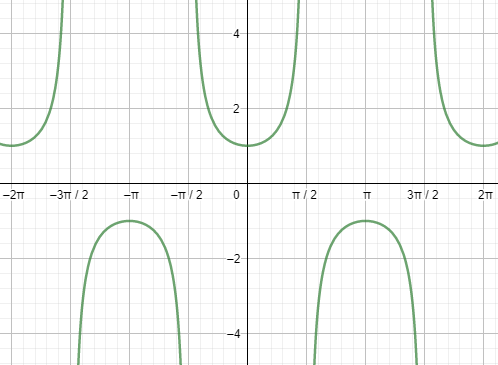
Before moving to the solution, let us discuss the periodicity of the secant and tangent function, which we would be using in the solution. All the trigonometric ratios, including secant and tangent, are periodic functions. We can better understand this using the graph of secant and tangent.
First, let us start with the graph of secx.
Next, let us see the graph of tanx.
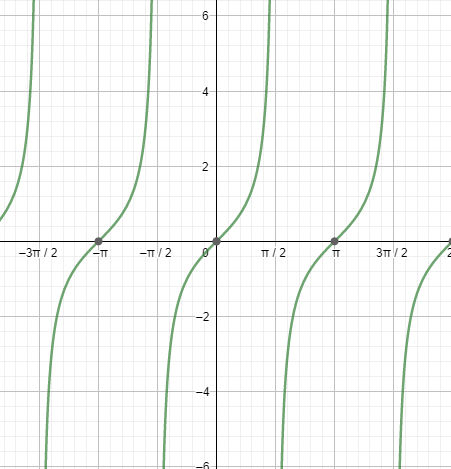
Looking at both the graphs, we can say that the graphs are repeating after a fixed period i.e. $2{{\pi }^{c}}$ . So, we can say that the fundamental period of the secant function and the tangent function is $2{{\pi }^{c}}=360{}^\circ $
We will now solve the left-hand side of the equation given in the question.
$\sec \left( \dfrac{3\pi }{2}-\theta \right)\sec \left( \theta -\dfrac{5\pi }{2} \right)+\tan \left( \dfrac{5\pi }{2}+\theta \right)\tan \left( \theta -\dfrac{3\pi }{2} \right)$
$=\sec \left( 2\pi -\left( \dfrac{\pi }{2}+\theta \right) \right)\sec \left( \theta -2\pi -\dfrac{\pi }{2} \right)+\tan \left( 2\pi +\dfrac{\pi }{2}+\theta \right)\tan \left( \theta -2\pi +\dfrac{\pi }{2} \right)$
Now we know $\sec \left( 2\pi \pm x \right)=\sec x$ and $\tan \left( 2\pi \pm x \right)=\pm \tan x$ . On putting these values in our expression, we get
\[=\sec \left( \dfrac{\pi }{2}+\theta \right)\sec \left( \theta -2\pi -\dfrac{\pi }{2} \right)+\tan \left( \dfrac{\pi }{2}+\theta \right)\tan \left( \theta -2\pi +\dfrac{\pi }{2} \right)\]
Now we also know that tan(-x)=-tanx and sec(-x)=secx.
\[\sec \left( \dfrac{\pi }{2}+\theta \right)\sec \left( 2\pi -\left( \theta -\dfrac{\pi }{2} \right) \right)-\tan \left( \dfrac{\pi }{2}+\theta \right)\tan \left( 2\pi -\left( \theta +\dfrac{\pi }{2} \right) \right)\]
\[\sec \left( \dfrac{\pi }{2}+\theta \right)\sec \left( \theta -\dfrac{\pi }{2} \right)+\tan \left( \dfrac{\pi }{2}+\theta \right)\tan \left( \theta +\dfrac{\pi }{2} \right)\]
Now according to the property of complementary angles, we can say:
$\begin{align}
& \sec \left( \dfrac{\pi }{2}+\theta \right)=-\cos ec\theta \\
& sec\left( \dfrac{\pi }{2}-\theta \right)=\cos ec\theta \\
& \tan \left( \dfrac{\pi }{2}+\theta \right)=-\cot \theta \\
& \tan \left( \dfrac{\pi }{2}-\theta \right)=\cot \theta \\
\end{align}$
Therefore, our expression becomes:
\[\sec \left( \dfrac{\pi }{2}+\theta \right)\sec \left( \theta -\dfrac{\pi }{2} \right)+\tan \left( \dfrac{\pi }{2}+\theta \right)\tan \left( \theta +\dfrac{\pi }{2} \right)\]
$-{{\sec }^{2}}\theta +{{\tan }^{2}}\theta $
Now we know ${{\sec }^{2}}x-{{\tan }^{2}}x=1$ .
$-{{\sec }^{2}}\theta +{{\tan }^{2}}\theta =-1$
As we have shown that the left-hand side of the equation given in the question is equal to the right-hand side of the equation in the question, which is equal to -1 . Hence, we can say that we have proved that $\sec \left( \dfrac{3\pi }{2}-\theta \right)\sec \left( \theta -\dfrac{5\pi }{2} \right)+\tan \left( \dfrac{5\pi }{2}+\theta \right)\tan \left( \theta -\dfrac{3\pi }{2} \right)=-1$ .
Note: Be careful about the calculation and the signs while opening the brackets. The general mistake that a student can make is 1+x-(x-1)=1+x-x-1. Also, you need to remember the properties related to complementary angles and trigonometric ratios.
Complete step-by-step answer:
Before moving to the solution, let us discuss the periodicity of the secant and tangent function, which we would be using in the solution. All the trigonometric ratios, including secant and tangent, are periodic functions. We can better understand this using the graph of secant and tangent.
First, let us start with the graph of secx.
Next, let us see the graph of tanx.
Looking at both the graphs, we can say that the graphs are repeating after a fixed period i.e. $2{{\pi }^{c}}$ . So, we can say that the fundamental period of the secant function and the tangent function is $2{{\pi }^{c}}=360{}^\circ $
We will now solve the left-hand side of the equation given in the question.
$\sec \left( \dfrac{3\pi }{2}-\theta \right)\sec \left( \theta -\dfrac{5\pi }{2} \right)+\tan \left( \dfrac{5\pi }{2}+\theta \right)\tan \left( \theta -\dfrac{3\pi }{2} \right)$
$=\sec \left( 2\pi -\left( \dfrac{\pi }{2}+\theta \right) \right)\sec \left( \theta -2\pi -\dfrac{\pi }{2} \right)+\tan \left( 2\pi +\dfrac{\pi }{2}+\theta \right)\tan \left( \theta -2\pi +\dfrac{\pi }{2} \right)$
Now we know $\sec \left( 2\pi \pm x \right)=\sec x$ and $\tan \left( 2\pi \pm x \right)=\pm \tan x$ . On putting these values in our expression, we get
\[=\sec \left( \dfrac{\pi }{2}+\theta \right)\sec \left( \theta -2\pi -\dfrac{\pi }{2} \right)+\tan \left( \dfrac{\pi }{2}+\theta \right)\tan \left( \theta -2\pi +\dfrac{\pi }{2} \right)\]
Now we also know that tan(-x)=-tanx and sec(-x)=secx.
\[\sec \left( \dfrac{\pi }{2}+\theta \right)\sec \left( 2\pi -\left( \theta -\dfrac{\pi }{2} \right) \right)-\tan \left( \dfrac{\pi }{2}+\theta \right)\tan \left( 2\pi -\left( \theta +\dfrac{\pi }{2} \right) \right)\]
\[\sec \left( \dfrac{\pi }{2}+\theta \right)\sec \left( \theta -\dfrac{\pi }{2} \right)+\tan \left( \dfrac{\pi }{2}+\theta \right)\tan \left( \theta +\dfrac{\pi }{2} \right)\]
Now according to the property of complementary angles, we can say:
$\begin{align}
& \sec \left( \dfrac{\pi }{2}+\theta \right)=-\cos ec\theta \\
& sec\left( \dfrac{\pi }{2}-\theta \right)=\cos ec\theta \\
& \tan \left( \dfrac{\pi }{2}+\theta \right)=-\cot \theta \\
& \tan \left( \dfrac{\pi }{2}-\theta \right)=\cot \theta \\
\end{align}$
Therefore, our expression becomes:
\[\sec \left( \dfrac{\pi }{2}+\theta \right)\sec \left( \theta -\dfrac{\pi }{2} \right)+\tan \left( \dfrac{\pi }{2}+\theta \right)\tan \left( \theta +\dfrac{\pi }{2} \right)\]
$-{{\sec }^{2}}\theta +{{\tan }^{2}}\theta $
Now we know ${{\sec }^{2}}x-{{\tan }^{2}}x=1$ .
$-{{\sec }^{2}}\theta +{{\tan }^{2}}\theta =-1$
As we have shown that the left-hand side of the equation given in the question is equal to the right-hand side of the equation in the question, which is equal to -1 . Hence, we can say that we have proved that $\sec \left( \dfrac{3\pi }{2}-\theta \right)\sec \left( \theta -\dfrac{5\pi }{2} \right)+\tan \left( \dfrac{5\pi }{2}+\theta \right)\tan \left( \theta -\dfrac{3\pi }{2} \right)=-1$ .
Note: Be careful about the calculation and the signs while opening the brackets. The general mistake that a student can make is 1+x-(x-1)=1+x-x-1. Also, you need to remember the properties related to complementary angles and trigonometric ratios.
Recently Updated Pages
Basicity of sulphurous acid and sulphuric acid are

Master Class 11 Business Studies: Engaging Questions & Answers for Success
Master Class 11 Computer Science: Engaging Questions & Answers for Success
Master Class 11 Economics: Engaging Questions & Answers for Success
Master Class 11 Social Science: Engaging Questions & Answers for Success
Master Class 11 English: Engaging Questions & Answers for Success
Trending doubts
One Metric ton is equal to kg A 10000 B 1000 C 100 class 11 physics CBSE
The largest wind power cluster is located in the state class 11 social science CBSE
Explain zero factorial class 11 maths CBSE
State and prove Bernoullis theorem class 11 physics CBSE
Which among the following are examples of coming together class 11 social science CBSE
Can anyone list 10 advantages and disadvantages of friction