




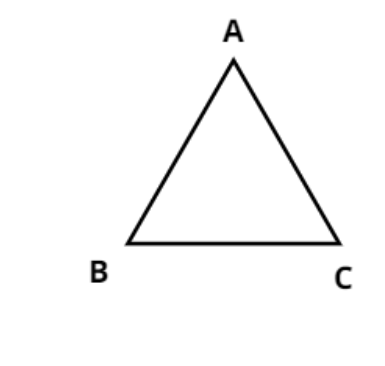
Prove that in triangle ABC: $\left( {\tan A + \tan B + \tan C} \right)\left( {\cot A + \cot B + \cot C} \right) = 1 + \sec A\sec B\sec C$
Answer
 Verified
640.8k+ views
Hint – In this question use the angle sum property of triangle to write tan of angle A+B in terms of tan C. Then use the direct formula of $\tan \left( {A + B} \right)$ that is $\tan \left( {A + B} \right) = \dfrac{{\tan A + \tan B}}{{1 - \tan A\tan B}}$. Simplify the L.H.S part by writing cot x in terms of $\cot x = \dfrac{1}{{\tan x}}$. This will help getting the right hand side.
Complete step-by-step answer:
As we know in triangle the sum of all angle is ${180^o} = \pi $
$ \Rightarrow A + B + C = \pi $................... (1)
Now take C to R.H.S and take tan on both sides we have,
$ \Rightarrow \tan \left( {A + B} \right) = \tan \left( {\pi - C} \right)$
Now apply tan rule we have,
$ \Rightarrow \dfrac{{\tan A + \tan B}}{{1 - \tan A\tan B}} = - \tan C$, $\left[ {\because \tan \left( {\pi - C} \right) = - \tan C} \right]$
Now simplify it we have,
$ \Rightarrow \tan A + \tan B = - \tan C\left( {1 - \tan A\tan B} \right)$
$ \Rightarrow \tan A + \tan B = - \tan C + \tan A\tan B\tan C$
$ \Rightarrow \tan A + \tan B + \tan C = \tan A\tan B\tan C$..................... (2)
Now take L.H.S of the given equation we have,
$ \Rightarrow \left( {\tan A + \tan B + \tan C} \right)\left( {\cot A + \cot B + \cot C} \right)$
Now as we know $\cot x = \dfrac{1}{{\tan x}}$ so use this property in above equation we have,
$ \Rightarrow \left( {\tan A + \tan B + \tan C} \right)\left( {\dfrac{1}{{\tan A}} + \dfrac{1}{{\tan B}} + \dfrac{1}{{\tan C}}} \right)$
Now simplify this equation we have,
$ \Rightarrow \left( {\tan A + \tan B + \tan C} \right)\left( {\dfrac{{\tan B\tan C + \tan A\tan C + \tan A\tan B}}{{\tan A\tan B\tan C}}} \right)$
Now substitute the value from equation (2) we have,
$ \Rightarrow \left( {\tan A\tan B\tan C} \right)\left( {\dfrac{{\tan B\tan C + \tan A\tan C + \tan A\tan B}}{{\tan A\tan B\tan C}}} \right)$
$ \Rightarrow \tan B\tan C + \tan A\tan C + \tan A\tan B$
Now as we know that $\tan x = \dfrac{{\sin x}}{{\cos x}}$ so use this property in above equation we have,
\[ \Rightarrow \dfrac{{\sin B}}{{\cos B}}\dfrac{{\sin C}}{{\cos C}} + \dfrac{{\sin A}}{{\cos A}}\dfrac{{\sin C}}{{\cos C}} + \dfrac{{\sin A}}{{\cos A}}\dfrac{{\sin B}}{{\cos B}}\]
Now take cos A cos B cos C as L.C.M we have,
\[ \Rightarrow \dfrac{{\cos A\sin B\sin C + \cos B\sin A\sin C + \cos C\sin A\sin B}}{{\cos A\cos B\cos C}}\]
Now take sin C common from the numerator first and second term we have,
\[ \Rightarrow \dfrac{{\sin C\left( {\cos A\sin B + \cos B\sin A} \right) + \cos C\sin A\sin B}}{{\cos A\cos B\cos C}}\]
Now as we know that $\sin \left( {A + B} \right) = \sin A\cos B + \cos A\sin B$ so we have,
\[ \Rightarrow \dfrac{{\sin C\sin \left( {A + B} \right) + \cos C\sin A\sin B}}{{\cos A\cos B\cos C}}\]
Now from equation (1) we have,
\[ \Rightarrow \dfrac{{\sin C\sin \left( {\pi - C} \right) + \cos C\sin A\sin B}}{{\cos A\cos B\cos C}}\]
\[ \Rightarrow \dfrac{{{{\sin }^2}C + \cos C\sin A\sin B}}{{\cos A\cos B\cos C}}\], $\left[ {\because \sin \left( {\pi - C} \right) = \sin C} \right]$
Now use ${\sin ^2}C = 1 - {\cos ^2}C$ so we have,
\[ \Rightarrow \dfrac{{1 - {{\cos }^2}C + \cos C\sin A\sin B}}{{\cos A\cos B\cos C}}\]
\[ \Rightarrow \dfrac{1}{{\cos A\cos B\cos C}} - \dfrac{{\cos C\left( {\cos C - \sin A\sin B} \right)}}{{\cos A\cos B\cos C}}\]
\[ \Rightarrow \dfrac{1}{{\cos A\cos B\cos C}} - \dfrac{{\left( {\cos C - \sin A\sin B} \right)}}{{\cos A\cos B}}\]
Now from equation (1) $C = \pi - \left( {A + B} \right)$ so we have,
\[ \Rightarrow \dfrac{1}{{\cos A\cos B\cos C}} - \dfrac{{\left( {\cos \left( {\pi - \left( {A + B} \right)} \right) - \sin A\sin B} \right)}}{{\cos A\cos B}}\]
Now as we know that $\cos \left( {\pi - \theta } \right) = - \cos \theta $ so we have,
\[ \Rightarrow \dfrac{1}{{\cos A\cos B\cos C}} - \dfrac{{\left( { - \cos \left( {A + B} \right) - \sin A\sin B} \right)}}{{\cos A\cos B}}\]
\[ \Rightarrow \dfrac{1}{{\cos A\cos B\cos C}} + \dfrac{{\cos \left( {A + B} \right) + \sin A\sin B}}{{\cos A\cos B}}\]
Now as we know that $\cos \left( {A + B} \right) = \cos A\cos B - \sin A\sin B$ so use this we have,
\[ \Rightarrow \dfrac{1}{{\cos A\cos B\cos C}} + \dfrac{{\cos A\cos B - \sin A\sin B + \sin A\sin B}}{{\cos A\cos B}}\]
\[ \Rightarrow \dfrac{1}{{\cos A\cos B\cos C}} + \dfrac{{\cos A\cos B}}{{\cos A\cos B}}\]
\[ \Rightarrow 1 + \dfrac{1}{{\cos A\cos B\cos C}}\]
Now use $\dfrac{1}{{\cos x}} = \sec x$ so we have,
\[ \Rightarrow 1 + \sec A\sec B\sec C\]
= R.H.S
Hence proved.
Note – It is always advisable to remember the direct trigonometric identities like some of them are being mentioned above. Other important identities include${\sin ^2}x + {\cos ^2}x = 1,{\text{ 1 + ta}}{{\text{n}}^2}x = {\sec ^2}x$, ${\text{tanx = }}\dfrac{{\sin x}}{{\cos x}},\sec x = \dfrac{1}{{\cos x}},\cos ecx = \dfrac{1}{{\sin x}}$. These identities help save a lot of time, for these kinds of problems.
Complete step-by-step answer:
As we know in triangle the sum of all angle is ${180^o} = \pi $
$ \Rightarrow A + B + C = \pi $................... (1)
Now take C to R.H.S and take tan on both sides we have,
$ \Rightarrow \tan \left( {A + B} \right) = \tan \left( {\pi - C} \right)$
Now apply tan rule we have,
$ \Rightarrow \dfrac{{\tan A + \tan B}}{{1 - \tan A\tan B}} = - \tan C$, $\left[ {\because \tan \left( {\pi - C} \right) = - \tan C} \right]$
Now simplify it we have,
$ \Rightarrow \tan A + \tan B = - \tan C\left( {1 - \tan A\tan B} \right)$
$ \Rightarrow \tan A + \tan B = - \tan C + \tan A\tan B\tan C$
$ \Rightarrow \tan A + \tan B + \tan C = \tan A\tan B\tan C$..................... (2)
Now take L.H.S of the given equation we have,
$ \Rightarrow \left( {\tan A + \tan B + \tan C} \right)\left( {\cot A + \cot B + \cot C} \right)$
Now as we know $\cot x = \dfrac{1}{{\tan x}}$ so use this property in above equation we have,
$ \Rightarrow \left( {\tan A + \tan B + \tan C} \right)\left( {\dfrac{1}{{\tan A}} + \dfrac{1}{{\tan B}} + \dfrac{1}{{\tan C}}} \right)$
Now simplify this equation we have,
$ \Rightarrow \left( {\tan A + \tan B + \tan C} \right)\left( {\dfrac{{\tan B\tan C + \tan A\tan C + \tan A\tan B}}{{\tan A\tan B\tan C}}} \right)$
Now substitute the value from equation (2) we have,
$ \Rightarrow \left( {\tan A\tan B\tan C} \right)\left( {\dfrac{{\tan B\tan C + \tan A\tan C + \tan A\tan B}}{{\tan A\tan B\tan C}}} \right)$
$ \Rightarrow \tan B\tan C + \tan A\tan C + \tan A\tan B$
Now as we know that $\tan x = \dfrac{{\sin x}}{{\cos x}}$ so use this property in above equation we have,
\[ \Rightarrow \dfrac{{\sin B}}{{\cos B}}\dfrac{{\sin C}}{{\cos C}} + \dfrac{{\sin A}}{{\cos A}}\dfrac{{\sin C}}{{\cos C}} + \dfrac{{\sin A}}{{\cos A}}\dfrac{{\sin B}}{{\cos B}}\]
Now take cos A cos B cos C as L.C.M we have,
\[ \Rightarrow \dfrac{{\cos A\sin B\sin C + \cos B\sin A\sin C + \cos C\sin A\sin B}}{{\cos A\cos B\cos C}}\]
Now take sin C common from the numerator first and second term we have,
\[ \Rightarrow \dfrac{{\sin C\left( {\cos A\sin B + \cos B\sin A} \right) + \cos C\sin A\sin B}}{{\cos A\cos B\cos C}}\]
Now as we know that $\sin \left( {A + B} \right) = \sin A\cos B + \cos A\sin B$ so we have,
\[ \Rightarrow \dfrac{{\sin C\sin \left( {A + B} \right) + \cos C\sin A\sin B}}{{\cos A\cos B\cos C}}\]
Now from equation (1) we have,
\[ \Rightarrow \dfrac{{\sin C\sin \left( {\pi - C} \right) + \cos C\sin A\sin B}}{{\cos A\cos B\cos C}}\]
\[ \Rightarrow \dfrac{{{{\sin }^2}C + \cos C\sin A\sin B}}{{\cos A\cos B\cos C}}\], $\left[ {\because \sin \left( {\pi - C} \right) = \sin C} \right]$
Now use ${\sin ^2}C = 1 - {\cos ^2}C$ so we have,
\[ \Rightarrow \dfrac{{1 - {{\cos }^2}C + \cos C\sin A\sin B}}{{\cos A\cos B\cos C}}\]
\[ \Rightarrow \dfrac{1}{{\cos A\cos B\cos C}} - \dfrac{{\cos C\left( {\cos C - \sin A\sin B} \right)}}{{\cos A\cos B\cos C}}\]
\[ \Rightarrow \dfrac{1}{{\cos A\cos B\cos C}} - \dfrac{{\left( {\cos C - \sin A\sin B} \right)}}{{\cos A\cos B}}\]
Now from equation (1) $C = \pi - \left( {A + B} \right)$ so we have,
\[ \Rightarrow \dfrac{1}{{\cos A\cos B\cos C}} - \dfrac{{\left( {\cos \left( {\pi - \left( {A + B} \right)} \right) - \sin A\sin B} \right)}}{{\cos A\cos B}}\]
Now as we know that $\cos \left( {\pi - \theta } \right) = - \cos \theta $ so we have,
\[ \Rightarrow \dfrac{1}{{\cos A\cos B\cos C}} - \dfrac{{\left( { - \cos \left( {A + B} \right) - \sin A\sin B} \right)}}{{\cos A\cos B}}\]
\[ \Rightarrow \dfrac{1}{{\cos A\cos B\cos C}} + \dfrac{{\cos \left( {A + B} \right) + \sin A\sin B}}{{\cos A\cos B}}\]
Now as we know that $\cos \left( {A + B} \right) = \cos A\cos B - \sin A\sin B$ so use this we have,
\[ \Rightarrow \dfrac{1}{{\cos A\cos B\cos C}} + \dfrac{{\cos A\cos B - \sin A\sin B + \sin A\sin B}}{{\cos A\cos B}}\]
\[ \Rightarrow \dfrac{1}{{\cos A\cos B\cos C}} + \dfrac{{\cos A\cos B}}{{\cos A\cos B}}\]
\[ \Rightarrow 1 + \dfrac{1}{{\cos A\cos B\cos C}}\]
Now use $\dfrac{1}{{\cos x}} = \sec x$ so we have,
\[ \Rightarrow 1 + \sec A\sec B\sec C\]
= R.H.S
Hence proved.
Note – It is always advisable to remember the direct trigonometric identities like some of them are being mentioned above. Other important identities include${\sin ^2}x + {\cos ^2}x = 1,{\text{ 1 + ta}}{{\text{n}}^2}x = {\sec ^2}x$, ${\text{tanx = }}\dfrac{{\sin x}}{{\cos x}},\sec x = \dfrac{1}{{\cos x}},\cos ecx = \dfrac{1}{{\sin x}}$. These identities help save a lot of time, for these kinds of problems.
Recently Updated Pages
Master Class 12 Economics: Engaging Questions & Answers for Success

Master Class 12 English: Engaging Questions & Answers for Success
Master Class 12 Social Science: Engaging Questions & Answers for Success
Master Class 12 Maths: Engaging Questions & Answers for Success
Master Class 12 Physics: Engaging Questions & Answers for Success
Master Class 11 Social Science: Engaging Questions & Answers for Success
Trending doubts
One Metric ton is equal to kg A 10000 B 1000 C 100 class 11 physics CBSE
Difference Between Prokaryotic Cells and Eukaryotic Cells
Find the value of the expression given below sin 30circ class 11 maths CBSE
Two of the body parts which do not appear in MRI are class 11 biology CBSE
Draw a diagram of nephron and explain its structur class 11 biology CBSE
10 examples of friction in our daily life