




Prove that in any triangle ${{\cos }^{2}}A+{{\cos }^{2}}B-{{\cos }^{2}}C=1-2\sin A\sin B\sin C$
Answer
 Verified
574.8k+ views
Hint: We will first use the trigonometric identity that ${{\sin }^{2}}B+{{\cos }^{2}}B=1$ to simplify the left hand side of the equation to be proved then we will use the identity that ${{\cos }^{2}}A-{{\sin }^{2}}B=\cos \left( A+B \right)\cos \left( A-B \right)$ to combine the cosine terms and take $\cos C$ common in the left hand side then we will use the trigonometric identity that \[\cos C+\cos D=2\cos \left( \dfrac{C+D}{2} \right)\sin \left( \dfrac{D-C}{2} \right)\] to further simplify the left hand side and made it equal to the right hand side.
Complete step-by-step answer:
We have been given a triangle ABC and we have to prove that ${{\cos }^{2}}A+{{\cos }^{2}}B-{{\cos }^{2}}C=1-2\sin A\sin B\sin C$
We will first draw a $\Delta ABC$ and label its sides as a, b, c
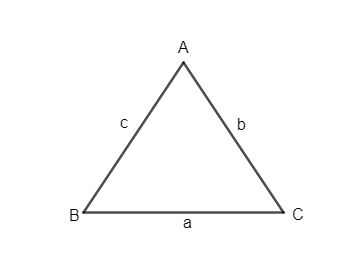
Now, we will take the LHS of the question and prove it to be equal to RHS. In LHS we have \[{{\cos }^{2}}A+{{\cos }^{2}}B-{{\cos }^{2}}C\]
Now we know that ${{\sin }^{2}}B+{{\cos }^{2}}B=1$
Therefore ${{\cos }^{2}}B=1-{{\sin }^{2}}B$using this we have,
\[{{\cos }^{2}}A+{{\cos }^{2}}B-{{\cos }^{2}}C={{\cos }^{2}}A+1-{{\sin }^{2}}B-{{\cos }^{2}}C=1+\left( {{\cos }^{2}}A-{{\sin }^{2}}B \right)-co{{s}^{2}}C\]
Now we know the trigonometric identity that,
${{\cos }^{2}}A-{{\sin }^{2}}B=\cos \left( A+B \right)\cos \left( A-B \right)$
So, we have
\[{{\cos }^{2}}A+{{\cos }^{2}}B-{{\cos }^{2}}C=1+\left( \cos \left( A+B \right)\cos \left( A-B \right) \right)-{{\cos }^{2}}C\]
Also, now we know that according to angle sum property of triangle we have
$\begin{align}
& A+B+C=\pi \\
& A+B=\pi -C \\
\end{align}$
So, using this we have,
\[{{\cos }^{2}}A+{{\cos }^{2}}B-{{\cos }^{2}}C=1+\cos \left( \pi -C \right)\cos \left( A-B \right)-{{\cos }^{2}}C\]
Also, we know that
$\cos \left( \pi -C \right)=-\cos C$
So we have
\[{{\cos }^{2}}A+{{\cos }^{2}}B-{{\cos }^{2}}C=1-\cos C\left( \cos \left( A-B \right)+\cos C \right)\]
Also, we know that
$\cos C=\cos \left( \pi -\left( A+B \right) \right)$
\[{{\cos }^{2}}A+{{\cos }^{2}}B-{{\cos }^{2}}C=1-\cos C\left( \cos \left( A-B \right)+\cos \left( \pi -\left( A+B \right) \right) \right)\]
\[=1-\cos C\left( \cos \left( A-B \right)+\cos \left( A+B \right) \right)\]
Now using the trigonometric identity that
$\operatorname{cosC}+cosD=2sin\left( \dfrac{C+D}{2} \right)\sin \left( \dfrac{D-C}{2} \right)$
We have,
\[{{\cos }^{2}}A+{{\cos }^{2}}B-{{\cos }^{2}}C=1-\cos C\left( 2\sin \left( \dfrac{A-B+A+B}{2} \right)\sin \left( \dfrac{A+B-A+B}{2} \right) \right)\]
\[=1-\cos C\left( 2\sin \left( \dfrac{2A}{2} \right)\sin \left( \dfrac{2B}{2} \right) \right)\]
\[=1-\cos C\left( 2\sin A\sin B \right)\]
\[=1-2\sin A\sin B\cos C\]
Since, LHS = RHS
Hence proved
Note: In these types of questions it is very important to remember trigonometric identities like
$\begin{align}
& \cos A+\operatorname{cosB}=2\sin \left( \dfrac{A+B}{2} \right)\sin \left( \dfrac{B-A}{2} \right) \\
& {{\sin }^{2}}A+{{\cos }^{2}}A=1 \\
& A+B+C=\pi \\
\end{align}$
Complete step-by-step answer:
We have been given a triangle ABC and we have to prove that ${{\cos }^{2}}A+{{\cos }^{2}}B-{{\cos }^{2}}C=1-2\sin A\sin B\sin C$
We will first draw a $\Delta ABC$ and label its sides as a, b, c
Now, we will take the LHS of the question and prove it to be equal to RHS. In LHS we have \[{{\cos }^{2}}A+{{\cos }^{2}}B-{{\cos }^{2}}C\]
Now we know that ${{\sin }^{2}}B+{{\cos }^{2}}B=1$
Therefore ${{\cos }^{2}}B=1-{{\sin }^{2}}B$using this we have,
\[{{\cos }^{2}}A+{{\cos }^{2}}B-{{\cos }^{2}}C={{\cos }^{2}}A+1-{{\sin }^{2}}B-{{\cos }^{2}}C=1+\left( {{\cos }^{2}}A-{{\sin }^{2}}B \right)-co{{s}^{2}}C\]
Now we know the trigonometric identity that,
${{\cos }^{2}}A-{{\sin }^{2}}B=\cos \left( A+B \right)\cos \left( A-B \right)$
So, we have
\[{{\cos }^{2}}A+{{\cos }^{2}}B-{{\cos }^{2}}C=1+\left( \cos \left( A+B \right)\cos \left( A-B \right) \right)-{{\cos }^{2}}C\]
Also, now we know that according to angle sum property of triangle we have
$\begin{align}
& A+B+C=\pi \\
& A+B=\pi -C \\
\end{align}$
So, using this we have,
\[{{\cos }^{2}}A+{{\cos }^{2}}B-{{\cos }^{2}}C=1+\cos \left( \pi -C \right)\cos \left( A-B \right)-{{\cos }^{2}}C\]
Also, we know that
$\cos \left( \pi -C \right)=-\cos C$
So we have
\[{{\cos }^{2}}A+{{\cos }^{2}}B-{{\cos }^{2}}C=1-\cos C\left( \cos \left( A-B \right)+\cos C \right)\]
Also, we know that
$\cos C=\cos \left( \pi -\left( A+B \right) \right)$
\[{{\cos }^{2}}A+{{\cos }^{2}}B-{{\cos }^{2}}C=1-\cos C\left( \cos \left( A-B \right)+\cos \left( \pi -\left( A+B \right) \right) \right)\]
\[=1-\cos C\left( \cos \left( A-B \right)+\cos \left( A+B \right) \right)\]
Now using the trigonometric identity that
$\operatorname{cosC}+cosD=2sin\left( \dfrac{C+D}{2} \right)\sin \left( \dfrac{D-C}{2} \right)$
We have,
\[{{\cos }^{2}}A+{{\cos }^{2}}B-{{\cos }^{2}}C=1-\cos C\left( 2\sin \left( \dfrac{A-B+A+B}{2} \right)\sin \left( \dfrac{A+B-A+B}{2} \right) \right)\]
\[=1-\cos C\left( 2\sin \left( \dfrac{2A}{2} \right)\sin \left( \dfrac{2B}{2} \right) \right)\]
\[=1-\cos C\left( 2\sin A\sin B \right)\]
\[=1-2\sin A\sin B\cos C\]
Since, LHS = RHS
Hence proved
Note: In these types of questions it is very important to remember trigonometric identities like
$\begin{align}
& \cos A+\operatorname{cosB}=2\sin \left( \dfrac{A+B}{2} \right)\sin \left( \dfrac{B-A}{2} \right) \\
& {{\sin }^{2}}A+{{\cos }^{2}}A=1 \\
& A+B+C=\pi \\
\end{align}$
Recently Updated Pages
Master Class 11 Computer Science: Engaging Questions & Answers for Success

Master Class 11 Business Studies: Engaging Questions & Answers for Success
Master Class 11 Economics: Engaging Questions & Answers for Success
Master Class 11 English: Engaging Questions & Answers for Success
Master Class 11 Maths: Engaging Questions & Answers for Success
Master Class 11 Biology: Engaging Questions & Answers for Success
Trending doubts
One Metric ton is equal to kg A 10000 B 1000 C 100 class 11 physics CBSE
There are 720 permutations of the digits 1 2 3 4 5 class 11 maths CBSE
Discuss the various forms of bacteria class 11 biology CBSE
Draw a diagram of a plant cell and label at least eight class 11 biology CBSE
State the laws of reflection of light
Explain zero factorial class 11 maths CBSE