




Prove that if the diagonals of a quadrilateral bisect each other, then prove that it is a parallelogram.
Answer
 Verified
654.6k+ views
Hint: First of all draw a quadrilateral with two diagonals. Then take two vertically opposite triangles made by the diagonals and the sides of the quadrilateral then prove the congruence of two vertically opposite triangles. After that use the property of CPCT to show that opposite sides of the quadrilateral are equal and parallel and we know that a parallelogram has the opposite sides are equal and parallel.
Complete step-by-step answer:
The below diagram is representing a quadrilateral ABCD with two diagonals AC and BD which is intersecting at point E.
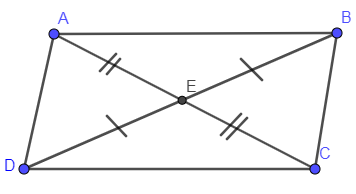
It is given that the diagonals bisect each other so $\text{AE}=\text{EC}$ and $\text{DE}=\text{EB}$.
We are going to prove the congruence of two triangles $\Delta AED\And \Delta BEC$.
In $\Delta AED\And \Delta BEC$,
$\text{AE}=\text{EC}$
$\text{DE}=\text{EB}$
$\angle AED=\angle BEC$
The above two angles are vertically opposite angles and we know that vertically opposite angles are equal.
From the above, we have shown that $\Delta AED\cong \Delta BEC$ by SAS congruence.
As $\Delta AED\cong \Delta BEC$ so using the corresponding part of congruent triangles (CPCT) $\angle ADE=\angle CBE$.
As $\angle ADE\And \angle CBE$ are alternate interior angles when AD is parallel to BC and BD is transversal.
And we have shown that $\angle ADE=\angle CBE$ so AD is parallel to BC.
Through CPCT, $AD=BC$.
Similarly, we can show that AB is parallel to DC and $AB=DC$ by proving the congruence of $\Delta AEB\And \Delta DEC$.
We know the property of a parallelogram that opposite sides are parallel and equal and we have shown above that opposite sides are parallel and equal so the above quadrilateral ABCD is a parallelogram.
Note: You should brush up your concepts of alternate interior angles and vertically opposite angles. The question demands the good knowledge of these properties and the congruence of triangles.
The point to be noted here is that whenever you have given some part of equality of the two triangles and we are asked to find the relation between the other sides and angles of the two triangles then first of all find the congruence of two given triangles and then using CPCT find the relation between other sides and angles of the triangles.
Complete step-by-step answer:
The below diagram is representing a quadrilateral ABCD with two diagonals AC and BD which is intersecting at point E.
It is given that the diagonals bisect each other so $\text{AE}=\text{EC}$ and $\text{DE}=\text{EB}$.
We are going to prove the congruence of two triangles $\Delta AED\And \Delta BEC$.
In $\Delta AED\And \Delta BEC$,
$\text{AE}=\text{EC}$
$\text{DE}=\text{EB}$
$\angle AED=\angle BEC$
The above two angles are vertically opposite angles and we know that vertically opposite angles are equal.
From the above, we have shown that $\Delta AED\cong \Delta BEC$ by SAS congruence.
As $\Delta AED\cong \Delta BEC$ so using the corresponding part of congruent triangles (CPCT) $\angle ADE=\angle CBE$.
As $\angle ADE\And \angle CBE$ are alternate interior angles when AD is parallel to BC and BD is transversal.
And we have shown that $\angle ADE=\angle CBE$ so AD is parallel to BC.
Through CPCT, $AD=BC$.
Similarly, we can show that AB is parallel to DC and $AB=DC$ by proving the congruence of $\Delta AEB\And \Delta DEC$.
We know the property of a parallelogram that opposite sides are parallel and equal and we have shown above that opposite sides are parallel and equal so the above quadrilateral ABCD is a parallelogram.
Note: You should brush up your concepts of alternate interior angles and vertically opposite angles. The question demands the good knowledge of these properties and the congruence of triangles.
The point to be noted here is that whenever you have given some part of equality of the two triangles and we are asked to find the relation between the other sides and angles of the two triangles then first of all find the congruence of two given triangles and then using CPCT find the relation between other sides and angles of the triangles.
Recently Updated Pages
Basicity of sulphurous acid and sulphuric acid are

Master Class 12 Economics: Engaging Questions & Answers for Success
Master Class 12 Biology: Engaging Questions & Answers for Success
Master Class 11 English: Engaging Questions & Answers for Success
Master Class 11 Physics: Engaging Questions & Answers for Success
Master Class 11 Computer Science: Engaging Questions & Answers for Success
Trending doubts
What is the Total Duration of Football Match?
Explain the Treaty of Vienna of 1815 class 10 social science CBSE
In football, which nation is called "La Roja"?
Why is there a time difference of about 5 hours between class 10 social science CBSE
10 examples of evaporation in daily life with explanations
What is the full form of POSCO class 10 social science CBSE