




Prove that for a triangle $ABC$ with sides $a,b,c$ and circumradius and inradius respectively $R$ and $r$, area of the triangle $S = 4Rr\cos \dfrac{A}{2}\cos \dfrac{B}{2}\cos \dfrac{C}{2}$.
Answer
 Verified
585k+ views
Hint: Area of a triangle is expressed using a different formula. Here we use equations using semi-perimeter, circumradius and inradius. Substituting these appropriately and making necessary simplifications we can prove the expression.
Formula used
For a triangle ABC with sides $a,b,c$
Area of the triangle, $S = \sqrt {s(s - a)(s - b)(s - c)} $
where $s = \dfrac{{a + b + c}}{2}$, the semi-perimeter of the triangle.
Also, $\cos \dfrac{A}{2} = \sqrt {\dfrac{{s(s - a)}}{{bc}}} ,\cos \dfrac{B}{2} = \sqrt {\dfrac{{s(s - b)}}{{ac}}} ,\cos \dfrac{C}{2} = \sqrt {\dfrac{{s(s - c)}}{{ab}}} $
If the circumradius and inradius are represented by $R,r$, then
Area of the triangle, $S = \dfrac{{abc}}{{4R}} = rs$, where $s$ is the semi-perimeter.
Complete step-by-step answer:
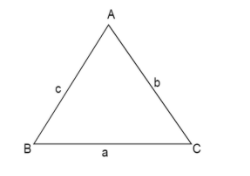
Given that the triangle has sides $a,b,c$ and circumradius and inradius, $R,r$ respectively.
If $s$ is the semi-perimeter of a triangle, then $s = \dfrac{{a + b + c}}{2}$.
Also we have $\cos \dfrac{A}{2} = \sqrt {\dfrac{{s(s - a)}}{{bc}}} ,\cos \dfrac{B}{2} = \sqrt {\dfrac{{s(s - b)}}{{ac}}} ,\cos \dfrac{C}{2} = \sqrt {\dfrac{{s(s - c)}}{{ab}}} $
To prove the area of the triangle is the expression given, we can start with the RHS.
Substituting for $\cos $ terms in RHS we have,
$ \Rightarrow 4Rr\cos \dfrac{A}{2}\cos \dfrac{B}{2}\cos \dfrac{C}{2} = 4Rr\sqrt {\dfrac{{s(s - a)}}{{bc}}} \sqrt {\dfrac{{s(s - b)}}{{ac}}} \sqrt {\dfrac{{s(s - c)}}{{ab}}} $
Simplifying we get,
$ \Rightarrow 4Rr\cos \dfrac{A}{2}\cos \dfrac{B}{2}\cos \dfrac{C}{2} = 4Rr\sqrt {\dfrac{{{s^3}(s - a)(s - b)(s - c)}}{{{a^2}{b^2}{c^2}}}} $
$ \Rightarrow 4Rr\cos \dfrac{A}{2}\cos \dfrac{B}{2}\cos \dfrac{C}{2} = \dfrac{{4Rrs}}{{abc}}\sqrt {s(s - a)(s - b)(s - c)} $
Now since the expression inside the radical/root symbol is the area of a triangle, we can substitute it with $S$.
$ \Rightarrow 4Rr\cos \dfrac{A}{2}\cos \dfrac{B}{2}\cos \dfrac{C}{2} = \dfrac{{4Rrs}}{{abc}}S$
Also, if the circumradius and inradius are represented by $R,r$, then
Area of the triangle, $S = \dfrac{{abc}}{{4R}} = rs$, where $s$ is the semi-perimeter.
So we get,
$ \Rightarrow 4Rr\cos \dfrac{A}{2}\cos \dfrac{B}{2}\cos \dfrac{C}{2} = \dfrac{{4R}}{{abc}} \times rs \times S$
$ \Rightarrow 4Rr\cos \dfrac{A}{2}\cos \dfrac{B}{2}\cos \dfrac{C}{2} = \dfrac{1}{S} \times S \times S$
Cancelling $S$ from numerator and denominator we have,
$ \Rightarrow 4Rr\cos \dfrac{A}{2}\cos \dfrac{B}{2}\cos \dfrac{C}{2} = S$
Hence we had proved the given expression.
Note: Here to substitute the terms easily we start from the RHS. Starting with LHS and getting RHS is somewhat impossible or will be a difficult task. So in these types of questions we have to observe and decide from where we have to start. After making necessary steps we can get into the solution.
Formula used
For a triangle ABC with sides $a,b,c$
Area of the triangle, $S = \sqrt {s(s - a)(s - b)(s - c)} $
where $s = \dfrac{{a + b + c}}{2}$, the semi-perimeter of the triangle.
Also, $\cos \dfrac{A}{2} = \sqrt {\dfrac{{s(s - a)}}{{bc}}} ,\cos \dfrac{B}{2} = \sqrt {\dfrac{{s(s - b)}}{{ac}}} ,\cos \dfrac{C}{2} = \sqrt {\dfrac{{s(s - c)}}{{ab}}} $
If the circumradius and inradius are represented by $R,r$, then
Area of the triangle, $S = \dfrac{{abc}}{{4R}} = rs$, where $s$ is the semi-perimeter.
Complete step-by-step answer:
Given that the triangle has sides $a,b,c$ and circumradius and inradius, $R,r$ respectively.
If $s$ is the semi-perimeter of a triangle, then $s = \dfrac{{a + b + c}}{2}$.
Also we have $\cos \dfrac{A}{2} = \sqrt {\dfrac{{s(s - a)}}{{bc}}} ,\cos \dfrac{B}{2} = \sqrt {\dfrac{{s(s - b)}}{{ac}}} ,\cos \dfrac{C}{2} = \sqrt {\dfrac{{s(s - c)}}{{ab}}} $
To prove the area of the triangle is the expression given, we can start with the RHS.
Substituting for $\cos $ terms in RHS we have,
$ \Rightarrow 4Rr\cos \dfrac{A}{2}\cos \dfrac{B}{2}\cos \dfrac{C}{2} = 4Rr\sqrt {\dfrac{{s(s - a)}}{{bc}}} \sqrt {\dfrac{{s(s - b)}}{{ac}}} \sqrt {\dfrac{{s(s - c)}}{{ab}}} $
Simplifying we get,
$ \Rightarrow 4Rr\cos \dfrac{A}{2}\cos \dfrac{B}{2}\cos \dfrac{C}{2} = 4Rr\sqrt {\dfrac{{{s^3}(s - a)(s - b)(s - c)}}{{{a^2}{b^2}{c^2}}}} $
$ \Rightarrow 4Rr\cos \dfrac{A}{2}\cos \dfrac{B}{2}\cos \dfrac{C}{2} = \dfrac{{4Rrs}}{{abc}}\sqrt {s(s - a)(s - b)(s - c)} $
Now since the expression inside the radical/root symbol is the area of a triangle, we can substitute it with $S$.
$ \Rightarrow 4Rr\cos \dfrac{A}{2}\cos \dfrac{B}{2}\cos \dfrac{C}{2} = \dfrac{{4Rrs}}{{abc}}S$
Also, if the circumradius and inradius are represented by $R,r$, then
Area of the triangle, $S = \dfrac{{abc}}{{4R}} = rs$, where $s$ is the semi-perimeter.
So we get,
$ \Rightarrow 4Rr\cos \dfrac{A}{2}\cos \dfrac{B}{2}\cos \dfrac{C}{2} = \dfrac{{4R}}{{abc}} \times rs \times S$
$ \Rightarrow 4Rr\cos \dfrac{A}{2}\cos \dfrac{B}{2}\cos \dfrac{C}{2} = \dfrac{1}{S} \times S \times S$
Cancelling $S$ from numerator and denominator we have,
$ \Rightarrow 4Rr\cos \dfrac{A}{2}\cos \dfrac{B}{2}\cos \dfrac{C}{2} = S$
Hence we had proved the given expression.
Note: Here to substitute the terms easily we start from the RHS. Starting with LHS and getting RHS is somewhat impossible or will be a difficult task. So in these types of questions we have to observe and decide from where we have to start. After making necessary steps we can get into the solution.
Recently Updated Pages
Master Class 11 Computer Science: Engaging Questions & Answers for Success

Master Class 11 Business Studies: Engaging Questions & Answers for Success
Master Class 11 Economics: Engaging Questions & Answers for Success
Master Class 11 English: Engaging Questions & Answers for Success
Master Class 11 Maths: Engaging Questions & Answers for Success
Master Class 11 Biology: Engaging Questions & Answers for Success
Trending doubts
One Metric ton is equal to kg A 10000 B 1000 C 100 class 11 physics CBSE
There are 720 permutations of the digits 1 2 3 4 5 class 11 maths CBSE
Discuss the various forms of bacteria class 11 biology CBSE
Draw a diagram of a plant cell and label at least eight class 11 biology CBSE
State the laws of reflection of light
Explain zero factorial class 11 maths CBSE