




Prove that equal chords of a circle (or of congruent circles) are equidistant from the centre (or centres).
Answer
 Verified
591.9k+ views
Hint: We use the theorem that the perpendicular drawn from the centre of a circle to any chord bisects the chord to have to get $BM=DN$. We then prove the congruence of the right angled triangles OBM and ODN which will give us $OM=ON$.
Complete step-by-step solution:
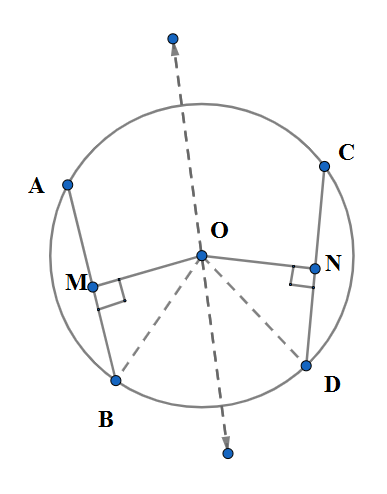
We see in the given figure that two chords of equal length $AB=CD$. We are also given in the centre O and perpendicular are dropped from O on AB as Om and on CD as ON. We are asked to prove AB and CD are equidistant from the centre O which means we have to prove $OM=ON$. \[\]
We know the theorem that the perpendicular (or radius) drawn from the centre of a circle to any chord bisects the chord. We use this theorem to deduce that OM will bisect AB to have
\[\begin{align}
& AM=BM \\
& \Rightarrow AM+BM=AB \\
& \Rightarrow BM+BM=AB\left( \because AM=BM \right) \\
& \Rightarrow 2BM=AB \\
& \Rightarrow BM=\dfrac{1}{2}AB.....\left( 1 \right) \\
\end{align}\]
We use the theorem again to conclude that ON will bisect CD. So we have
\[\begin{align}
& CN=DN \\
& \Rightarrow CN+DN=CD \\
& \Rightarrow DN+DN=CD\left( \because CN=DN \right) \\
& \Rightarrow 2DN=CD \\
& \Rightarrow DN=\dfrac{1}{2}CD....\left( 2 \right) \\
\end{align}\]
Since we are given $AB=CD$ then we have
\[\begin{align}
& \dfrac{1}{2}AB=\dfrac{1}{2}CD \\
& \Rightarrow BM=DN\left( \text{from }\left( 1 \right)\text{ and }\left( 2 \right) \right) \\
\end{align}\]
We observe the right angled triangles OBM and ODN. We have already proved $BM=DN$ and the hypotenuse is $OB=OD$ because of $OB=OD$ are radii of the same circle. So hypotenuse-leg congruence we have
\[\Delta OBM\cong \Delta ODN\]
So the corresponding sides and angles are going to be equal. The only other pair of corresponding sides left are OM and ON. So we have $OM=ON$. Hence it is proved.\[\]
Note: We can proceed similarly to prove the result for two congruent circles (circles with equal radii) that equal chords are equidistant from centres. We note that when two right have equal hypotenuses and one other side (called leg) equal then they are congruent and it is called hypotenuse-leg congruence of right angled triangles.
Complete step-by-step solution:
We see in the given figure that two chords of equal length $AB=CD$. We are also given in the centre O and perpendicular are dropped from O on AB as Om and on CD as ON. We are asked to prove AB and CD are equidistant from the centre O which means we have to prove $OM=ON$. \[\]
We know the theorem that the perpendicular (or radius) drawn from the centre of a circle to any chord bisects the chord. We use this theorem to deduce that OM will bisect AB to have
\[\begin{align}
& AM=BM \\
& \Rightarrow AM+BM=AB \\
& \Rightarrow BM+BM=AB\left( \because AM=BM \right) \\
& \Rightarrow 2BM=AB \\
& \Rightarrow BM=\dfrac{1}{2}AB.....\left( 1 \right) \\
\end{align}\]
We use the theorem again to conclude that ON will bisect CD. So we have
\[\begin{align}
& CN=DN \\
& \Rightarrow CN+DN=CD \\
& \Rightarrow DN+DN=CD\left( \because CN=DN \right) \\
& \Rightarrow 2DN=CD \\
& \Rightarrow DN=\dfrac{1}{2}CD....\left( 2 \right) \\
\end{align}\]
Since we are given $AB=CD$ then we have
\[\begin{align}
& \dfrac{1}{2}AB=\dfrac{1}{2}CD \\
& \Rightarrow BM=DN\left( \text{from }\left( 1 \right)\text{ and }\left( 2 \right) \right) \\
\end{align}\]
We observe the right angled triangles OBM and ODN. We have already proved $BM=DN$ and the hypotenuse is $OB=OD$ because of $OB=OD$ are radii of the same circle. So hypotenuse-leg congruence we have
\[\Delta OBM\cong \Delta ODN\]
So the corresponding sides and angles are going to be equal. The only other pair of corresponding sides left are OM and ON. So we have $OM=ON$. Hence it is proved.\[\]
Note: We can proceed similarly to prove the result for two congruent circles (circles with equal radii) that equal chords are equidistant from centres. We note that when two right have equal hypotenuses and one other side (called leg) equal then they are congruent and it is called hypotenuse-leg congruence of right angled triangles.
Recently Updated Pages
Master Class 11 Social Science: Engaging Questions & Answers for Success

Master Class 11 English: Engaging Questions & Answers for Success
Master Class 11 Maths: Engaging Questions & Answers for Success
Master Class 11 Chemistry: Engaging Questions & Answers for Success
Master Class 11 Biology: Engaging Questions & Answers for Success
Master Class 11 Physics: Engaging Questions & Answers for Success
Trending doubts
One Metric ton is equal to kg A 10000 B 1000 C 100 class 11 physics CBSE
Difference Between Prokaryotic Cells and Eukaryotic Cells
How many of the following diseases can be studied with class 11 biology CBSE
Which of the following enzymes is used for carboxylation class 11 biology CBSE
Draw a diagram of a plant cell and label at least eight class 11 biology CBSE
Two of the body parts which do not appear in MRI are class 11 biology CBSE