




Prove that $\dfrac{{\cos ec\left( {{{90}^ \circ } - x} \right)\sin \left( {{{180}^ \circ } - x} \right)\cot \left( {{{360}^ \circ } - x} \right)}}{{\sec \left( {{{180}^ \circ } + x} \right)\tan \left( {{{90}^ \circ } + x} \right)\sin \left( { - x} \right)}} = 1$
Answer
 Verified
580.2k+ views
Hint: It is known that $\cos ec\left( {{{90}^ \circ } - x} \right) = \sec x$,$\sin \left( {{{180}^ \circ } - x} \right) = \sin x$,$\cot \left( {{{360}^ \circ } - x} \right) = - \cot x$, $\sec \left( {{{180}^ \circ } + x} \right) = - \sec x$,$\tan \left( {{{90}^ \circ } + x} \right) = - \cot x$and $\sin \left( { - x} \right) = - \sin x$. We do this conversion and simplify this if L.H.S will be equal to 1 then it will be proved that $L.H.S = R.H.S$.
Complete step-by-step answer:
\[L.H.S = \dfrac{{\cos ec\left( {{{90}^ \circ } - x} \right)\sin \left( {{{180}^ \circ } - x} \right)\cot \left( {{{360}^ \circ } - x} \right)}}{{\sec \left( {{{180}^ \circ } + x} \right)\tan \left( {{{90}^ \circ } + x} \right)\sin \left( { - x} \right)}}\]
Substitute $\cos ec\left( {{{90}^ \circ } - x} \right) = \sec x$,$\sin \left( {{{180}^ \circ } - x} \right) = \sin x$,$\cot \left( {{{360}^ \circ } - x} \right) = - \cot x$, $\sec \left( {{{180}^ \circ } + x} \right) = - \sec x$,$\tan \left( {{{90}^ \circ } + x} \right) = - \cot x$and $\sin \left( { - x} \right) = - \sin x$, we get,
$ \Rightarrow \dfrac{{\sec x\sin x\left( { - \cot x} \right)}}{{\left( { - \sec x} \right)\left( { - \cot x} \right)\left( { - \sin x} \right)}}$
As we can see every term get cancelled
$\therefore L.H.S = 1$
Given $R.H.S = 1$
Therefore, $L.H.S = R.H.S$proved
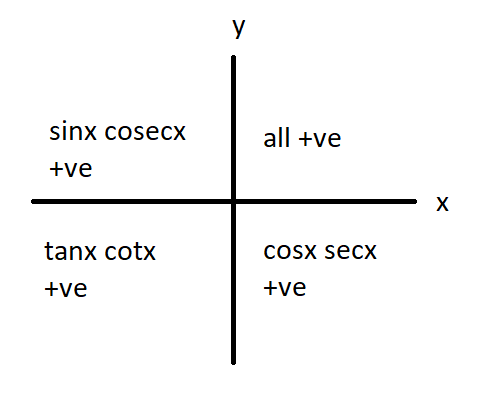
Note: Some important formula. Try to remember these formulas to solve these types of problems.
\[
\sin ({90^ \circ } - x) = \cos x \\
\tan ({90^ \circ } - x) = \cot x \\
\cos ec({90^ \circ } - x) = \sec x \\
\cos \left( {{{90}^ \circ } - x} \right) = \sin x \\
\cot \left( {{{90}^ \circ } - x} \right) = \tan x \\
\sec \left( {{{90}^ \circ } - x} \right) = \cos ecx \\
\]
\[
\sin ({90^ \circ } + x) = \cos x \\
\tan ({90^ \circ } + x) = - \cot x \\
\cos ec({90^ \circ } + x) = \sec x \\
\cos \left( {{{90}^ \circ } + x} \right) = - \sin x \\
\cot \left( {{{90}^ \circ } + x} \right) = - \tan x \\
\sec \left( {{{90}^ \circ } + x} \right) = - \cos ecx \\
\]
$
\sin ({180^ \circ } + x) = - \cos x \\
\tan ({180^ \circ } + x) = \cot x \\
\cos ec({180^ \circ } + x) = - \sec x \\
\cos \left( {{{180}^ \circ } + x} \right) = - \sin x \\
\cot \left( {{{180}^ \circ } + x} \right) = \tan x \\
\sec \left( {{{180}^ \circ } + x} \right) = - \cos ecx \\
$
\[
\sin ({360^ \circ } - x) = - \cos x \\
\tan ({360^ \circ } - x) = - \cot x \\
\cos ec({360^ \circ } - x) = - \sec x \\
\cos \left( {{{360}^ \circ } - x} \right) = \sin x \\
\cot \left( {{{360}^ \circ } - x} \right) = - \tan x \\
\sec \left( {{{360}^ \circ } - x} \right) = \cos ecx \\
\]
Complete step-by-step answer:
\[L.H.S = \dfrac{{\cos ec\left( {{{90}^ \circ } - x} \right)\sin \left( {{{180}^ \circ } - x} \right)\cot \left( {{{360}^ \circ } - x} \right)}}{{\sec \left( {{{180}^ \circ } + x} \right)\tan \left( {{{90}^ \circ } + x} \right)\sin \left( { - x} \right)}}\]
Substitute $\cos ec\left( {{{90}^ \circ } - x} \right) = \sec x$,$\sin \left( {{{180}^ \circ } - x} \right) = \sin x$,$\cot \left( {{{360}^ \circ } - x} \right) = - \cot x$, $\sec \left( {{{180}^ \circ } + x} \right) = - \sec x$,$\tan \left( {{{90}^ \circ } + x} \right) = - \cot x$and $\sin \left( { - x} \right) = - \sin x$, we get,
$ \Rightarrow \dfrac{{\sec x\sin x\left( { - \cot x} \right)}}{{\left( { - \sec x} \right)\left( { - \cot x} \right)\left( { - \sin x} \right)}}$
As we can see every term get cancelled
$\therefore L.H.S = 1$
Given $R.H.S = 1$
Therefore, $L.H.S = R.H.S$proved
Note: Some important formula. Try to remember these formulas to solve these types of problems.
\[
\sin ({90^ \circ } - x) = \cos x \\
\tan ({90^ \circ } - x) = \cot x \\
\cos ec({90^ \circ } - x) = \sec x \\
\cos \left( {{{90}^ \circ } - x} \right) = \sin x \\
\cot \left( {{{90}^ \circ } - x} \right) = \tan x \\
\sec \left( {{{90}^ \circ } - x} \right) = \cos ecx \\
\]
\[
\sin ({90^ \circ } + x) = \cos x \\
\tan ({90^ \circ } + x) = - \cot x \\
\cos ec({90^ \circ } + x) = \sec x \\
\cos \left( {{{90}^ \circ } + x} \right) = - \sin x \\
\cot \left( {{{90}^ \circ } + x} \right) = - \tan x \\
\sec \left( {{{90}^ \circ } + x} \right) = - \cos ecx \\
\]
$
\sin ({180^ \circ } + x) = - \cos x \\
\tan ({180^ \circ } + x) = \cot x \\
\cos ec({180^ \circ } + x) = - \sec x \\
\cos \left( {{{180}^ \circ } + x} \right) = - \sin x \\
\cot \left( {{{180}^ \circ } + x} \right) = \tan x \\
\sec \left( {{{180}^ \circ } + x} \right) = - \cos ecx \\
$
\[
\sin ({360^ \circ } - x) = - \cos x \\
\tan ({360^ \circ } - x) = - \cot x \\
\cos ec({360^ \circ } - x) = - \sec x \\
\cos \left( {{{360}^ \circ } - x} \right) = \sin x \\
\cot \left( {{{360}^ \circ } - x} \right) = - \tan x \\
\sec \left( {{{360}^ \circ } - x} \right) = \cos ecx \\
\]
Recently Updated Pages
Master Class 11 English: Engaging Questions & Answers for Success

Master Class 11 Maths: Engaging Questions & Answers for Success
Master Class 11 Biology: Engaging Questions & Answers for Success
Master Class 11 Physics: Engaging Questions & Answers for Success
Master Class 11 Accountancy: Engaging Questions & Answers for Success
Class 11 Question and Answer - Your Ultimate Solutions Guide
Trending doubts
One Metric ton is equal to kg A 10000 B 1000 C 100 class 11 physics CBSE
Discuss the various forms of bacteria class 11 biology CBSE
Draw a diagram of a plant cell and label at least eight class 11 biology CBSE
State the laws of reflection of light
Explain zero factorial class 11 maths CBSE
10 examples of friction in our daily life