




Prove that:
Chords equidistant from the centre of a circle are equal in length.
Answer
 Verified
560.2k+ views
Hint: Let AB and CD are two chords of a circle with center O. Chord AB is at a distance of OM from the center of the circle and chord CD is at distance ON from the center of the circle. It is given that the chords are equidistant from the center of the circle, therefore, OM = ON.
Join OB and OC. Now, prove $\Delta BOM$ and $\Delta CON$ are congruent by the RHS rule of congruence and we get MB = NC. By using this relation, try to prove AB = CD
Complete step by step answer:
The given diagram shows the chords AB and CD at equidistant from the center of the circle O.
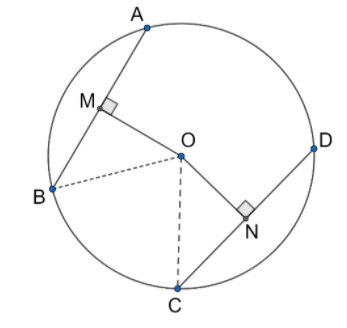
Join OB and OC.
We have $\Delta BOM$ and $\Delta CON$.
In $\Delta BOM$ and $\Delta CON$
OB = OC = radius of circle
OM = ON (given)
$\angle OMB=\angle ONC={{90}^{\circ }}$
So, by RHS rule of congruence,
\[~~\Delta BOM\cong \Delta CON\]
Since corresponding parts of congruent triangles are equal.
Therefore, \[MB=CN......(1)\]
Also, we know that the perpendicular from the center of a circle to a chord divides the chord into two equal halves.
Therefore, AM = MB and CN = ND
From equation (1) we have:
\[MB=CN\]
Multiply both sides by 2, we get:
\[2MB=2CN\]
\[\Rightarrow MB+MB=CN+CN\]
Since AM = MB and CN = ND
We can write,
\[AM+MB=CN+ND\]
\[\Rightarrow AB=CD\]
Hence proved.
Therefore, chords equidistant from the center of a circle are equal in length.
Note: Instead of applying the RHS rule of congruence, we can apply Pythagoras theorem in both the triangles to prove AB = CD.
i.e.
OB = OC = radius of circle, say r
OM = ON = say d
So, by applying Pythagoras theorem in both the triangle, we get:
\[\begin{align}
& MB=\sqrt{{{\left( OB \right)}^{2}}-{{\left( OM \right)}^{2}}} \\
& =\sqrt{{{r}^{2}}-{{d}^{2}}}......(1)
\end{align}\]
\[\begin{align}
& CN=\sqrt{{{\left( OC \right)}^{2}}-{{\left( ON \right)}^{2}}} \\
& =\sqrt{{{r}^{2}}-{{d}^{2}}}......(2)
\end{align}\]
Hence, by comparing equation (1) and (2), we can say that MB = NC and therefore, AB = CD as proved earlier.
Join OB and OC. Now, prove $\Delta BOM$ and $\Delta CON$ are congruent by the RHS rule of congruence and we get MB = NC. By using this relation, try to prove AB = CD
Complete step by step answer:
The given diagram shows the chords AB and CD at equidistant from the center of the circle O.
Join OB and OC.
We have $\Delta BOM$ and $\Delta CON$.
In $\Delta BOM$ and $\Delta CON$
OB = OC = radius of circle
OM = ON (given)
$\angle OMB=\angle ONC={{90}^{\circ }}$
So, by RHS rule of congruence,
\[~~\Delta BOM\cong \Delta CON\]
Since corresponding parts of congruent triangles are equal.
Therefore, \[MB=CN......(1)\]
Also, we know that the perpendicular from the center of a circle to a chord divides the chord into two equal halves.
Therefore, AM = MB and CN = ND
From equation (1) we have:
\[MB=CN\]
Multiply both sides by 2, we get:
\[2MB=2CN\]
\[\Rightarrow MB+MB=CN+CN\]
Since AM = MB and CN = ND
We can write,
\[AM+MB=CN+ND\]
\[\Rightarrow AB=CD\]
Hence proved.
Therefore, chords equidistant from the center of a circle are equal in length.
Note: Instead of applying the RHS rule of congruence, we can apply Pythagoras theorem in both the triangles to prove AB = CD.
i.e.
OB = OC = radius of circle, say r
OM = ON = say d
So, by applying Pythagoras theorem in both the triangle, we get:
\[\begin{align}
& MB=\sqrt{{{\left( OB \right)}^{2}}-{{\left( OM \right)}^{2}}} \\
& =\sqrt{{{r}^{2}}-{{d}^{2}}}......(1)
\end{align}\]
\[\begin{align}
& CN=\sqrt{{{\left( OC \right)}^{2}}-{{\left( ON \right)}^{2}}} \\
& =\sqrt{{{r}^{2}}-{{d}^{2}}}......(2)
\end{align}\]
Hence, by comparing equation (1) and (2), we can say that MB = NC and therefore, AB = CD as proved earlier.
Recently Updated Pages
Master Class 11 English: Engaging Questions & Answers for Success

Master Class 11 Social Science: Engaging Questions & Answers for Success
Master Class 11 Maths: Engaging Questions & Answers for Success
Master Class 11 Biology: Engaging Questions & Answers for Success
Master Class 11 Physics: Engaging Questions & Answers for Success
Master Class 11 Chemistry: Engaging Questions & Answers for Success
Trending doubts
Explain the Treaty of Vienna of 1815 class 10 social science CBSE
What is the full form of POSCO class 10 social science CBSE
Define Potential, Developed, Stock and Reserved resources
The diagonals of a rhombus are 10cm and 24cm Find the class 10 maths CBSE
Fill the blanks with proper collective nouns 1 A of class 10 english CBSE
What planets have no moons Which one has only one moon class 10 physics CBSE