




Prove that $$\angle BOC = 90 + \dfrac{1}{2}\angle BAC$$.
Answer
 Verified
549.3k+ views
Hint: Here in this question, we have to prove $$\angle BOC = 90 + \dfrac{1}{2}\angle BAC$$, For this, first we need to find the values of angle by using a angle bisector, then by using a sum of internal angle of triangle $$\Delta \,ABC$$ and $$\Delta \,BOC$$ which is equal to $${180^ \circ }$$, then on comparing the both triangles and further simplify by using a some triangle properties to get the required solution.
Complete answer:Bisector - A Bisector is any segment, line that splits another line into two congruent (equal) parts. It is applied to both angles and line segments.
Angle bisector: A line that cuts an angle into two equal parts.
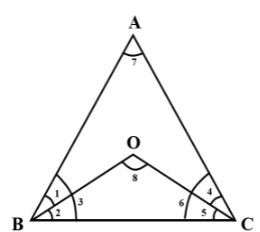
Let us Consider a given triangle $$\Delta \,ABC$$,
In $$\Delta \,ABC$$, line $$BO$$ bisects an angle 3 at point B.
Similarly, line $$CO$$ bisects an angle 4 at point C and makes an triangle $$\Delta \,BOC$$.
The by the bisectors $$BO$$ and $$CO$$, then we have
$$\angle 1 = \angle 2$$ and $$\angle 4 = \angle 5$$.
In triangle $$\Delta \,ABC$$ having an internal angle $$\angle A$$, $$\angle B$$ and $$\angle C$$, then the sum of internal angle is:
$$ \Rightarrow \,\,\angle A + \angle B + \angle C = {180^ \circ }$$
By the given triangle,
But, $$\angle B = 2\angle 2$$ and $$\angle C = 2\angle 5$$, then
$$ \Rightarrow \,\,\angle A + 2\angle 2 + 2\angle 5 = {180^ \circ }$$
Subtract both side by $$\angle A$$, then we have
$$ \Rightarrow \,\,2\left( {\angle 2 + \angle 5} \right) = {180^ \circ } - \angle A$$
Divide both side by 2
$$ \Rightarrow \,\,\angle 2 + \angle 5 = \dfrac{{{{180}^ \circ } - \angle A}}{2}$$
$$ \Rightarrow \,\,\angle 2 + \angle 5 = {90^ \circ } - \dfrac{1}{2}\angle A$$ -------(1)
Now, consider $$\Delta \,BOC$$ having an internal angle $$\angle B$$, $$\angle O$$ and $$\angle C$$, then the sum of internal angle is:
$$ \Rightarrow \,\,\angle O + \angle B + \angle C = {180^ \circ }$$
$$ \Rightarrow \,\,\angle O + \angle 2 + \angle 5 = {180^ \circ }$$
By using a equation (1)
$$ \Rightarrow \,\,\angle O + {90^ \circ } - \dfrac{1}{2}\angle A = {180^ \circ }$$
Subtract $${90^ \circ }$$ on both the sides, then
$$ \Rightarrow \,\,\angle O - \dfrac{1}{2}\angle A = {180^ \circ } - {90^ \circ }$$
$$ \Rightarrow \,\,\angle O - \dfrac{1}{2}\angle A = {90^ \circ }$$
Add $$\dfrac{1}{2}\angle A$$ on both the sides, then we get
$$ \Rightarrow \,\,\angle O = {90^ \circ } + \dfrac{1}{2}\angle A$$
Angle $$\angle O$$ can also be written as $$\angle BOC$$, similarly $$\angle A = \angle BAC$$, then we get
$$\therefore \,\,\,\,\,\angle \,BOC = {90^ \circ } + \dfrac{1}{2}\angle \,BAC$$
Hence, proved.
Note:
While solving these types of questions, we have to know some basic properties, Axioms and postulates of triangles like when two triangles are congruent all sides and angles of two triangles should be equal. Remember the bisector line cuts an angle into two equal angles and the sum of internal angles of any triangles should be always equal to an angle $${180^ \circ }$$.
Complete answer:Bisector - A Bisector is any segment, line that splits another line into two congruent (equal) parts. It is applied to both angles and line segments.
Angle bisector: A line that cuts an angle into two equal parts.
Let us Consider a given triangle $$\Delta \,ABC$$,
In $$\Delta \,ABC$$, line $$BO$$ bisects an angle 3 at point B.
Similarly, line $$CO$$ bisects an angle 4 at point C and makes an triangle $$\Delta \,BOC$$.
The by the bisectors $$BO$$ and $$CO$$, then we have
$$\angle 1 = \angle 2$$ and $$\angle 4 = \angle 5$$.
In triangle $$\Delta \,ABC$$ having an internal angle $$\angle A$$, $$\angle B$$ and $$\angle C$$, then the sum of internal angle is:
$$ \Rightarrow \,\,\angle A + \angle B + \angle C = {180^ \circ }$$
By the given triangle,
But, $$\angle B = 2\angle 2$$ and $$\angle C = 2\angle 5$$, then
$$ \Rightarrow \,\,\angle A + 2\angle 2 + 2\angle 5 = {180^ \circ }$$
Subtract both side by $$\angle A$$, then we have
$$ \Rightarrow \,\,2\left( {\angle 2 + \angle 5} \right) = {180^ \circ } - \angle A$$
Divide both side by 2
$$ \Rightarrow \,\,\angle 2 + \angle 5 = \dfrac{{{{180}^ \circ } - \angle A}}{2}$$
$$ \Rightarrow \,\,\angle 2 + \angle 5 = {90^ \circ } - \dfrac{1}{2}\angle A$$ -------(1)
Now, consider $$\Delta \,BOC$$ having an internal angle $$\angle B$$, $$\angle O$$ and $$\angle C$$, then the sum of internal angle is:
$$ \Rightarrow \,\,\angle O + \angle B + \angle C = {180^ \circ }$$
$$ \Rightarrow \,\,\angle O + \angle 2 + \angle 5 = {180^ \circ }$$
By using a equation (1)
$$ \Rightarrow \,\,\angle O + {90^ \circ } - \dfrac{1}{2}\angle A = {180^ \circ }$$
Subtract $${90^ \circ }$$ on both the sides, then
$$ \Rightarrow \,\,\angle O - \dfrac{1}{2}\angle A = {180^ \circ } - {90^ \circ }$$
$$ \Rightarrow \,\,\angle O - \dfrac{1}{2}\angle A = {90^ \circ }$$
Add $$\dfrac{1}{2}\angle A$$ on both the sides, then we get
$$ \Rightarrow \,\,\angle O = {90^ \circ } + \dfrac{1}{2}\angle A$$
Angle $$\angle O$$ can also be written as $$\angle BOC$$, similarly $$\angle A = \angle BAC$$, then we get
$$\therefore \,\,\,\,\,\angle \,BOC = {90^ \circ } + \dfrac{1}{2}\angle \,BAC$$
Hence, proved.
Note:
While solving these types of questions, we have to know some basic properties, Axioms and postulates of triangles like when two triangles are congruent all sides and angles of two triangles should be equal. Remember the bisector line cuts an angle into two equal angles and the sum of internal angles of any triangles should be always equal to an angle $${180^ \circ }$$.
Recently Updated Pages
Basicity of sulphurous acid and sulphuric acid are

Master Class 10 Computer Science: Engaging Questions & Answers for Success
Master Class 10 Social Science: Engaging Questions & Answers for Success
Master Class 10 Science: Engaging Questions & Answers for Success
Class 10 Question and Answer - Your Ultimate Solutions Guide
Master Class 10 Maths: Engaging Questions & Answers for Success
Trending doubts
What is the Total Duration of Football Match?
Explain the Treaty of Vienna of 1815 class 10 social science CBSE
In football, which nation is called "La Roja"?
Why is there a time difference of about 5 hours between class 10 social science CBSE
10 examples of evaporation in daily life with explanations
What is the full form of POSCO class 10 social science CBSE