




Prove that $a\left( b\cos C- c\cos B \right)={{b}^{2}}-{{c}^{2}}$ where $a,b$ and $c$ are sides opposite to the angles with measure $A,B,C$ in triangle ABC.\[\]
Answer
 Verified
576.9k+ views
Hint: We proceed from the left hand side of the statement of proof by using the projection formula$a=b\cos C+c\cos B$. We then use algebraic identity${{x}^{2}}-{{y}^{2}}=\left( x+y \right)\left( x-y \right)$, the trigonometric identity ${{\cos }^{2}}\theta =1-{{\sin }^{2}}\theta $ and the sine law $\dfrac{a}{\sin A}=\dfrac{b}{\sin B}=\dfrac{c}{\sin C}$ to arrive at the right hand side of the equation.
Complete step-by-step solution:
We are given the question that $a,b$, and $c$ are the length of sides opposite to the angles with measure $A, B, C$ in triangle ABC. We have the right figure of the problem below, \[\]
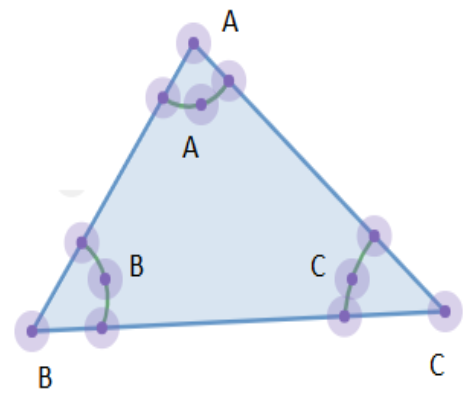
We observe in the above triangle that
\[\angle BAC=\angle A,\angle ABC=\angle B,\angle ACB=\angle C\]
We know from projection formula that
\[a=b\cos C+c\cos B\]
We know from sine law or rule that those lengths of sides of triangle are always in proportion with sines of opposite angles which we can write in symbol as
\[\dfrac{a}{\sin A}=\dfrac{b}{\sin B}=\dfrac{c}{\sin C}\]
We take second and third term in the above equation to have,
\[\begin{align}
& \dfrac{b}{\sin B}=\dfrac{c}{\sin C} \\
& \Rightarrow b\sin C=c\sin B \\
& \Rightarrow {{\left( b\sin C \right)}^{2}}={{\left( c\sin B \right)}^{2}} \\
& \Rightarrow {{b}^{2}}{{\sin }^{2}}C={{c}^{2}}{{\sin }^{2}}B.....\left( 1 \right) \\
\end{align}\]
We are asked to prove the statement
\[ a\left( b\cos C- c\cos B \right)={{b}^{2}}-{{c}^{2}}\]
Let us proceed from the left hand side of the statement and use the projection formula $a=b\cos C+c\cos B$ to have,
\[ a\left( b\cos C- c\cos B \right)=\left( b\cos C+c\cos B \right)\left( b\cos C- c\cos B \right)\]
We use the algebraic identity ${{x}^{2}}-{{y}^{2}}=\left( x+y \right)\left( x-y \right)$ for $x=b\cos C,y=c\cos B$in the above step to have,
\[={{b}^{2}}{{\cos }^{2}}C-{{c}^{2}}{{\cos }^{2}}B\]
We use the trigonometric identity ${{\cos }^{2}}\theta =1-{{\sin }^{2}}\theta $ for any angle with measure $\theta $ for $\theta =C,B$in above step to have,
\[ \begin{align}
& ={{b}^{2}}\left( 1-{{\sin }^{2}}C \right)-{{c}^{2}}\left( 1-{{\sin }^{2}}B \right) \\
& ={{b}^{2}}-{{c}^{2}}-\left( {{b}^{2}}{{\sin }^{2}}C-{{c}^{2}}{{\sin }^{2}}B \right) \\
\end{align}\]
We use the value from (1) in the above step and proceed to have,
\[ \begin{align}
& ={{b}^{2}}-{{c}^{2}}-\left( 0 \right) \\
& ={{b}^{2}}-{{c}^{2}} \\
\end{align}\]
The above expression is at the right hand side of the statement of proof and hence the statement is proved.
Note: We can alternatively solve the above problem using law of cosine relates the sides of a triangle with cosine of one of the angles from where we obtain $\cos C=\dfrac{{{a}^{2}}+{{b}^{2}}-{{c}^{2}}}{2ab}$ and $\cos B=\dfrac{{{b}^{2}}+{{c}^{2}}-{{a}^{2}}}{2bc}$. We put $\cos B,\cos C$ on the left-hand side of the statement of proof, and simplify to arrive at the right-hand side. The law of sine and cosine is used to obtain the third side when lengths of two sides and angles are given in a technique known as triangulation.
Complete step-by-step solution:
We are given the question that $a,b$, and $c$ are the length of sides opposite to the angles with measure $A, B, C$ in triangle ABC. We have the right figure of the problem below, \[\]
We observe in the above triangle that
\[\angle BAC=\angle A,\angle ABC=\angle B,\angle ACB=\angle C\]
We know from projection formula that
\[a=b\cos C+c\cos B\]
We know from sine law or rule that those lengths of sides of triangle are always in proportion with sines of opposite angles which we can write in symbol as
\[\dfrac{a}{\sin A}=\dfrac{b}{\sin B}=\dfrac{c}{\sin C}\]
We take second and third term in the above equation to have,
\[\begin{align}
& \dfrac{b}{\sin B}=\dfrac{c}{\sin C} \\
& \Rightarrow b\sin C=c\sin B \\
& \Rightarrow {{\left( b\sin C \right)}^{2}}={{\left( c\sin B \right)}^{2}} \\
& \Rightarrow {{b}^{2}}{{\sin }^{2}}C={{c}^{2}}{{\sin }^{2}}B.....\left( 1 \right) \\
\end{align}\]
We are asked to prove the statement
\[ a\left( b\cos C- c\cos B \right)={{b}^{2}}-{{c}^{2}}\]
Let us proceed from the left hand side of the statement and use the projection formula $a=b\cos C+c\cos B$ to have,
\[ a\left( b\cos C- c\cos B \right)=\left( b\cos C+c\cos B \right)\left( b\cos C- c\cos B \right)\]
We use the algebraic identity ${{x}^{2}}-{{y}^{2}}=\left( x+y \right)\left( x-y \right)$ for $x=b\cos C,y=c\cos B$in the above step to have,
\[={{b}^{2}}{{\cos }^{2}}C-{{c}^{2}}{{\cos }^{2}}B\]
We use the trigonometric identity ${{\cos }^{2}}\theta =1-{{\sin }^{2}}\theta $ for any angle with measure $\theta $ for $\theta =C,B$in above step to have,
\[ \begin{align}
& ={{b}^{2}}\left( 1-{{\sin }^{2}}C \right)-{{c}^{2}}\left( 1-{{\sin }^{2}}B \right) \\
& ={{b}^{2}}-{{c}^{2}}-\left( {{b}^{2}}{{\sin }^{2}}C-{{c}^{2}}{{\sin }^{2}}B \right) \\
\end{align}\]
We use the value from (1) in the above step and proceed to have,
\[ \begin{align}
& ={{b}^{2}}-{{c}^{2}}-\left( 0 \right) \\
& ={{b}^{2}}-{{c}^{2}} \\
\end{align}\]
The above expression is at the right hand side of the statement of proof and hence the statement is proved.
Note: We can alternatively solve the above problem using law of cosine relates the sides of a triangle with cosine of one of the angles from where we obtain $\cos C=\dfrac{{{a}^{2}}+{{b}^{2}}-{{c}^{2}}}{2ab}$ and $\cos B=\dfrac{{{b}^{2}}+{{c}^{2}}-{{a}^{2}}}{2bc}$. We put $\cos B,\cos C$ on the left-hand side of the statement of proof, and simplify to arrive at the right-hand side. The law of sine and cosine is used to obtain the third side when lengths of two sides and angles are given in a technique known as triangulation.
Recently Updated Pages
Master Class 10 Computer Science: Engaging Questions & Answers for Success

Master Class 10 General Knowledge: Engaging Questions & Answers for Success
Master Class 10 English: Engaging Questions & Answers for Success
Master Class 10 Social Science: Engaging Questions & Answers for Success
Master Class 10 Maths: Engaging Questions & Answers for Success
Master Class 10 Science: Engaging Questions & Answers for Success
Trending doubts
What is the median of the first 10 natural numbers class 10 maths CBSE
Which women's tennis player has 24 Grand Slam singles titles?
Who is the Brand Ambassador of Incredible India?
Why is there a time difference of about 5 hours between class 10 social science CBSE
Write a letter to the principal requesting him to grant class 10 english CBSE
A moving boat is observed from the top of a 150 m high class 10 maths CBSE