




Prove that a cyclic trapezium is isosceles and its diagonals are equal.
Answer
 Verified
631.5k+ views
Hint: First we will draw the required trapezium ABCD and then we will draw a parallel line CE to AD. Then we will use that parallelogram AECD to prove that the cyclic quadrilateral is isosceles. Now we will use the SAS rule of congruence to prove that the diagonals AC and BD are equal.
Complete step-by-step solution -
Let’s first look at the diagram,
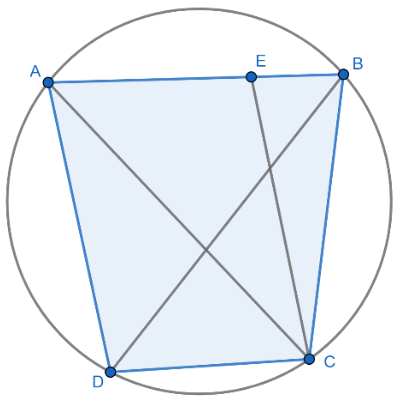
AC and BD are the diagonals and the line CE is parallel to AD.
We know that the opposite angles of a parallelogram are equal.
Therefore, $\angle D=\angle AEC..........(1)$
Now we also know that the sum of opposite angles of a cyclic quadrilateral is 180 degree.
Therefore, $\angle D+\angle ABC=180..........(2)$
From (1) and (2) we can say that,
$\angle AEC+\angle ABC=180........(3)$
Now angle AEC and CEB are linear pair,
Therefore, $\angle AEC+\angle CEB=180.........(4)$
Now again from (3) and (4) we can say that,
$\angle ABC=\angle CEB$
We know that the sides opposite the equal angles are also equal.
Therefore, from $\angle ABC=\angle CEB$ we get
CE = CB ………(5)
But we know that AECD is a parallelogram and hence opposite sides must be equal.
Therefore,
CE = AD ……….(6)
Therefore, from (5) and (6) we can say that
AD = CB ……….(7)
Thus the cyclic trapezium ABCD is isosceles.
Now for the second part,
We have the diagonals as AC and BD.
In triangle DBA and CBA,
AD = CB from (7)
AB = AB common side.
$\angle ADB=\angle ACB$( angles in the same segment of a circle are equal )
Hence, from the SAS rule.
Triangle ABD and ABC are congruent.
Note: All the properties of triangle and circle that we have used must be kept in mind. Cyclic quadrilateral is the quadrilateral which has the sum of opposite angles must be equal to 180.This is also a very important property of the cyclic quadrilateral which makes itself unique from the other quadrilaterals.
Complete step-by-step solution -
Let’s first look at the diagram,
AC and BD are the diagonals and the line CE is parallel to AD.
We know that the opposite angles of a parallelogram are equal.
Therefore, $\angle D=\angle AEC..........(1)$
Now we also know that the sum of opposite angles of a cyclic quadrilateral is 180 degree.
Therefore, $\angle D+\angle ABC=180..........(2)$
From (1) and (2) we can say that,
$\angle AEC+\angle ABC=180........(3)$
Now angle AEC and CEB are linear pair,
Therefore, $\angle AEC+\angle CEB=180.........(4)$
Now again from (3) and (4) we can say that,
$\angle ABC=\angle CEB$
We know that the sides opposite the equal angles are also equal.
Therefore, from $\angle ABC=\angle CEB$ we get
CE = CB ………(5)
But we know that AECD is a parallelogram and hence opposite sides must be equal.
Therefore,
CE = AD ……….(6)
Therefore, from (5) and (6) we can say that
AD = CB ……….(7)
Thus the cyclic trapezium ABCD is isosceles.
Now for the second part,
We have the diagonals as AC and BD.
In triangle DBA and CBA,
AD = CB from (7)
AB = AB common side.
$\angle ADB=\angle ACB$( angles in the same segment of a circle are equal )
Hence, from the SAS rule.
Triangle ABD and ABC are congruent.
Note: All the properties of triangle and circle that we have used must be kept in mind. Cyclic quadrilateral is the quadrilateral which has the sum of opposite angles must be equal to 180.This is also a very important property of the cyclic quadrilateral which makes itself unique from the other quadrilaterals.
Recently Updated Pages
Master Class 12 Business Studies: Engaging Questions & Answers for Success

Master Class 12 Biology: Engaging Questions & Answers for Success
Master Class 12 Chemistry: Engaging Questions & Answers for Success
Class 12 Question and Answer - Your Ultimate Solutions Guide
Master Class 11 Social Science: Engaging Questions & Answers for Success
Master Class 11 English: Engaging Questions & Answers for Success
Trending doubts
What is BLO What is the full form of BLO class 8 social science CBSE
What are the 12 elements of nature class 8 chemistry CBSE
Citizens of India can vote at the age of A 18 years class 8 social science CBSE
Right to vote is a AFundamental Right BFundamental class 8 social science CBSE
Advantages and disadvantages of science
Full form of STD, ISD and PCO