




Prove that
1. \[\dfrac{{\cos A}}{{1 - \sin A}} = \tan \left( {\dfrac{\pi }{4} + \dfrac{A}{2}} \right)\]
2. \[\sin 20^\circ \sin 40^\circ \sin 60^\circ \sin 80^\circ = \dfrac{3}{{16}}\]
Answer
 Verified
648k+ views
Hint: In this problem they give the trigonometric relation to prove. We are going to prove this problem by using the method, first consider the left hand side and from that we will derive the right hand side.
Formula used: We have used the following formula to derive the right hand side in i),
Algebraic formula,
\[{a^2} - {b^2} = (a + b)(a - b)\]
\[{(a + b)^2} = {a^2} + 2ab + {b^2}\]
Trigonometric formula,
\[{\sin ^2}\theta + {\cos ^2}\theta = 1\]
\[\sin 2\theta = 2\sin \theta \cos \theta \]
\[\cos 2\theta = {\cos ^2}\theta - {\sin ^2}\theta \]
$\dfrac{{\sin {\text{ }}\theta }}{{\cos {\text{ }}\theta }} = \tan \;\theta $
$\tan \left( {a + b} \right) = \dfrac{{\tan {\text{ a + tan b}}}}{{1 - \left( {\tan {\text{ a}}} \right)\left( {\tan {\text{ b}}} \right)}}$
We have used the following formula to derive the right hand side in ii),
Trigonometric formula,
\[2\sin x\sin y = \cos (x - y) - \cos (x + y)\]
\[2\sin x\cos y = \sin (x + y) + \sin (x - y)\]
\[\sin ( - \theta ) = - \sin \theta \]
Complete step-by-step answer:
1. We need to prove \[\dfrac{{\cos A}}{{1 - \sin A}} = \tan \left( {\dfrac{\pi }{4} + \dfrac{A}{2}} \right)\].
Let us consider the L.H.S \[ = \dfrac{{\cos A}}{{1 - \sin A}}\]
We will multiply and divide the same term \[1 + \sin A\], we get
\[ \Rightarrow \dfrac{{\cos A}}{{1 - \sin A}} \times \dfrac{{1 + \sin A}}{{1 + \sin A}}\]
Simplifying we get,
\[ \Rightarrow \dfrac{{\cos A(1 + \sin A)}}{{(1 - \sin A)(1 + \sin A)}}\]
Using the algebraic formula \[{a^2} - {b^2} = (a + b)(a - b)\] for denominator,
\[ \Rightarrow \dfrac{{\cos A(1 + \sin A)}}{{(1 - {{\sin }^2}A)}}\]
We know, \[{\sin ^2}\theta + {\cos ^2}\theta = 1\] by using this,
\[ \Rightarrow \dfrac{{\cos A(1 + \sin A)}}{{{{\cos }^2}A}}\]
Simplifying we get,
\[ \Rightarrow \dfrac{{1 + \sin A}}{{\cos A}}\]
By using the \[\sin 2\theta = 2\sin \theta \cos \theta \] to get the required result,
\[ \Rightarrow \dfrac{{{{\sin }^2}\dfrac{A}{2} + {{\cos }^2}\dfrac{A}{2} + 2\sin \dfrac{A}{2}\cos \dfrac{A}{2}}}{{{{\cos }^2}\dfrac{A}{2} - {{\sin }^2}\dfrac{A}{2}}}\]
Now, we can use the algebraic formula, \[{(a + b)^2} = {a^2} + 2ab + {b^2}\] and the trigonometric formula,\[\cos 2\theta = {\cos ^2}\theta - {\sin ^2}\theta \]
\[ \Rightarrow \dfrac{{{{(\sin \dfrac{A}{2} + \cos \dfrac{A}{2})}^2}}}{{(\cos \dfrac{A}{2} + \sin \dfrac{A}{2})(\cos \dfrac{A}{2} - \sin \dfrac{A}{2})}}\]
Cancelling the common terms in numerator and denominator we get,
\[ \Rightarrow \dfrac{{\sin \dfrac{A}{2} + \cos \dfrac{A}{2}}}{{\cos \dfrac{A}{2} - \sin \dfrac{A}{2}}}\]
Dividing denominator and numerator by \[\cos \dfrac{A}{2}\],
\[ \Rightarrow \dfrac{{\dfrac{{\sin \dfrac{A}{2} + \cos \dfrac{A}{2}}}{{\cos \dfrac{A}{2}}}}}{{\dfrac{{\cos \dfrac{A}{2} - \sin \dfrac{A}{2}}}{{\cos \dfrac{A}{2}}}}}\]
By using the formula $\dfrac{{\sin {\text{ }}\theta }}{{\cos {\text{ }}\theta }} = \tan \;\theta $ we get,
\[ \Rightarrow \dfrac{{\tan \dfrac{A}{2} + \tan \dfrac{\pi }{4}}}{{1 - \tan \dfrac{A}{2}\tan \dfrac{\pi }{4}}}\]
We know that is $\tan \left( {a + b} \right) = \dfrac{{\tan {\text{ a + tan b}}}}{{1 - \left( {\tan {\text{ a}}} \right)\left( {\tan {\text{ b}}} \right)}}$ which gives,
\[ \Rightarrow \tan \left( {\dfrac{\pi }{4} + \dfrac{A}{2}} \right)\]
=R.H.S.
Hence L.H.S = R.H.S.
\[\therefore \dfrac{{\cos A}}{{1 - \sin A}} = \tan \left( {\dfrac{\pi }{4} + \dfrac{A}{2}} \right)\](proved).
2. We need to prove \[\sin 20^\circ \sin 40^\circ \sin 60^\circ \sin 80^\circ = \dfrac{3}{{16}}\]
L.H.S =
\[ \Rightarrow \sin 20^\circ \sin 40^\circ \sin 60^\circ \sin 80^\circ \]
Multiply and divide by $2$ we get,
\[ \Rightarrow \dfrac{1}{2}(\sin 20^\circ \sin 60^\circ )(2\sin 40^\circ \sin 80^\circ )\]
We know, \[2\sin x\sin y = \cos (x - y) - \cos (x + y)\] by using,
\[ \Rightarrow \dfrac{1}{2}(\sin 20^\circ \sin 60^\circ )[\cos (80^\circ - 40^\circ ) - \cos (80^\circ + 40^\circ )]\]
Substituting the value $\sin {60^ \circ } = \dfrac{{\sqrt 3 }}{2}$,
\[ \Rightarrow \dfrac{1}{2}\left( {\sin 20^\circ \dfrac{{\sqrt 3 }}{2}} \right)\left( {\cos 40^\circ - \cos 120^\circ } \right)\]
Simplifying we get,
\[ \Rightarrow \dfrac{{\sqrt 3 }}{4}\sin 20^\circ \left( {\cos 40^\circ + \dfrac{1}{2}} \right)\]
Again we can use, \[2\sin x\cos y = \sin (x + y) + \sin (x - y)\]
\[ \Rightarrow \dfrac{{\sqrt 3 }}{8}2\sin 20^\circ \cos 40^\circ + \dfrac{{\sqrt 3 }}{8}\sin 20^\circ \]
\[ \Rightarrow \dfrac{{\sqrt 3 }}{8}\left[ {\sin (20^\circ + 40^\circ ) + \sin (20^\circ - 40^\circ )} \right] + \dfrac{{\sqrt 3 }}{8}\sin 20^\circ \]
Simplifying we get,
\[ \Rightarrow \dfrac{{\sqrt 3 }}{8}\left[ {\sin 60^\circ + \sin ( - 20^\circ )} \right] + \dfrac{{\sqrt 3 }}{8}\sin 20^\circ \]
Now, \[\sin ( - \theta ) = - \sin \theta \]
\[ \Rightarrow \dfrac{{\sqrt 3 }}{8}\left( {\sin 60^\circ - \sin 20^\circ } \right) + \dfrac{{\sqrt 3 }}{8}\sin 20^\circ \]
\[ \Rightarrow \dfrac{{\sqrt 3 }}{8}\sin 60^\circ - \dfrac{{\sqrt 3 }}{8}\sin 20^\circ + \dfrac{{\sqrt 3 }}{8}\sin 20^\circ \]
Subtracting the terms and substituting the value of $\sin {60^ \circ } = \dfrac{{\sqrt 3 }}{2}$ we get,
\[ \Rightarrow \dfrac{{\sqrt 3 }}{8} \times \dfrac{{\sqrt 3 }}{2}\]
\[ \Rightarrow \dfrac{3}{{16}}\]
=R.H.S.
L.H.S. = R.H.S.
$\therefore $Hence, \[\sin 20^\circ \sin 40^\circ \sin 60^\circ \sin 80^\circ = \dfrac{3}{{16}}\](Proved).
Note: Sin Cos formulas are based on sides of the right-angled triangle. Sin and Cos are basic trigonometric functions along with tan function, in trigonometry. Sine of angle is equal to the ratio of opposite side and hypotenuse whereas cosine of an angle is equal to ratio of adjacent side and hypotenuse.
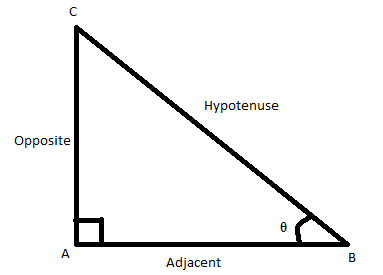
\[{\text{sin}} \theta = \dfrac{{{\text{Opposite side}}}}{{{\text{Hypotenuse}}}}\]
\[{\text{cos}} \theta = \dfrac{{{\text{Adjacent}}}}{{{\text{Hypotenuse}}}}\]
In mathematics, the trigonometric functions are real functions which relate an angle of a right-angled triangle to ratios of two side lengths. They are widely used in all sciences that are related to geometry, such as navigation, solid mechanics, celestial mechanics, geodesy, and many others. The most widely used trigonometric functions are the sine, the cosine, and the tangent.
Formula used: We have used the following formula to derive the right hand side in i),
Algebraic formula,
\[{a^2} - {b^2} = (a + b)(a - b)\]
\[{(a + b)^2} = {a^2} + 2ab + {b^2}\]
Trigonometric formula,
\[{\sin ^2}\theta + {\cos ^2}\theta = 1\]
\[\sin 2\theta = 2\sin \theta \cos \theta \]
\[\cos 2\theta = {\cos ^2}\theta - {\sin ^2}\theta \]
$\dfrac{{\sin {\text{ }}\theta }}{{\cos {\text{ }}\theta }} = \tan \;\theta $
$\tan \left( {a + b} \right) = \dfrac{{\tan {\text{ a + tan b}}}}{{1 - \left( {\tan {\text{ a}}} \right)\left( {\tan {\text{ b}}} \right)}}$
We have used the following formula to derive the right hand side in ii),
Trigonometric formula,
\[2\sin x\sin y = \cos (x - y) - \cos (x + y)\]
\[2\sin x\cos y = \sin (x + y) + \sin (x - y)\]
\[\sin ( - \theta ) = - \sin \theta \]
Complete step-by-step answer:
1. We need to prove \[\dfrac{{\cos A}}{{1 - \sin A}} = \tan \left( {\dfrac{\pi }{4} + \dfrac{A}{2}} \right)\].
Let us consider the L.H.S \[ = \dfrac{{\cos A}}{{1 - \sin A}}\]
We will multiply and divide the same term \[1 + \sin A\], we get
\[ \Rightarrow \dfrac{{\cos A}}{{1 - \sin A}} \times \dfrac{{1 + \sin A}}{{1 + \sin A}}\]
Simplifying we get,
\[ \Rightarrow \dfrac{{\cos A(1 + \sin A)}}{{(1 - \sin A)(1 + \sin A)}}\]
Using the algebraic formula \[{a^2} - {b^2} = (a + b)(a - b)\] for denominator,
\[ \Rightarrow \dfrac{{\cos A(1 + \sin A)}}{{(1 - {{\sin }^2}A)}}\]
We know, \[{\sin ^2}\theta + {\cos ^2}\theta = 1\] by using this,
\[ \Rightarrow \dfrac{{\cos A(1 + \sin A)}}{{{{\cos }^2}A}}\]
Simplifying we get,
\[ \Rightarrow \dfrac{{1 + \sin A}}{{\cos A}}\]
By using the \[\sin 2\theta = 2\sin \theta \cos \theta \] to get the required result,
\[ \Rightarrow \dfrac{{{{\sin }^2}\dfrac{A}{2} + {{\cos }^2}\dfrac{A}{2} + 2\sin \dfrac{A}{2}\cos \dfrac{A}{2}}}{{{{\cos }^2}\dfrac{A}{2} - {{\sin }^2}\dfrac{A}{2}}}\]
Now, we can use the algebraic formula, \[{(a + b)^2} = {a^2} + 2ab + {b^2}\] and the trigonometric formula,\[\cos 2\theta = {\cos ^2}\theta - {\sin ^2}\theta \]
\[ \Rightarrow \dfrac{{{{(\sin \dfrac{A}{2} + \cos \dfrac{A}{2})}^2}}}{{(\cos \dfrac{A}{2} + \sin \dfrac{A}{2})(\cos \dfrac{A}{2} - \sin \dfrac{A}{2})}}\]
Cancelling the common terms in numerator and denominator we get,
\[ \Rightarrow \dfrac{{\sin \dfrac{A}{2} + \cos \dfrac{A}{2}}}{{\cos \dfrac{A}{2} - \sin \dfrac{A}{2}}}\]
Dividing denominator and numerator by \[\cos \dfrac{A}{2}\],
\[ \Rightarrow \dfrac{{\dfrac{{\sin \dfrac{A}{2} + \cos \dfrac{A}{2}}}{{\cos \dfrac{A}{2}}}}}{{\dfrac{{\cos \dfrac{A}{2} - \sin \dfrac{A}{2}}}{{\cos \dfrac{A}{2}}}}}\]
By using the formula $\dfrac{{\sin {\text{ }}\theta }}{{\cos {\text{ }}\theta }} = \tan \;\theta $ we get,
\[ \Rightarrow \dfrac{{\tan \dfrac{A}{2} + \tan \dfrac{\pi }{4}}}{{1 - \tan \dfrac{A}{2}\tan \dfrac{\pi }{4}}}\]
We know that is $\tan \left( {a + b} \right) = \dfrac{{\tan {\text{ a + tan b}}}}{{1 - \left( {\tan {\text{ a}}} \right)\left( {\tan {\text{ b}}} \right)}}$ which gives,
\[ \Rightarrow \tan \left( {\dfrac{\pi }{4} + \dfrac{A}{2}} \right)\]
=R.H.S.
Hence L.H.S = R.H.S.
\[\therefore \dfrac{{\cos A}}{{1 - \sin A}} = \tan \left( {\dfrac{\pi }{4} + \dfrac{A}{2}} \right)\](proved).
2. We need to prove \[\sin 20^\circ \sin 40^\circ \sin 60^\circ \sin 80^\circ = \dfrac{3}{{16}}\]
L.H.S =
\[ \Rightarrow \sin 20^\circ \sin 40^\circ \sin 60^\circ \sin 80^\circ \]
Multiply and divide by $2$ we get,
\[ \Rightarrow \dfrac{1}{2}(\sin 20^\circ \sin 60^\circ )(2\sin 40^\circ \sin 80^\circ )\]
We know, \[2\sin x\sin y = \cos (x - y) - \cos (x + y)\] by using,
\[ \Rightarrow \dfrac{1}{2}(\sin 20^\circ \sin 60^\circ )[\cos (80^\circ - 40^\circ ) - \cos (80^\circ + 40^\circ )]\]
Substituting the value $\sin {60^ \circ } = \dfrac{{\sqrt 3 }}{2}$,
\[ \Rightarrow \dfrac{1}{2}\left( {\sin 20^\circ \dfrac{{\sqrt 3 }}{2}} \right)\left( {\cos 40^\circ - \cos 120^\circ } \right)\]
Simplifying we get,
\[ \Rightarrow \dfrac{{\sqrt 3 }}{4}\sin 20^\circ \left( {\cos 40^\circ + \dfrac{1}{2}} \right)\]
Again we can use, \[2\sin x\cos y = \sin (x + y) + \sin (x - y)\]
\[ \Rightarrow \dfrac{{\sqrt 3 }}{8}2\sin 20^\circ \cos 40^\circ + \dfrac{{\sqrt 3 }}{8}\sin 20^\circ \]
\[ \Rightarrow \dfrac{{\sqrt 3 }}{8}\left[ {\sin (20^\circ + 40^\circ ) + \sin (20^\circ - 40^\circ )} \right] + \dfrac{{\sqrt 3 }}{8}\sin 20^\circ \]
Simplifying we get,
\[ \Rightarrow \dfrac{{\sqrt 3 }}{8}\left[ {\sin 60^\circ + \sin ( - 20^\circ )} \right] + \dfrac{{\sqrt 3 }}{8}\sin 20^\circ \]
Now, \[\sin ( - \theta ) = - \sin \theta \]
\[ \Rightarrow \dfrac{{\sqrt 3 }}{8}\left( {\sin 60^\circ - \sin 20^\circ } \right) + \dfrac{{\sqrt 3 }}{8}\sin 20^\circ \]
\[ \Rightarrow \dfrac{{\sqrt 3 }}{8}\sin 60^\circ - \dfrac{{\sqrt 3 }}{8}\sin 20^\circ + \dfrac{{\sqrt 3 }}{8}\sin 20^\circ \]
Subtracting the terms and substituting the value of $\sin {60^ \circ } = \dfrac{{\sqrt 3 }}{2}$ we get,
\[ \Rightarrow \dfrac{{\sqrt 3 }}{8} \times \dfrac{{\sqrt 3 }}{2}\]
\[ \Rightarrow \dfrac{3}{{16}}\]
=R.H.S.
L.H.S. = R.H.S.
$\therefore $Hence, \[\sin 20^\circ \sin 40^\circ \sin 60^\circ \sin 80^\circ = \dfrac{3}{{16}}\](Proved).
Note: Sin Cos formulas are based on sides of the right-angled triangle. Sin and Cos are basic trigonometric functions along with tan function, in trigonometry. Sine of angle is equal to the ratio of opposite side and hypotenuse whereas cosine of an angle is equal to ratio of adjacent side and hypotenuse.
\[{\text{sin}} \theta = \dfrac{{{\text{Opposite side}}}}{{{\text{Hypotenuse}}}}\]
\[{\text{cos}} \theta = \dfrac{{{\text{Adjacent}}}}{{{\text{Hypotenuse}}}}\]
In mathematics, the trigonometric functions are real functions which relate an angle of a right-angled triangle to ratios of two side lengths. They are widely used in all sciences that are related to geometry, such as navigation, solid mechanics, celestial mechanics, geodesy, and many others. The most widely used trigonometric functions are the sine, the cosine, and the tangent.
Recently Updated Pages
Which will be the least stable resonating structure class 11 chemistry CBSE

How many 5 digit telephone numbers can be construc-class-11-maths-CBSE
How do you find the angle of the resultant vector class 11 physics CBSE
Draw labelled diagram of the following i Gram seed class 11 biology CBSE
1 Quintal is equal to a 110 kg b 10 kg c 100kg d 1000 class 11 physics CBSE
What is the need and importance of classification class 11 biology CBSE
Trending doubts
One Metric ton is equal to kg A 10000 B 1000 C 100 class 11 physics CBSE
Find the value of the expression given below sin 30circ class 11 maths CBSE
Draw a diagram of nephron and explain its structur class 11 biology CBSE
10 examples of friction in our daily life
Proton was discovered by A Thomson B Rutherford C Chadwick class 11 chemistry CBSE
The teeth used for biting and cutting food are called class 11 biology CBSE