




How do you prove \[{\sec ^{ - 1}}x + \cos e{c^{ - 1}}x = \dfrac{\pi }{2}\] ?
Answer
 Verified
493.8k+ views
Hint: These inverse functions in trigonometry are used to get the angle with any of the trigonometry ratios. So, we will substitute and solve accordingly. By using the Pythagoras theorem, we know \[\sin \theta = \dfrac{{Opposite}}{{Hypotenuse}}\] . We will use this identity \[si{n^{-1}}a + si{n^{-1}}b = si{n^{-1}}(a\sqrt {1-{b^2}} + b\sqrt {1-{a^2}} )\] and solve this given equation and get the final output.
Complete step-by-step answer:
Inverse function: If y=f(x) and x=g(y) are two functions such that f(g(y))=y and g(f(y))=x, then f and y are said to be inverse of each other \[x = {f^{ - 1}}(y)\].
As we know that trigonometric functions are not one-one and onto in their natural domain and range, so their inverse do not exist but if we restrict their domain and range, then their inverse may exist.
Given that,
\[{\sec ^{ - 1}}x + \cos e{c^{ - 1}}x = \dfrac{\pi }{2}\]
Let,
\[{\sec ^{ - 1}}x = y\]
\[ \Rightarrow x = \sec y\]
\[ \Rightarrow x = \cos ec\left( {\dfrac{\pi }{2} - y} \right)\]
\[ \Rightarrow \cos e{c^{ - 1}}x = \dfrac{\pi }{2} - y\]
Substituting back the value of y, we will get,
\[ \Rightarrow \cos e{c^{ - 1}}x = \dfrac{\pi }{2} - {\sec ^{ - 1}}x\]
By using transposing method, move the RHS term to LHS term, we will get,
\[ \Rightarrow \cos e{c^{ - 1}}x + {\sec ^{ - 1}}x = \dfrac{\pi }{2}\]
Rearrange this, we will get,
\[ \Rightarrow {\sec ^{ - 1}}x + \cos e{c^{ - 1}}x = \dfrac{\pi }{2}\]
Note: Let,
\[{\sec ^{ - 1}}x = \theta \]
\[ \Rightarrow x = \sec \theta \]
\[ \Rightarrow x = \dfrac{1}{{\cos \theta }}\]
\[ \Rightarrow \cos \theta = \dfrac{1}{x}\]
\[ \Rightarrow \dfrac{1}{x} = \cos \theta \]
\[ \Rightarrow \theta = {\cos ^{ - 1}}\left( {\dfrac{1}{x}} \right)\]
\[ \Rightarrow \theta = {\cos ^{ - 1}}\left( {\dfrac{1}{x}} \right)\]
According to the Pythagoras theorem, we will draw the diagram as below:
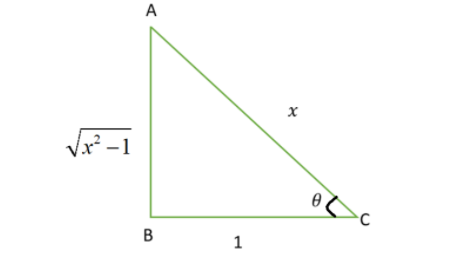
We know that, \[\sin \theta = \dfrac{{Opposite}}{{Hypotenuse}} = \dfrac{{AB}}{{AC}}\]
\[\sin \theta = \dfrac{{\sqrt {{x^2} - 1} }}{x}\]
\[ \Rightarrow \theta = {\sin ^{ - 1}}\left( {\dfrac{{\sqrt {{x^2} - 1} }}{x}} \right)\]
Now,
\[\therefore {\sec ^{ - 1}}x + \cos e{c^{ - 1}}x\]
\[ = {\cos ^{ - 1}}\left( {\dfrac{1}{x}} \right) + {\sin ^{ - 1}}\left( {\dfrac{1}{x}} \right)\]
\[ = \theta + {\sin ^{ - 1}}\left( {\dfrac{1}{x}} \right)\]
Substituting the value of \[\theta \] , we will get,
\[ = {\sin ^{ - 1}}\left( {\dfrac{{\sqrt {{x^2} - 1} }}{x}} \right) + {\sin ^{ - 1}}\left( {\dfrac{1}{x}} \right)\]
We know the identity \[si{n^{-1}}a + si{n^{-1}}b = si{n^{-1}}(a\sqrt {1-{b^2}} + b\sqrt {1-{a^2}} )\] , and so applying this, we will get,
\[ = {\sin ^{ - 1}}\left( {\dfrac{{\sqrt {{x^2} - 1} }}{x} \times \sqrt {1 - \dfrac{1}{{{x^2}}}} + \sqrt {1 - \dfrac{{{x^2} - 1}}{{{x^2}}}} \times \dfrac{1}{x}} \right)\]
\[ = {\sin ^{ - 1}}\left( {\dfrac{{\sqrt {{x^2} - 1} }}{x} \times \dfrac{{\sqrt {{x^2} - 1} }}{x} + \dfrac{1}{x} \times \dfrac{1}{x}} \right)\]
\[ = {\sin ^{ - 1}}\left( {\dfrac{{{x^2} - 1}}{{{x^2}}} + \dfrac{1}{{{x^2}}}} \right)\]
Taking LCM, we will get,
\[ = {\sin ^{ - 1}}\left( {\dfrac{{{x^2} - 1 + 1}}{{{x^2}}}} \right)\]
\[ = {\sin ^{ - 1}}\left( 1 \right)\]
\[ = \dfrac{\pi }{2}\]
Hence, it is proved that \[{\sec ^{ - 1}}x + \cos e{c^{ - 1}}x = \dfrac{\pi }{2}\] .
Complete step-by-step answer:
Inverse function: If y=f(x) and x=g(y) are two functions such that f(g(y))=y and g(f(y))=x, then f and y are said to be inverse of each other \[x = {f^{ - 1}}(y)\].
As we know that trigonometric functions are not one-one and onto in their natural domain and range, so their inverse do not exist but if we restrict their domain and range, then their inverse may exist.
Given that,
\[{\sec ^{ - 1}}x + \cos e{c^{ - 1}}x = \dfrac{\pi }{2}\]
Let,
\[{\sec ^{ - 1}}x = y\]
\[ \Rightarrow x = \sec y\]
\[ \Rightarrow x = \cos ec\left( {\dfrac{\pi }{2} - y} \right)\]
\[ \Rightarrow \cos e{c^{ - 1}}x = \dfrac{\pi }{2} - y\]
Substituting back the value of y, we will get,
\[ \Rightarrow \cos e{c^{ - 1}}x = \dfrac{\pi }{2} - {\sec ^{ - 1}}x\]
By using transposing method, move the RHS term to LHS term, we will get,
\[ \Rightarrow \cos e{c^{ - 1}}x + {\sec ^{ - 1}}x = \dfrac{\pi }{2}\]
Rearrange this, we will get,
\[ \Rightarrow {\sec ^{ - 1}}x + \cos e{c^{ - 1}}x = \dfrac{\pi }{2}\]
Note: Let,
\[{\sec ^{ - 1}}x = \theta \]
\[ \Rightarrow x = \sec \theta \]
\[ \Rightarrow x = \dfrac{1}{{\cos \theta }}\]
\[ \Rightarrow \cos \theta = \dfrac{1}{x}\]
\[ \Rightarrow \dfrac{1}{x} = \cos \theta \]
\[ \Rightarrow \theta = {\cos ^{ - 1}}\left( {\dfrac{1}{x}} \right)\]
\[ \Rightarrow \theta = {\cos ^{ - 1}}\left( {\dfrac{1}{x}} \right)\]
According to the Pythagoras theorem, we will draw the diagram as below:
We know that, \[\sin \theta = \dfrac{{Opposite}}{{Hypotenuse}} = \dfrac{{AB}}{{AC}}\]
\[\sin \theta = \dfrac{{\sqrt {{x^2} - 1} }}{x}\]
\[ \Rightarrow \theta = {\sin ^{ - 1}}\left( {\dfrac{{\sqrt {{x^2} - 1} }}{x}} \right)\]
Now,
\[\therefore {\sec ^{ - 1}}x + \cos e{c^{ - 1}}x\]
\[ = {\cos ^{ - 1}}\left( {\dfrac{1}{x}} \right) + {\sin ^{ - 1}}\left( {\dfrac{1}{x}} \right)\]
\[ = \theta + {\sin ^{ - 1}}\left( {\dfrac{1}{x}} \right)\]
Substituting the value of \[\theta \] , we will get,
\[ = {\sin ^{ - 1}}\left( {\dfrac{{\sqrt {{x^2} - 1} }}{x}} \right) + {\sin ^{ - 1}}\left( {\dfrac{1}{x}} \right)\]
We know the identity \[si{n^{-1}}a + si{n^{-1}}b = si{n^{-1}}(a\sqrt {1-{b^2}} + b\sqrt {1-{a^2}} )\] , and so applying this, we will get,
\[ = {\sin ^{ - 1}}\left( {\dfrac{{\sqrt {{x^2} - 1} }}{x} \times \sqrt {1 - \dfrac{1}{{{x^2}}}} + \sqrt {1 - \dfrac{{{x^2} - 1}}{{{x^2}}}} \times \dfrac{1}{x}} \right)\]
\[ = {\sin ^{ - 1}}\left( {\dfrac{{\sqrt {{x^2} - 1} }}{x} \times \dfrac{{\sqrt {{x^2} - 1} }}{x} + \dfrac{1}{x} \times \dfrac{1}{x}} \right)\]
\[ = {\sin ^{ - 1}}\left( {\dfrac{{{x^2} - 1}}{{{x^2}}} + \dfrac{1}{{{x^2}}}} \right)\]
Taking LCM, we will get,
\[ = {\sin ^{ - 1}}\left( {\dfrac{{{x^2} - 1 + 1}}{{{x^2}}}} \right)\]
\[ = {\sin ^{ - 1}}\left( 1 \right)\]
\[ = \dfrac{\pi }{2}\]
Hence, it is proved that \[{\sec ^{ - 1}}x + \cos e{c^{ - 1}}x = \dfrac{\pi }{2}\] .
Recently Updated Pages
Master Class 11 Computer Science: Engaging Questions & Answers for Success

Master Class 11 Business Studies: Engaging Questions & Answers for Success
Master Class 11 Economics: Engaging Questions & Answers for Success
Master Class 11 English: Engaging Questions & Answers for Success
Master Class 11 Maths: Engaging Questions & Answers for Success
Master Class 11 Biology: Engaging Questions & Answers for Success
Trending doubts
One Metric ton is equal to kg A 10000 B 1000 C 100 class 11 physics CBSE
There are 720 permutations of the digits 1 2 3 4 5 class 11 maths CBSE
Discuss the various forms of bacteria class 11 biology CBSE
Draw a diagram of a plant cell and label at least eight class 11 biology CBSE
State the laws of reflection of light
Explain zero factorial class 11 maths CBSE