




Prove ${\rm{v = }}\;{\rm{u + at}}$
Where u = initial velocity, v = final velocity, a = acceleration and t= time period.
Answer
 Verified
612.3k+ views
Hint: We know that this is the first kinematic equation of motion. When a particle moves in a straight line with constant acceleration, then position, time velocity and acceleration of the particle are represented by equations known as the kinematic equation.
Complete step by step answer:
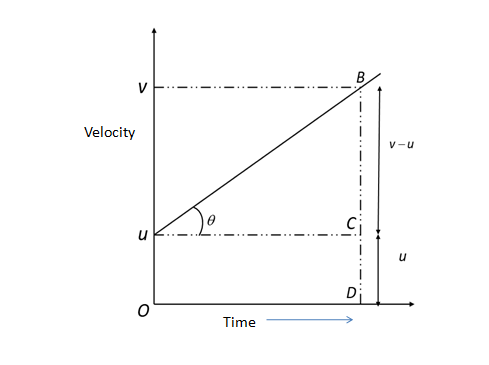
Consider a velocity-time graph for the positive constant acceleration of a particle. Let u be the initial velocity of the particle at t=0 and v is the final velocity of the particle after time t. Consider two points A and B on the curve corresponding to t=0 and t=t. Draw BD perpendicular on the time axis. Also, draw AC perpendicular on BD.
Therefore, OA = CD = u; BC = (v-u) and OD = t as shown in graph.
Also acceleration (a) = change in velocity/time taken
According to the graph,
a = slope of v-t graph = $tan\theta\ {\rm{ = }}\dfrac{{{\rm{BC}}}}{{{\rm{AC}}}}\; = \;\dfrac{{{\rm{BC}}}}{{{\rm{OD}}}}$
$ \Rightarrow {\rm{v - u = at}}$
$ \Rightarrow \;{\rm{v}}\,{\rm{ = u + }}\;{\rm{at}}$
Hence, it is proved by graphical method.
Additional information: This equation represents the relation between velocities, acceleration and time. This equation can be proved by calculus method and by checking dimensional correctness or displacement method.
Note: Here the velocity is defined as rate of change of displacement and it is a vector quantity because it represents magnitude as well as direction and acceleration is defined as the rate of change of velocity with respect to time. It is also a vector quantity. Sometimes the negative acceleration is also called a negative retardation. The unit of velocity is ${\rm{m/s}}$ and the unit represents ${\rm{m/}}{{\rm{s}}^2}$. The dimensional formula of velocity is $\left[ {{\rm{L}}{{\rm{T}}^{ - 1}}} \right]$ and the dimensional formula of acceleration is $\left[ {{\rm{L}}{{\rm{T}}^{ - 2}}} \right]$ .
Complete step by step answer:
Consider a velocity-time graph for the positive constant acceleration of a particle. Let u be the initial velocity of the particle at t=0 and v is the final velocity of the particle after time t. Consider two points A and B on the curve corresponding to t=0 and t=t. Draw BD perpendicular on the time axis. Also, draw AC perpendicular on BD.
Therefore, OA = CD = u; BC = (v-u) and OD = t as shown in graph.
Also acceleration (a) = change in velocity/time taken
According to the graph,
a = slope of v-t graph = $tan\theta\ {\rm{ = }}\dfrac{{{\rm{BC}}}}{{{\rm{AC}}}}\; = \;\dfrac{{{\rm{BC}}}}{{{\rm{OD}}}}$
$ \Rightarrow {\rm{v - u = at}}$
$ \Rightarrow \;{\rm{v}}\,{\rm{ = u + }}\;{\rm{at}}$
Hence, it is proved by graphical method.
Additional information: This equation represents the relation between velocities, acceleration and time. This equation can be proved by calculus method and by checking dimensional correctness or displacement method.
Note: Here the velocity is defined as rate of change of displacement and it is a vector quantity because it represents magnitude as well as direction and acceleration is defined as the rate of change of velocity with respect to time. It is also a vector quantity. Sometimes the negative acceleration is also called a negative retardation. The unit of velocity is ${\rm{m/s}}$ and the unit represents ${\rm{m/}}{{\rm{s}}^2}$. The dimensional formula of velocity is $\left[ {{\rm{L}}{{\rm{T}}^{ - 1}}} \right]$ and the dimensional formula of acceleration is $\left[ {{\rm{L}}{{\rm{T}}^{ - 2}}} \right]$ .
Recently Updated Pages
Master Class 12 Economics: Engaging Questions & Answers for Success

Master Class 12 English: Engaging Questions & Answers for Success
Master Class 12 Social Science: Engaging Questions & Answers for Success
Master Class 12 Maths: Engaging Questions & Answers for Success
Master Class 12 Physics: Engaging Questions & Answers for Success
Master Class 9 General Knowledge: Engaging Questions & Answers for Success
Trending doubts
One Metric ton is equal to kg A 10000 B 1000 C 100 class 11 physics CBSE
Difference Between Prokaryotic Cells and Eukaryotic Cells
Two of the body parts which do not appear in MRI are class 11 biology CBSE
1 ton equals to A 100 kg B 1000 kg C 10 kg D 10000 class 11 physics CBSE
10 examples of friction in our daily life
Name the Largest and the Smallest Cell in the Human Body ?