




How do you to prove $\dfrac{\tan A+\tan B}{1-\tan A\tan B}=\dfrac{\cot A+\cot B}{1-\cot A\cot B}$ ?
Answer
 Verified
579.9k+ views
Hint: We recall tangent and cotangent of an angle as a ratio right angled triangle. We recall that tangent and cotangent ratios are reciprocal to each other to have $\tan \theta =\dfrac{1}{\cot \theta }$. We use this relation and replace tangents at left hand side by co-tangents. We proceed to the right hand side.
Complete step by step answer:
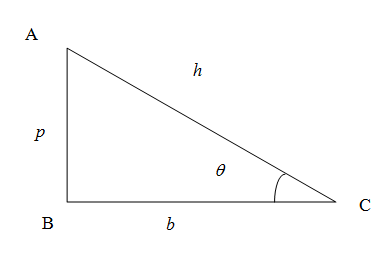
We know that in right angled triangle the side opposite to right angled triangle is called hypotenuse denoted as $h$, the vertical side is called perpendicular denoted as $p$ and the horizontal side is called the base denoted as $b$.\[\]
The tangent of the angle is the ratio of opposite side to the adjacent side (excluding hypotenuse) . So we have tangent of the angle $\theta $
\[\tan \theta =\dfrac{p}{b}\]
The co-tangent tangent of the angle is the ratio of the adjacent side (excluding hypotenuse) to the opposite side too . So we have tangent of the angle $\theta $
\[\cot \theta =\dfrac{b}{p}\]
We see that
\[\begin{align}
& \tan \theta \times \cot \theta =\dfrac{p}{b}\times \dfrac{b}{p}=1 \\
& \Rightarrow \tan \theta =\dfrac{1}{\cot \theta } \\
\end{align}\]
The above relation is called reciprocal relation between tangent and cotangent. We are asked to prove the following statement
\[\dfrac{\tan A+\tan B}{1-\tan A\tan B}=\dfrac{\cot A+\cot B}{1-\cot A\cot B}\]
Let us begin from the left hand side by converting the tangents at left hand side to cotangents using $\tan \theta =\dfrac{1}{\cot \theta }$ for $\theta =A,B$ to have;
\[\begin{align}
& \dfrac{\tan A+\tan B}{1-\tan A\tan B} \\
& \Rightarrow \dfrac{\dfrac{1}{\cot A}+\dfrac{1}{\cot B}}{1-\dfrac{1}{\cot A}\cdot \dfrac{1}{\cot B}} \\
& \Rightarrow \dfrac{\dfrac{1}{\cot A}+\dfrac{1}{\cot B}}{1-\dfrac{1}{\cot A\cot B}} \\
\end{align}\]
We add the cotangents terms in the numerator and subtract in the denominator to have
\[\Rightarrow \dfrac{\dfrac{\cot B+\cot A}{\cot A\cot B}}{\dfrac{\cot A\cot B-1}{\cot A\cot B}}\]
We cancel out $\cot A\cot B$ from the numerator and denominator to have;
\[\Rightarrow \dfrac{\cot A+\cot B}{\cot A\cot B-1}\]
The above expression is the expression at the right hand side of the statement. Hence the required statement is proved.
Note:
We can alternatively prove beginning fro right side by converting cotangents to tangents using $\cot \theta =\dfrac{1}{\tan \theta }$ for $\theta =A,B$. The expression $\dfrac{\tan A+\tan B}{1-\tan A\tan B}$ is the expression for tangent sum of angles $\tan \left( A+B \right)$. The given statement fails for $A,B={{90}^{\circ }}$ since tangent is undefined for ${{90}^{\circ }}$ and for $A,B\ne {{0}^{\circ }}$ since cotangent is undefined for ${{0}^{\circ }}$.
Complete step by step answer:
We know that in right angled triangle the side opposite to right angled triangle is called hypotenuse denoted as $h$, the vertical side is called perpendicular denoted as $p$ and the horizontal side is called the base denoted as $b$.\[\]
The tangent of the angle is the ratio of opposite side to the adjacent side (excluding hypotenuse) . So we have tangent of the angle $\theta $
\[\tan \theta =\dfrac{p}{b}\]
The co-tangent tangent of the angle is the ratio of the adjacent side (excluding hypotenuse) to the opposite side too . So we have tangent of the angle $\theta $
\[\cot \theta =\dfrac{b}{p}\]
We see that
\[\begin{align}
& \tan \theta \times \cot \theta =\dfrac{p}{b}\times \dfrac{b}{p}=1 \\
& \Rightarrow \tan \theta =\dfrac{1}{\cot \theta } \\
\end{align}\]
The above relation is called reciprocal relation between tangent and cotangent. We are asked to prove the following statement
\[\dfrac{\tan A+\tan B}{1-\tan A\tan B}=\dfrac{\cot A+\cot B}{1-\cot A\cot B}\]
Let us begin from the left hand side by converting the tangents at left hand side to cotangents using $\tan \theta =\dfrac{1}{\cot \theta }$ for $\theta =A,B$ to have;
\[\begin{align}
& \dfrac{\tan A+\tan B}{1-\tan A\tan B} \\
& \Rightarrow \dfrac{\dfrac{1}{\cot A}+\dfrac{1}{\cot B}}{1-\dfrac{1}{\cot A}\cdot \dfrac{1}{\cot B}} \\
& \Rightarrow \dfrac{\dfrac{1}{\cot A}+\dfrac{1}{\cot B}}{1-\dfrac{1}{\cot A\cot B}} \\
\end{align}\]
We add the cotangents terms in the numerator and subtract in the denominator to have
\[\Rightarrow \dfrac{\dfrac{\cot B+\cot A}{\cot A\cot B}}{\dfrac{\cot A\cot B-1}{\cot A\cot B}}\]
We cancel out $\cot A\cot B$ from the numerator and denominator to have;
\[\Rightarrow \dfrac{\cot A+\cot B}{\cot A\cot B-1}\]
The above expression is the expression at the right hand side of the statement. Hence the required statement is proved.
Note:
We can alternatively prove beginning fro right side by converting cotangents to tangents using $\cot \theta =\dfrac{1}{\tan \theta }$ for $\theta =A,B$. The expression $\dfrac{\tan A+\tan B}{1-\tan A\tan B}$ is the expression for tangent sum of angles $\tan \left( A+B \right)$. The given statement fails for $A,B={{90}^{\circ }}$ since tangent is undefined for ${{90}^{\circ }}$ and for $A,B\ne {{0}^{\circ }}$ since cotangent is undefined for ${{0}^{\circ }}$.
Recently Updated Pages
Master Class 11 Economics: Engaging Questions & Answers for Success

Master Class 11 English: Engaging Questions & Answers for Success
Master Class 11 Maths: Engaging Questions & Answers for Success
Class 11 Question and Answer - Your Ultimate Solutions Guide
Master Class 11 Social Science: Engaging Questions & Answers for Success
Master Class 11 Business Studies: Engaging Questions & Answers for Success
Trending doubts
Differentiate between an exothermic and an endothermic class 11 chemistry CBSE
One Metric ton is equal to kg A 10000 B 1000 C 100 class 11 physics CBSE
There are 720 permutations of the digits 1 2 3 4 5 class 11 maths CBSE
In what year Guru Nanak Dev ji was born A15 April 1469 class 11 social science CBSE
Difference Between Prokaryotic Cells and Eukaryotic Cells
Draw a diagram of a plant cell and label at least eight class 11 biology CBSE