




How do you prove $a=\dfrac{{{v}^{2}}}{r}\And a=r{{\omega }^{2}}$ using a circle and a vector?
Answer
 Verified
560.4k+ views
Hint: To prove $a=\dfrac{{{v}^{2}}}{r}\And a=r{{\omega }^{2}}$, we are going to draw an arc which is cutting y axis and then take two points on the arc, one of the points lying on the y axis and arc and another point is on the arc. Now, we have joined the other point on the arc that we drew to the origin and let us say the angle from the y axis to that other point as $\Delta \phi $. And then we will draw the vector of “v(t)” which is at tangent to the arc at the point which is lying on the y axis and also another vector $''v\left( t+\Delta t \right)''$ which is lying on the curve. Then we will use the property that $a=\dfrac{\Delta v}{\Delta t}$ and then use the properties of arc to further prove it.
Complete step by step answer:
First of all, we are going to draw an arc of radius r and two velocity vectors $v\left( t \right)\And v\left( t+\Delta t \right)$ at points H and I respectively in the following way:
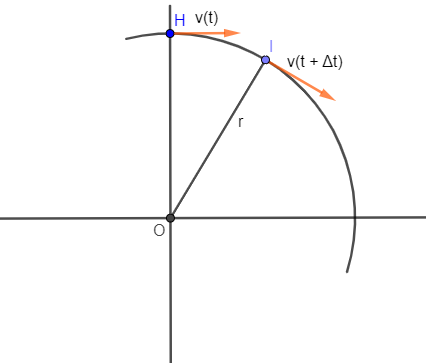
In the above, “t” is the initial time of the vector and $''\Delta t''$ is the extra time to cover the distance HI by the vector. Now, let us draw the angle $\Delta \phi $ between HO and IO.
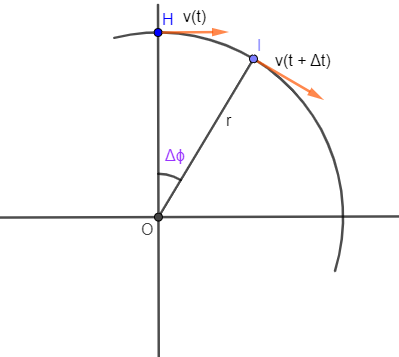
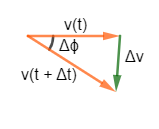
Now, let us draw the resultants of two vectors $v\left( t \right)\And v\left( t+\Delta t \right)$ in the following way:
Now, we know that “a” is acceleration in the above formula and we know that:
$a=\dfrac{\Delta v}{\Delta t}$ ………… Eq. (1)
According to the resultant vectors we can see that:
$\Delta v=v\left( t \right)\Delta \phi $
Substituting the above value of $\Delta v$ in eq. (1) we get,
$a=\dfrac{v\left( t \right)\Delta \phi }{\Delta t}$ ……….. Eq. (2)
Now, we also know the relation between angle $\left( \theta \right)$ , length of arc and radius as:
$\theta =\dfrac{arc}{radius}$
Let us assume the length of arc HI as “s” and then substitute $\theta $ as $\Delta \phi $, arc as $''\Delta s''$ and radius as “r” in the above equation and we get,
$\Delta \phi =\dfrac{\Delta s}{r}$ ………. Eq. (3)
Now, substituting the above value of $\Delta \phi $ in eq. (2) we get,
$a=\dfrac{v\left( t \right)}{\Delta t}\left( \dfrac{\Delta s}{r} \right)$…….. Eq. (4)
Also, we know the relation between velocity, displacement and time is equal to:
$velocity=\dfrac{displacement}{time}$
Now, substituting velocity as $v\left( t \right)$, displacement as $''\Delta s''$ and time as $\Delta t$ in the above we get,
$v\left( t \right)=\dfrac{\Delta s}{\Delta t}$
Cross multiplying the above we get,
$v\left( t \right)\Delta t=\Delta s$
Using the above relation in eq. (3) we get,
$\begin{align}
& a=\dfrac{v\left( t \right)}{\Delta t}\left( \dfrac{v\left( t \right)\Delta t}{r} \right) \\
& \Rightarrow a=\dfrac{{{v}^{2}}}{r} \\
\end{align}$
Hence, we have proved that $a=\dfrac{{{v}^{2}}}{r}$. Now, proving the other relation of acceleration we get,
We know that the relation between $\omega ,\theta ,t$ is equal to:
$\omega =\dfrac{\theta }{t}$
Substituting $\theta $ as $\Delta \phi $ and t as $\Delta t$ in the above equation we get,
$\omega =\dfrac{\Delta \phi }{\Delta t}$
Using the value of $\Delta \phi $ from eq. (3) and substituting that value in the above equation we get,
$\omega =\dfrac{\Delta s}{r\Delta t}$
Now, we are going to substitute $\Delta s=v\Delta t$ in the above equation we get,
$\begin{align}
& \omega =\dfrac{v\Delta t}{r\Delta t} \\
& \Rightarrow \omega =\dfrac{v}{r} \\
\end{align}$
Squaring on both the sides we get,
$\begin{align}
& {{\omega }^{2}}={{\left( \dfrac{v}{r} \right)}^{2}} \\
& \Rightarrow {{\omega }^{2}}=\dfrac{{{v}^{2}}}{{{r}^{2}}} \\
& \Rightarrow {{\omega }^{2}}=\dfrac{{{v}^{2}}}{r}\left( \dfrac{1}{r} \right) \\
\end{align}$
Substituting $\dfrac{{{v}^{2}}}{r}=a$ in the above equation we get,
$\begin{align}
& {{\omega }^{2}}=\dfrac{a}{r} \\
& \Rightarrow r{{\omega }^{2}}=a \\
\end{align}$
Hence, we have also proved the other equation in “a” i.e. $a=r{{\omega }^{2}}$.
Note:
If you can remember the relation between \[\omega ,v,r\] which we have shown below then we can prove the next relation very easily.
$\omega =\dfrac{v}{r}$
Second relation is $a=r{{\omega }^{2}}$ so substituting $\omega =\dfrac{v}{r}$ in $a=\dfrac{{{v}^{2}}}{r}$ by multiplying and dividing by r in “a” we get,
$\begin{align}
& a=\dfrac{{{v}^{2}}}{r}\times \dfrac{r}{r} \\
& \Rightarrow a={{\left( \dfrac{v}{r} \right)}^{2}}r \\
\end{align}$
Substituting $\omega =\dfrac{v}{r}$ in the above equation we get,
$a={{\left( \omega \right)}^{2}}r$
Complete step by step answer:
First of all, we are going to draw an arc of radius r and two velocity vectors $v\left( t \right)\And v\left( t+\Delta t \right)$ at points H and I respectively in the following way:
In the above, “t” is the initial time of the vector and $''\Delta t''$ is the extra time to cover the distance HI by the vector. Now, let us draw the angle $\Delta \phi $ between HO and IO.
Now, let us draw the resultants of two vectors $v\left( t \right)\And v\left( t+\Delta t \right)$ in the following way:
Now, we know that “a” is acceleration in the above formula and we know that:
$a=\dfrac{\Delta v}{\Delta t}$ ………… Eq. (1)
According to the resultant vectors we can see that:
$\Delta v=v\left( t \right)\Delta \phi $
Substituting the above value of $\Delta v$ in eq. (1) we get,
$a=\dfrac{v\left( t \right)\Delta \phi }{\Delta t}$ ……….. Eq. (2)
Now, we also know the relation between angle $\left( \theta \right)$ , length of arc and radius as:
$\theta =\dfrac{arc}{radius}$
Let us assume the length of arc HI as “s” and then substitute $\theta $ as $\Delta \phi $, arc as $''\Delta s''$ and radius as “r” in the above equation and we get,
$\Delta \phi =\dfrac{\Delta s}{r}$ ………. Eq. (3)
Now, substituting the above value of $\Delta \phi $ in eq. (2) we get,
$a=\dfrac{v\left( t \right)}{\Delta t}\left( \dfrac{\Delta s}{r} \right)$…….. Eq. (4)
Also, we know the relation between velocity, displacement and time is equal to:
$velocity=\dfrac{displacement}{time}$
Now, substituting velocity as $v\left( t \right)$, displacement as $''\Delta s''$ and time as $\Delta t$ in the above we get,
$v\left( t \right)=\dfrac{\Delta s}{\Delta t}$
Cross multiplying the above we get,
$v\left( t \right)\Delta t=\Delta s$
Using the above relation in eq. (3) we get,
$\begin{align}
& a=\dfrac{v\left( t \right)}{\Delta t}\left( \dfrac{v\left( t \right)\Delta t}{r} \right) \\
& \Rightarrow a=\dfrac{{{v}^{2}}}{r} \\
\end{align}$
Hence, we have proved that $a=\dfrac{{{v}^{2}}}{r}$. Now, proving the other relation of acceleration we get,
We know that the relation between $\omega ,\theta ,t$ is equal to:
$\omega =\dfrac{\theta }{t}$
Substituting $\theta $ as $\Delta \phi $ and t as $\Delta t$ in the above equation we get,
$\omega =\dfrac{\Delta \phi }{\Delta t}$
Using the value of $\Delta \phi $ from eq. (3) and substituting that value in the above equation we get,
$\omega =\dfrac{\Delta s}{r\Delta t}$
Now, we are going to substitute $\Delta s=v\Delta t$ in the above equation we get,
$\begin{align}
& \omega =\dfrac{v\Delta t}{r\Delta t} \\
& \Rightarrow \omega =\dfrac{v}{r} \\
\end{align}$
Squaring on both the sides we get,
$\begin{align}
& {{\omega }^{2}}={{\left( \dfrac{v}{r} \right)}^{2}} \\
& \Rightarrow {{\omega }^{2}}=\dfrac{{{v}^{2}}}{{{r}^{2}}} \\
& \Rightarrow {{\omega }^{2}}=\dfrac{{{v}^{2}}}{r}\left( \dfrac{1}{r} \right) \\
\end{align}$
Substituting $\dfrac{{{v}^{2}}}{r}=a$ in the above equation we get,
$\begin{align}
& {{\omega }^{2}}=\dfrac{a}{r} \\
& \Rightarrow r{{\omega }^{2}}=a \\
\end{align}$
Hence, we have also proved the other equation in “a” i.e. $a=r{{\omega }^{2}}$.
Note:
If you can remember the relation between \[\omega ,v,r\] which we have shown below then we can prove the next relation very easily.
$\omega =\dfrac{v}{r}$
Second relation is $a=r{{\omega }^{2}}$ so substituting $\omega =\dfrac{v}{r}$ in $a=\dfrac{{{v}^{2}}}{r}$ by multiplying and dividing by r in “a” we get,
$\begin{align}
& a=\dfrac{{{v}^{2}}}{r}\times \dfrac{r}{r} \\
& \Rightarrow a={{\left( \dfrac{v}{r} \right)}^{2}}r \\
\end{align}$
Substituting $\omega =\dfrac{v}{r}$ in the above equation we get,
$a={{\left( \omega \right)}^{2}}r$
Recently Updated Pages
Master Class 10 Computer Science: Engaging Questions & Answers for Success

Master Class 10 General Knowledge: Engaging Questions & Answers for Success
Master Class 10 English: Engaging Questions & Answers for Success
Master Class 10 Social Science: Engaging Questions & Answers for Success
Master Class 10 Maths: Engaging Questions & Answers for Success
Master Class 10 Science: Engaging Questions & Answers for Success
Trending doubts
What is the median of the first 10 natural numbers class 10 maths CBSE
Which women's tennis player has 24 Grand Slam singles titles?
Who is the Brand Ambassador of Incredible India?
Why is there a time difference of about 5 hours between class 10 social science CBSE
Write a letter to the principal requesting him to grant class 10 english CBSE
A moving boat is observed from the top of a 150 m high class 10 maths CBSE