




Protein infectious particles better known as ‘Prions’ are also called as
(a) Incomplete virus
(b) Slow virus
(c) Gemini viruses
(d) Satellite virus
Answer
 Verified
634.5k+ views
Hint: Infectious protein particles best known as 'Prions' are referred to as a virus-like agent associated with such illnesses, such as AIDS, Paget's bone disease, etc. This is a disease that follows a gradual, progressive path lasting months to years after a prolonged latency time, mostly affects the central nervous system, and progresses to death in most cases.
Complete step by step answer:
- Prions are infectious particles of protein that function as a pathogen that causes the human neurodegenerative disorder. They lack genetic material and multiply to refold into a shape called PrP scrapie by stimulating normal cellular prion protein. It is a malformed protein, so it does not replicate and is also known as a slow virus.
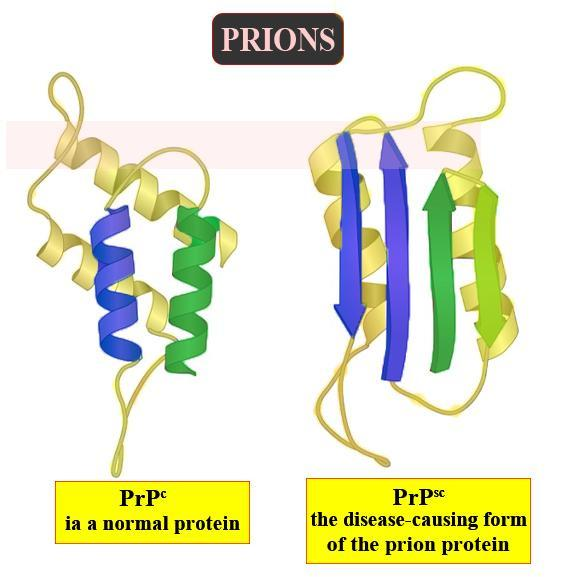
Transmissible spongiform encephalopathies (TSEs), like Creutzfeldt-Jakob disease, kuru, sheep scrapie, and cattle bovine spongiform encephalopathy (BSE), were previously known as slow viral diseases. TSEs are more accurately known as prion diseases, however.
So, the correct answer is, ‘Slow virus’.
Additional information: Prions are "infectious" misfolded proteins since they can induce misfolding in other previously normal proteins, but they do not contain DNA or RNA, so they cannot be labeled as viruses. They speculated that small virus particles, which they called virions, were to blame until scientists understood the cause of spongiform encephalopathy. The word virions were discarded and these particles were called prions after it was discovered that prions were the real cause of TSEs and that prions contained no nucleic acid.
Note: Prions are so called because only protein tends to contain them. In any prion particle examined, no proof of nucleic acid has been detected. Protein-depleting treatments, such as denaturation, eliminate prion infectivity, but nucleic acid-depleting treatments, such as UV radiation, do not kill prion infectivity.
Complete step by step answer:
- Prions are infectious particles of protein that function as a pathogen that causes the human neurodegenerative disorder. They lack genetic material and multiply to refold into a shape called PrP scrapie by stimulating normal cellular prion protein. It is a malformed protein, so it does not replicate and is also known as a slow virus.
Transmissible spongiform encephalopathies (TSEs), like Creutzfeldt-Jakob disease, kuru, sheep scrapie, and cattle bovine spongiform encephalopathy (BSE), were previously known as slow viral diseases. TSEs are more accurately known as prion diseases, however.
So, the correct answer is, ‘Slow virus’.
Additional information: Prions are "infectious" misfolded proteins since they can induce misfolding in other previously normal proteins, but they do not contain DNA or RNA, so they cannot be labeled as viruses. They speculated that small virus particles, which they called virions, were to blame until scientists understood the cause of spongiform encephalopathy. The word virions were discarded and these particles were called prions after it was discovered that prions were the real cause of TSEs and that prions contained no nucleic acid.
Note: Prions are so called because only protein tends to contain them. In any prion particle examined, no proof of nucleic acid has been detected. Protein-depleting treatments, such as denaturation, eliminate prion infectivity, but nucleic acid-depleting treatments, such as UV radiation, do not kill prion infectivity.
Recently Updated Pages
Master Class 12 Chemistry: Engaging Questions & Answers for Success

Master Class 11 Social Science: Engaging Questions & Answers for Success
Master Class 11 Accountancy: Engaging Questions & Answers for Success
Master Class 10 Maths: Engaging Questions & Answers for Success
Master Class 10 English: Engaging Questions & Answers for Success
Master Class 10 General Knowledge: Engaging Questions & Answers for Success
Trending doubts
Draw a labelled sketch of the human eye class 12 physics CBSE
Which are the Top 10 Largest Countries of the World?
Draw ray diagrams each showing i myopic eye and ii class 12 physics CBSE
Which is the correct genotypic ratio of mendel dihybrid class 12 biology CBSE
Differentiate between homogeneous and heterogeneous class 12 chemistry CBSE
An alga which can be possibly used in space flight class 12 biology CBSE